
Share your view on ageing care
Tell us whether you use anti-ageing products or treatments, and how you feel about looking older. Your answers are combined with other people's and reported only as totals.
Start the ageing and anti-ageing care surveyAbout 5 minutes. No account needed. You can stop at any time.
How appearance changes with age
Ageing affects the skin and hair in ways that are partly set by genes and partly by lifestyle and environment. Common changes include:
- Fine lines and wrinkles, as the skin makes less collagen and elastin, the proteins that keep it firm and springy.
- Loss of firmness and volume, especially in the cheeks, jawline and around the eyes.
- Dryness, as the skin produces less oil.
- Uneven colour, such as age spots or sun spots.
- Thinner skin, which bruises more easily.
- Grey or white hair, and thinning hair.
Sun exposure is one of the main outside causes of skin ageing, called photoageing. Smoking, poor sleep and some other habits are also linked to visible skin changes. This page describes products and treatments; it does not give medical or dermatological advice.
Everyday anti-ageing products
Most people who try to reduce the signs of ageing start with products used at home:
- Sunscreen, which many dermatologists describe as the most important product for preventing photoageing.
- Moisturizers, which make skin look smoother by holding in water.
- Retinoids, a family of vitamin A–related ingredients. Some, such as retinol, are sold in shops; stronger ones need a prescription in many countries. They can irritate the skin.
- Vitamin C serums, used for brightness and as antioxidants.
- Peptides and niacinamide, found in many creams and serums.
- Exfoliating acids, such as glycolic and lactic acid, which remove dead skin cells.
- Eye creams, for the thinner skin around the eyes.
- Hair dyes and hair loss products, for greying and thinning hair.
Products vary widely in price, and a higher price does not always mean a stronger effect.
Example
A 45-year-old who has used only a basic moisturizer for years begins using a daily sunscreen and an over-the-counter retinol cream. For the first few weeks her skin is dry and flaky, so she reduces use to twice a week and slowly increases it.
Cosmetic treatments
Some people go further with treatments carried out by doctors, nurses or trained practitioners:
- Botulinum toxin injections, which relax certain facial muscles to smooth lines, usually lasting a few months.
- Dermal fillers, often hyaluronic acid, injected to add volume or smooth folds.
- Chemical peels, which remove outer layers of skin.
- Laser and light treatments, for lines, spots and texture.
- Microneedling, which makes tiny punctures to encourage skin repair.
- Radiofrequency and ultrasound devices, used to tighten skin.
- Surgery, such as facelifts and eyelid surgery.
Rules on who may provide injections and other treatments differ widely between countries. In some, only doctors may give injections; in others nurses, dentists or trained beauty practitioners may. Health bodies in several countries have warned about treatments given by untrained people or using products bought online.
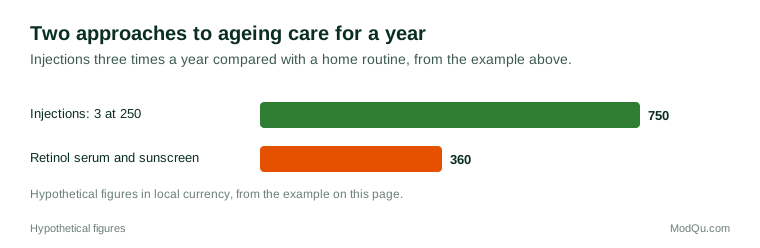
Example (hypothetical figures)
A person has injections to smooth forehead lines three times a year, at 250 in their local currency each time, for a yearly cost of 750. A friend chooses a skin care routine instead: a retinol serum at 30 every two months and sunscreen at 15 a month, for a yearly cost of 180 + 180 = 360.
Understanding the claims
Anti-ageing products often use words that sound scientific but can be hard to judge:
- "Clinically proven" may refer to a small study, sometimes run by the brand.
- "Reduces the appearance of wrinkles" often means a temporary effect, such as plumping from moisture.
- "Dermatologist tested" usually means a dermatologist was involved in a safety test, not that the product is recommended.
- Before-and-after photos can be affected by lighting, make-up and editing.
Advertising rules in many countries require that claims are backed by evidence, and regulators have acted against misleading ones. Still, people often find it hard to compare products.
Costs and how people decide
Spending on anti-ageing care varies from almost nothing to very large amounts. People weigh:
- How much the signs of ageing bother them.
- What they can afford over time, since many treatments need repeating.
- Fear of side effects or results that look unnatural.
- Advice from friends, family, professionals or social media.
- Work and social pressures, such as jobs where appearance is valued.
Example
A man in his fifties begins colouring his grey hair at home after starting a job search, because he worries about age discrimination. After finding a new job he stops colouring and lets the grey grow out.
Attitudes to ageing
Attitudes to looking older vary between cultures, generations and individuals. In some cultures older age is linked with respect and status; in others youthful looks are more strongly valued. Many people feel positive about some changes and negative about others.
Public discussion includes:
- Positive ageing and "pro-ageing" movements, which encourage people to accept visible ageing.
- Criticism of the term "anti-ageing", which some say presents ageing as a problem. Some magazines and brands have stopped using it.
- Pressure from social media and video calls, which some people say make them more aware of their appearance.
- Younger people starting anti-ageing treatments, sometimes in their twenties.
- Ageism, including in work and in how older people are shown in advertising.
Safety and regulation
Concerns about anti-ageing care include irritation from strong products, allergic reactions, complications from injections and fillers, and treatments by unqualified providers. Some countries have introduced age limits for certain treatments, such as banning cosmetic injections for people under 18, and licensing schemes for practitioners.
What people and businesses want to know
Questions businesses want answered include which anti-ageing products and treatments people use, when they started, what they spend, where they get treatments, what they worry about, and how they feel about looking older.
Key terms
- CollagenA protein that helps keep the skin firm.
- PhotoageingSkin ageing caused mainly by sun exposure.
- RetinoidA vitamin A–related ingredient used to improve skin texture and lines.
- AntioxidantAn ingredient that helps protect cells from certain kinds of damage.
- Botulinum toxinAn injected substance that relaxes muscles to smooth lines.
- Dermal fillerAn injected gel, often hyaluronic acid, used to add volume.
- Chemical peelA treatment that removes outer layers of skin using acids.
- AgeismStereotyping or discrimination based on age.
Full glossary: aesthetic dermatology terms on EditingTests.com.
Ageing and anti-ageing care vocabulary test
How well do you know the language of this topic? Try 8 quick questions. Your score is shown straight away and is not saved.
What the ageing and anti-ageing care survey asks
This survey is part of ModQu's Beauty and Personal Care survey. The ageing and anti-ageing care part takes about five minutes and covers:
- Whether you use products to reduce signs of ageing, and which ones.
- Whether you have had a cosmetic treatment for ageing, what it was and where.
- When you started using anti-ageing products or treatments.
- How much you spend in a typical year.
- What worries you about anti-ageing treatments.
- How you feel about looking older, and what influences those feelings.
After that you can choose to continue with other short parts of the Beauty and Personal Care survey, such as skin care or hair care and salons, or stop.
Ready to take part?
Your answers help show what people really think and do. Results are only ever reported as totals; no one can see your individual answers.
Start the surveyQuestions about this survey
Who can take part?
Adults aged 30 and over.
Do I have to give my name?
No. You may be asked for your age group, region and similar details so results can be broken down, but not your name. ModQu never asks for passwords, card numbers or account numbers.
How are the results used?
Answers are combined into totals and percentages and published in ModQu reports. Individual answers are never shown.
Is the vocabulary test part of the survey?
No. It is optional and separate, and your score is not stored.
At what age do people start using anti-ageing products?
It varies widely. Some start in their twenties with sunscreen and moisturizer, while others begin later or never use products marketed for ageing.
Do expensive creams work better than cheaper ones?
Not necessarily. The active ingredients and how regularly a product is used often matter more than the price.
Can lifestyle affect how skin ages?
Health bodies link sun exposure and smoking with visible skin ageing, and sleep, diet and stress are also often discussed.