
Share your experience of traffic fines
Tell us about fines you have received, whether you challenged them and what you think of enforcement. Your answers are combined with other people's and reported only as totals.
Start the traffic fines and driving offences surveyAbout 5 minutes. No account needed. You can stop at any time.
What counts as a driving offence
A driving offence is any breach of the rules of the road. Offences range from minor matters, such as parking in the wrong place, to very serious ones, such as causing a death by dangerous driving. Most countries separate them into levels, and the level decides how the case is handled and what the penalty can be.
Common offences include:
- Speeding, by any amount over the limit, with higher penalties for larger excesses.
- Parking and stopping in restricted places or beyond the paid time.
- Running a red light or ignoring other signs and road markings.
- Using a handheld phone while driving.
- Not wearing a seat belt, or not using child seats correctly.
- Driving without insurance, a valid licence or registration.
- Driving under the influence of alcohol or drugs.
- Careless or dangerous driving, which usually goes to a court.
- Toll and congestion charge offences, such as not paying a road charge.
Minor offences are often handled with a fixed penalty, while serious ones can lead to prosecution, a licence suspension, a driving ban or prison.
How a typical fine works
For many minor offences, the process is simple and designed to avoid court:
- The offence is recorded, by a police officer, a parking warden or an automatic camera.
- A notice is sent or handed over, either on the spot or by post to the registered keeper of the vehicle.
- The keeper names the driver, if someone else was driving, where the law requires this.
- The fine is paid, often with a discount for early payment in some countries, or the driver challenges it.
- Further steps follow if it is ignored, such as a higher amount, collection by enforcement agents, or a court summons.
In some countries fines are a fixed amount for each offence. In others, such as Finland and Switzerland, some fines are linked to the offender's income, so that the penalty has a similar effect on people with different earnings.
Example (hypothetical figures)
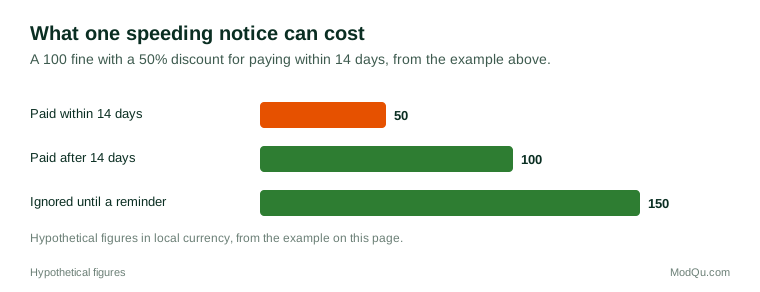
A driver receives a speeding notice for 100 in their local currency, with a 50% discount if it is paid within 14 days. Paying on time costs 50. Waiting a month means paying the full 100, and ignoring the notice leads to a higher amount of 150 after a reminder.
Penalty points and licence systems
Many countries use a points system alongside fines. Points are recorded on a driver's licence or record for certain offences, and reaching a limit leads to a suspension or ban.
There are two broad designs:
- Adding points, where each offence adds points and a ban follows if the total reaches a threshold within a set period. Ireland and the United Kingdom use this approach.
- Losing points, where a driver starts with a balance and offences take points away. France and Italy are examples.
New drivers often have lower limits, and points usually expire after a few years. In some countries a driver can attend a course to remove points or avoid them for a minor first offence. Points can also matter beyond the road, because insurers may ask about them when setting a premium.
Cameras and automatic enforcement
Automatic cameras now detect a large share of traffic offences in many countries. They include:
- Fixed speed cameras at known locations.
- Average speed cameras, which time a vehicle between two points.
- Red light cameras at junctions.
- Mobile cameras in vans or used by officers at the roadside.
- Bus lane, parking and low emission zone cameras, often run by local authorities.
Supporters say cameras reduce speeding at dangerous spots and treat every driver the same. Critics say some cameras are placed to raise money, that signs are unclear, or that automatic systems leave little room for explanation. Rules about warning signs, the visibility of cameras and how the money is used differ between countries and between cities.
Example
A driver receives a notice for entering a bus lane two weeks after a short trip into a city centre. They do not remember any sign. They look up the location on a street map and find that the lane's hours were shown only on a small sign before the junction.
Challenging a fine
Drivers who think a fine is wrong can usually challenge it. The process depends on who issued the notice. Parking fines from local authorities may go first to the authority and then to an independent adjudicator. Police matters may go to a court. Private parking charges on private land, common in some countries, follow different rules again.
Typical grounds include:
- The driver was not the person driving, or the vehicle had been sold or stolen.
- The signs or markings were missing, unclear or wrong.
- The equipment was faulty or not properly checked.
- The notice arrived late or contained mistakes.
- There was an emergency, such as taking someone to hospital.
- The payment was made but not recorded.
People who challenge a fine usually collect evidence, such as photographs, receipts and the original notice, and keep to the deadlines. In some systems, losing a court challenge can mean paying costs on top of the fine, so drivers weigh the amount at stake against the time and risk. Some drivers use lawyers or online services for more serious cases, especially where a licence is at risk.
Example
A driver who was parked legally finds a fine on their car. Their parking app shows a valid payment for the full time. They upload a screenshot with their challenge, and the authority cancels the fine three weeks later.
Serious offences
Serious offences, such as drink driving, driving while banned or causing injury, are usually dealt with in criminal courts. Penalties can include large fines, long driving bans, mandatory courses, ignition locks that test the driver's breath before the car starts, community sentences and prison. Many countries also have stricter alcohol limits for new or professional drivers. A conviction can affect insurance, employment and the ability to travel to some countries.
Debates about enforcement
People hold strong and differing views on traffic enforcement. Common points of disagreement include:
- Whether speed limits are set at the right levels.
- Whether cameras are about safety or revenue.
- Whether fines should be linked to income.
- How much discretion officers should have.
- How fairly enforcement is spread across neighbourhoods and groups.
- Whether new technology, such as phone-use cameras, intrudes on privacy.
Questions businesses and public bodies want answered include how many drivers receive fines, for what, how many challenge them and with what result, and how drivers feel about cameras and penalties.
Key terms
- Fixed penaltyA set fine for a minor offence that can be paid without going to court.
- Penalty pointsPoints recorded on a driving record that can lead to a ban.
- Registered keeperThe person or company recorded as responsible for a vehicle.
- Average speed cameraA system that times a vehicle between two points to measure its average speed.
- AdjudicatorAn independent person who decides appeals against certain fines.
- Driving banA period during which a person may not drive.
- Notice of intended prosecutionA formal warning that a driver may be taken to court for an offence.
- Income-based fineA fine set according to the offender's earnings.
Full glossary: law enforcement administration terms on EditingTests.com.
Traffic fines and driving offences vocabulary test
How well do you know the language of this topic? Try 8 quick questions. Your score is shown straight away and is not saved.
What the traffic fines and driving offences survey asks
This survey is part of ModQu's Law and Rights survey. The traffic fines and driving offences part takes about five minutes and covers:
- Whether you have received a traffic or parking fine in the last three years, and what it was for.
- How the offence was recorded, for example by a camera, an officer or a parking warden.
- Whether you paid straight away, challenged the fine, or ignored it, and what happened.
- Whether you have penalty points or have taken a driver course.
- How fair you think speed cameras, parking enforcement and fines are.
- What changes to enforcement you would support or oppose.
After that you can choose to continue with other short parts of the Law and Rights survey, such as using a lawyer or consumer rights and complaints, or stop.
Ready to take part?
Your answers help show what people really think and do. Results are only ever reported as totals; no one can see your individual answers.
Start the surveyQuestions about this survey
Who can take part?
Drivers.
Do I have to give my name?
No. You may be asked for your age group, region and similar details so results can be broken down, but not your name. ModQu never asks for passwords, card numbers or account numbers.
How are the results used?
Answers are combined into totals and percentages and published in ModQu reports. Individual answers are never shown.
Is the vocabulary test part of the survey?
No. It is optional and separate, and your score is not stored.