
Share how your family handles pocket money
Tell us whether your child gets pocket money, how much, and whether they have their own payment card. Your answers are combined with other people's and reported only as totals.
Start the teen spending and pocket money surveyAbout 5 minutes. No account needed. You can stop at any time.
What pocket money means
Pocket money, also called an allowance, is money parents or carers give children regularly to spend or save. It may be:
- A fixed amount each week or month, often rising with age.
- Linked to chores, paid for jobs around the house.
- Paid for specific needs, such as bus fares, lunches or phone credit.
- Occasional, given when the child asks or for special events.
Many families combine these, for example a small weekly amount plus extra for larger chores. Children also receive money as gifts at birthdays and festivals, and in many cultures festival gifts of money are an important tradition. Older teenagers may earn money from part-time jobs, babysitting, tutoring younger children or selling items online, subject to local rules on young people's work.
How much children get
Amounts vary widely with age, family income, country and family values. Some parents follow a rule of thumb, such as an amount tied to the child's age; others decide case by case. Some families give no regular pocket money, preferring to buy what children need. Questions that banks, retailers and family services want answered include how many children receive pocket money, how much, and how it changes with age.
Example (hypothetical figures)
A family gives each child a weekly amount equal to half their age: their 8-year-old gets 4 a week and their 14-year-old gets 7. The older child also earns 15 a week from a weekend job. Over a 52-week year, the younger child receives 208 (4 × 52) and the older child receives 1,144 (7 × 52 = 364, plus 15 × 52 = 780).
What children and teenagers spend money on
Spending changes with age. Younger children often spend on sweets, small toys, trading cards and collectables. Older children and teenagers commonly spend on:
- snacks, drinks and fast food with friends;
- clothes, shoes and beauty products;
- games, in-game purchases and app subscriptions;
- music, films, events and cinema;
- phone credit or data;
- transport;
- gifts for family and friends;
- saving for larger items such as a phone, a bicycle or a trip.
Online spending has grown, and parents often mention in-game purchases as a concern, because small amounts can add up and digital items can feel less like real money.
Cash, cards and apps
Children's money has moved from piggy banks and cash towards digital options:
- Children's bank accounts and savings accounts, often with no fees.
- Prepaid cards for young people, which parents top up and can often control through an app, for example by setting spending limits, blocking certain shops and seeing spending in real time.
- Debit cards for teenagers, offered by many banks from a certain age, often with parental oversight.
- Mobile payment apps linked to a card or account.
The age at which children can open accounts or hold cards differs between countries and providers. Parents choose digital options for convenience, safety (no lost cash) and the chance to watch spending. Some worry that cards make spending too easy or that children do not learn the value of money without handling cash.
Example
A thirteen-year-old gets a prepaid card with a parent app. The parent tops it up weekly and gets a notification for every purchase. After seeing several small game purchases add up in one week, the parent and child agree a monthly limit for games and a separate savings goal for a new bike.
Teaching money skills
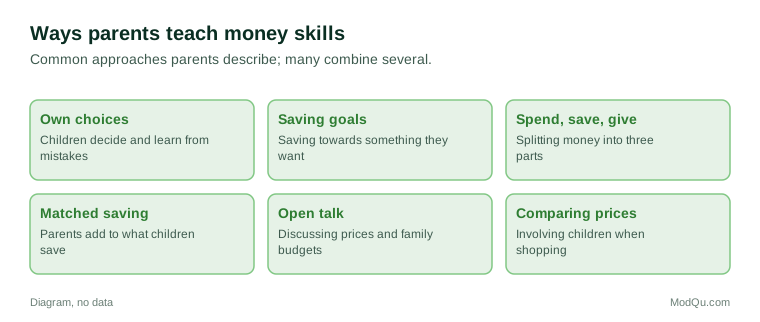
Many parents see pocket money as a way to teach children about money. Common approaches include:
- letting children make their own choices, including mistakes;
- encouraging saving towards a goal;
- splitting money into spend, save and give;
- matching savings, such as adding a little to every amount saved;
- talking openly about family budgets and prices;
- involving children in comparing prices when shopping.
Schools in many countries now teach financial literacy, and some banks and charities run money education programs. Researchers have studied whether pocket money improves later money skills; findings are mixed and depend on how parents approach it.
Example
A ten-year-old uses three jars labelled spend, save and give. Each week they put part of their pocket money in each. After two months the save jar has enough for a book series they want, and they choose a local animal shelter for the give jar.
Earning money as a teenager
Many teenagers earn money of their own. Common jobs include babysitting, pet sitting, tutoring, weekend or holiday work in shops, cafés and farms, delivering newspapers or leaflets, and selling items online. Many countries set rules on the minimum age for work, the hours young people can work during school terms and the types of work allowed, and some set lower minimum wages for young workers. Earning money can give teenagers independence and experience, though parents and teachers also mention the risk of work cutting into study time and sleep.
Parents' concerns
Parents mention:
- In-game and online spending, including loot boxes and subscriptions.
- Peer pressure to buy the same clothes, phones or games as friends.
- Advertising and influencers aimed at young people.
- Scams targeting young people online.
- Fairness between siblings of different ages.
- Money worries: in families with tight budgets, pocket money may be small or irregular.
What families disagree about
- Chores and pay. Some parents believe children should be paid for chores; others think chores are part of family life and should not be paid.
- Cash or cards. Some prefer cash for teaching; others prefer cards and apps for safety and oversight.
- Freedom or control. Parents differ on how much say children should have over their own money.
- Monitoring. Some parents check every purchase; others think teenagers need privacy and room to learn.
Key terms
- Pocket moneyMoney given regularly to a child to spend or save, also called an allowance.
- AllowanceAnother word for pocket money, common in North America.
- Prepaid cardA payment card loaded with money in advance; it cannot spend more than its balance.
- Spending limitA maximum amount that can be spent, often set by a parent on a child's card.
- Savings goalA target amount a person saves towards.
- Financial literacyKnowledge and skills for managing money.
- In-game purchaseBuying digital items inside a video game.
- Matched savingWhen a parent adds money in proportion to what a child saves.
Full glossary: consumer banking terms on EditingTests.com.
Teen spending and pocket money vocabulary test
How well do you know the language of this topic? Try 8 quick questions. Your score is shown straight away and is not saved.
What the teen spending and pocket money survey asks
This survey is part of ModQu's Parenting and Children survey. The teen spending and pocket money part takes about five minutes and covers:
- Whether your child gets pocket money, and how much a week.
- Whether pocket money is linked to chores or paid regardless.
- What your child mostly spends money on.
- Whether your child has their own bank account, prepaid card or debit card.
- How you try to teach your child about money.
- What worries you most about your child's spending.
After that you can choose to continue with other short parts of the Parenting and Children survey, such as baby products and nappies or baby food and formula, or stop.
Ready to take part?
Your answers help show what people really think and do. Results are only ever reported as totals; no one can see your individual answers.
Start the surveyQuestions about this survey
Who can take part?
Parents of children aged 8 to 17.
Do I have to give my name?
No. You may be asked for your age group, region and similar details so results can be broken down, but not your name. ModQu never asks for passwords, card numbers or account numbers.
How are the results used?
Answers are combined into totals and percentages and published in ModQu reports. Individual answers are never shown.
Is the vocabulary test part of the survey?
No. It is optional and separate, and your score is not stored.
At what age can a child have a payment card?
It depends on the country and provider. Many offer prepaid cards for younger children and debit cards from the early teens, usually with parental consent.
Should pocket money be paid for chores?
Families disagree. Some link money to chores, others pay a fixed amount and expect chores as part of family life.