
Share your views on medical research
Tell us whether you have taken part in medical research, whether you would join a trial and what would stop you. Your answers are combined with other people's and reported only as totals.
Start the taking part in medical research surveyAbout 5 minutes. No account needed. You can stop at any time.
Kinds of medical research
Medical research includes many kinds of studies:
- Clinical trials test a medicine, vaccine, device or procedure in people, usually comparing it with a standard treatment or a placebo.
- Observational studies follow groups of people over time to see how lifestyle, environment or genes relate to health, without assigning treatments.
- Surveys and interviews ask people about their health, symptoms and experiences of care.
- Biobanks store samples such as blood or tissue, with health data, for future research.
- Registries collect information about people with a particular condition.
- Healthy volunteer studies test how a new medicine behaves in people without the condition.
How clinical trials work
Trials usually happen in phases:
- Phase 1: a small group, often healthy volunteers, to check safety and dosage.
- Phase 2: a larger group with the condition, to check whether the treatment works and to watch for side effects.
- Phase 3: large numbers of patients, often in several countries, to compare the treatment with existing care.
- Phase 4: monitoring after approval, to find rare or long-term effects.
Many trials are randomized, meaning a chance process decides which treatment each volunteer receives. Some are blinded, so volunteers and sometimes doctors do not know who is receiving which treatment until the end. These methods help make results fair and reliable.
How volunteers are protected
International ethical guidelines and national laws set out protections for research volunteers. Common protections include:
- Informed consent: volunteers receive clear information about the study, its risks and benefits, and agree in writing before taking part.
- Right to withdraw: volunteers can leave at any time without affecting their normal care.
- Ethics review: an independent committee checks the study before it starts and monitors it.
- Confidentiality: personal data is protected and results are reported without names.
- Safety monitoring: independent boards may stop a trial early if harm appears.
- Registration: many countries require trials to be registered publicly before they begin.
Why people take part
Reasons people give include:
- hoping for access to a new treatment;
- wanting to help others with the same condition in the future;
- closer monitoring and more contact with doctors;
- payment or travel expenses, especially for healthy volunteer studies;
- a doctor's recommendation;
- curiosity about science.
Example
A woman with a long-term condition joins a trial at her hospital after her specialist mentions it. She says she joined mainly so that people diagnosed after her would have better options. She also valued the extra check-ups, though the trial visits took half a day each month.
What puts people off
Reasons for declining include:
- worry about side effects or being a "guinea pig";
- the chance of receiving a placebo or the standard treatment rather than the new one;
- time, travel and missed work;
- distrust of drug companies or of researchers, sometimes because of past abuses in research;
- not being asked, or not knowing that research is available;
- language barriers and complex consent forms;
- strict eligibility rules that exclude older people, pregnant women or people with other conditions.
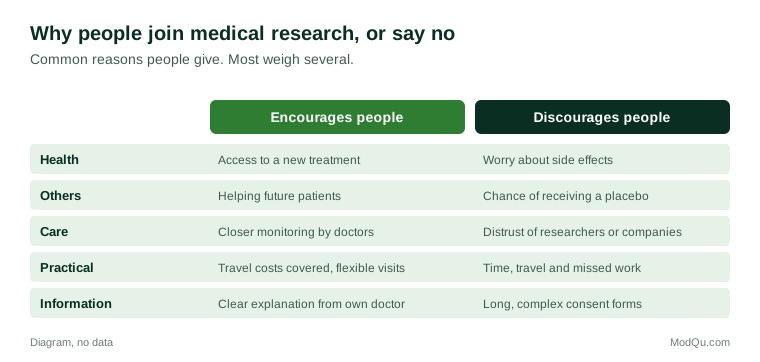
The figure below sets out the main factors that encourage and discourage people.
Example
A man is invited to join a vaccine study but works shifts at a factory 50 kilometres from the study clinic. He would like to help but cannot take the time off for six visits. When the study adds evening appointments and travel payments, he signs up.
Reaching more people
Research results are most useful when volunteers reflect the people who will use the treatment. In the past, trials often included more men than women, more younger than older people and fewer people from some ethnic and income groups. Steps that research teams take include holding visits in community clinics, translating materials, offering flexible appointments, covering costs, working with community groups and allowing some visits by phone or video.
Example (hypothetical figures)
A trial aims to enrol 400 volunteers in 12 months. After 6 months it has 120, below the planned 200. The team adds two community clinic sites and evening hours. In the next 6 months it enrols 260 more, for a total of 380, close to its target.
Payment and fairness
Practices differ. Healthy volunteers are often paid for their time. Patients in treatment trials are more often reimbursed for travel and expenses rather than paid. Ethics committees check that payments are not so high that they push people to accept risks they would otherwise refuse.
Results and sharing
Volunteers often want to know what a study found. More research teams now send plain-language summaries to participants. Registries and journals increasingly expect results to be published whether a treatment worked or not, so that negative results are not hidden.
What people disagree about
- How much volunteers should be paid.
- Whether people with serious illnesses should get early access to unproven treatments.
- How much data from health records researchers should be allowed to use.
- How to rebuild trust in communities harmed by past research.
- Whether consent forms are too long to be understood.
Why surveys ask about medical research
Questions that research bodies, universities, hospitals and public agencies want answered include how many people have taken part, whether they would join a trial, what would encourage them and what would stop them. Answers are grouped and every question can be skipped.
Key terms
- Clinical trialA study that tests a medicine, vaccine, device or procedure in people.
- PlaceboA dummy treatment with no active ingredient, used for comparison.
- RandomizationUsing chance to decide which treatment each volunteer receives.
- BlindingKeeping volunteers, and sometimes researchers, unaware of who receives which treatment.
- Informed consentAgreement to take part after receiving clear information about risks and benefits.
- Ethics committeeAn independent group that reviews and monitors research involving people.
- Eligibility criteriaRules on who can and cannot join a study.
- Healthy volunteerA person without the condition being studied who takes part, often in early trials.
Full glossary: clinical trials terms on EditingTests.com.
Taking part in medical research vocabulary test
How well do you know the language of this topic? Try 8 quick questions. Your score is shown straight away and is not saved.
What the taking part in medical research survey asks
This survey is part of ModQu's Science and Technology Attitudes survey. The taking part in medical research part takes about five minutes and covers:
- Whether you have taken part in medical research, and what kind.
- Whether you would join a clinical trial.
- What would encourage you, such as helping others, access to treatment or payment.
- What would stop you, such as side effects, time, travel or distrust.
- Whether you would allow your health data or samples to be used in research.
- Whether you received results from a study you joined.
After that you can choose to continue with other short parts of the Science and Technology Attitudes survey, such as trust in science or space exploration, or stop.
Ready to take part?
Your answers help show what people really think and do. Results are only ever reported as totals; no one can see your individual answers.
Start the surveyQuestions about this survey
Who can take part?
Adults.
Do I have to give my name?
No. You may be asked for your age group, region and similar details so results can be broken down, but not your name. ModQu never asks for passwords, card numbers or account numbers.
How are the results used?
Answers are combined into totals and percentages and published in ModQu reports. Individual answers are never shown.
Is the vocabulary test part of the survey?
No. It is optional and separate, and your score is not stored.
Is this survey itself a medical study?
No. It is an opinion survey about medical research and does not involve any treatment.
Will I be asked about my health conditions?
Some questions ask in general terms, and every question can be skipped.