
Share your experience of starting a business
Tell us whether you have started a business or plan to, how you funded it and what the biggest barrier was. Your answers are combined with other people's and reported only as totals.
Start the starting a business surveyAbout 5 minutes. No account needed. You can stop at any time.
Why people start businesses
People start businesses for many reasons, and most have more than one. Common motivations include:
- Independence: being one's own boss and making decisions.
- An idea or a passion: a product, service or craft they want to build.
- Income: earning more than in a job, or creating income where jobs are scarce.
- Flexibility: setting hours to fit family, health or other commitments.
- A gap in the market: noticing something people need that is not offered locally.
- Necessity: losing a job, struggling to find work, or facing barriers in the job market, as some newcomers do.
- Family tradition: taking over or joining a family business.
- Social purpose: solving a problem in the community, sometimes as a social enterprise or co-operative.
Researchers sometimes distinguish opportunity entrepreneurs, who start a business to pursue an idea, from necessity entrepreneurs, who start one because other work options are poor. Many founders are a mix of both.
Kinds of small business
New businesses in Canada range widely in type and size:
- Sole proprietors working alone, such as tradespeople, consultants, cleaners, artists and tutors;
- Home-based businesses, including online shops and services;
- Retail shops, restaurants and cafés;
- Professional services, such as accounting, design or IT;
- Trades and construction;
- Franchises, where the owner buys the right to run a business under an established name and system;
- Technology start-ups aiming to grow quickly, often with outside investors;
- Farms and food producers;
- Social enterprises and co-operatives.
Most businesses in Canada have fewer than 100 employees, and a large share have no employees beyond the owner. Innovation, Science and Economic Development Canada publishes regular statistics on small business.
Business structures and registering
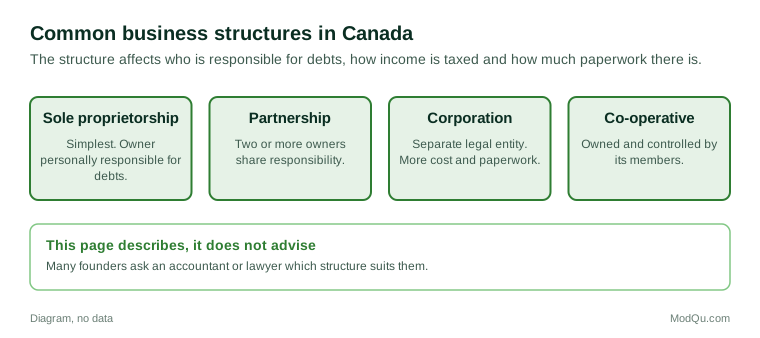
One of the first decisions is the legal structure. The main options in Canada are:
- Sole proprietorship: the simplest form. The owner and the business are legally the same, so the owner is personally responsible for the business's debts. Income is reported on the owner's personal tax return.
- Partnership: two or more people share ownership. In a general partnership, partners share responsibility for debts.
- Corporation: a separate legal entity, which can be incorporated federally or provincially. Shareholders' personal assets are generally protected from the corporation's debts, but setup and ongoing costs and paperwork are higher.
- Co-operative: owned and controlled by its members.
Common early steps include registering the business name with the province, getting a business number from the Canada Revenue Agency, registering for GST/HST once revenue passes the threshold, getting municipal licences and permits, arranging insurance, and opening a separate business bank account. The steps differ by province, city and type of business, and many founders get help from an accountant or lawyer. This page describes the options; it does not give legal or tax advice.
How people fund a business
Funding needs vary from almost nothing, for a service business run from home, to large sums for a restaurant, a manufacturing business or a technology start-up. Common sources include:
- Personal savings, the most common source for many small businesses.
- Family and friends, as gifts, loans or investments.
- Credit cards and personal lines of credit, which are quick but often costly.
- Bank and credit union loans, which usually require a business plan, credit history and often personal guarantees or collateral.
- Government-backed loans: in Canada, the Canada Small Business Financing Program shares risk with lenders on some small business loans, and the Business Development Bank of Canada (BDC), a federal Crown corporation, lends to small businesses.
- Grants and programs from federal, provincial and municipal governments and regional development agencies, often for particular groups, sectors or regions, such as youth, women, Indigenous entrepreneurs or rural businesses.
- Angel investors and venture capital, mainly for start-ups with high growth potential, in exchange for a share of ownership.
- Crowdfunding, raising small amounts from many people online, sometimes as pre-orders.
- Revenue from early customers, growing slowly without outside money, sometimes called bootstrapping.
Example
A baker who sells at a farmers market wants to open a small storefront. They use savings for the deposit and equipment, borrow from a parent for the first months' rent, and apply for a small loan through a community lender for the oven. They turn down a bank's offer of a larger loan because it would require a personal guarantee on their house.
Planning and costs
Founders often underestimate costs and the time it takes to earn money. Common start-up and early costs include equipment, inventory, rent and deposits, renovations, licences and permits, insurance, a website and marketing, professional fees, and the founder's own living costs while the business grows.
Example (hypothetical figures)
A founder plans a small café. They estimate $85,000 for equipment, renovations and opening stock, and monthly fixed costs of $14,000 for rent, wages, insurance and utilities. If each customer spends $8 on average and ingredients and supplies take 30% of sales, each sale contributes $5.60 towards fixed costs. To cover $14,000 a month, the café needs 2,500 sales a month, or about 96 a day over 26 opening days, just to break even each month. Paying back the $85,000 start-up cost needs sales above that.
A business plan sets out the idea, the market, competitors, costs, pricing, funding needs and financial forecasts. Lenders usually want one. Many founders also test the idea first, for example by selling at markets, online or to a few early customers.
Common barriers
When people who have started or tried to start a business are asked about the biggest barriers, common answers include:
- Access to funding, especially without collateral or credit history;
- Cash flow, when customers pay late or sales are seasonal;
- Regulation and paperwork, such as permits, licensing and tax compliance;
- Finding customers and competing with larger firms;
- Finding and keeping staff;
- High costs for rent, insurance and supplies;
- Lack of time and the strain of running a business alongside family or another job;
- Risk: fear of losing savings or a home;
- Knowledge gaps about accounting, marketing and law.
Some groups face extra barriers. Women, newcomers, Indigenous entrepreneurs, racialized founders and people with disabilities have reported greater difficulty getting funding, and there are programs aimed at closing these gaps.
Example
A newcomer with years of experience running a print shop in their home country wants to open one in Canada. They have savings but no Canadian credit history, and banks turn down their loan application. A settlement agency connects them with a newcomer business program that provides training, a mentor and a small loan, and they open a year later than planned.
What helps and what people disagree about
Founders often say that mentors, networks of other business owners, small business centres, college and university incubators, and clear advice from accountants and lawyers helped them most. Many cities and provinces run small business enterprise centres that offer free advice.
People disagree about how governments should support new businesses: through lower taxes, grants, loans, simpler regulation, or support for particular groups. They also disagree about whether start-up support should focus on high-growth companies or on the many small firms that create local jobs. Questions that businesses want answered here include why people start businesses, how they fund them, and which kinds of support actually helped.
Key terms
- Sole proprietorshipA business owned by one person who is personally responsible for its debts.
- IncorporationCreating a corporation, a business that is a separate legal entity.
- Business numberA number from the Canada Revenue Agency that identifies a business for tax purposes.
- BootstrappingBuilding a business with personal funds and revenue rather than outside money.
- Angel investorA person who invests their own money in an early-stage business.
- CollateralProperty pledged to a lender as security for a loan.
- Cash flowThe movement of money into and out of a business.
- Business planA document setting out a business idea, market, costs and financial forecasts.
Full glossary: commercial lending terms on EditingTests.com.
Starting a business vocabulary test
How well do you know the language of this topic? Try 8 quick questions. Your score is shown straight away and is not saved.
What the starting a business survey asks
This survey is part of ModQu's Work and Careers survey. The starting a business part takes about five minutes and covers:
- Whether you have started a business, plan to, or have thought about it.
- What kind of business it is or would be, and why you started it.
- How you funded it, or plan to.
- What the biggest barriers were or are.
- What kinds of help or advice you used, and how useful they were.
- How things have gone so far, if you have started.
After that you can choose to continue with other short parts of the Work and Careers survey, such as job satisfaction or remote and hybrid work, or stop.
Ready to take part?
Your answers help show what people really think and do. Results are only ever reported as totals; no one can see your individual answers.
Start the surveyQuestions about this survey
Who can take part?
Adults who started or plan to start a business.
Do I have to give my name?
No. You may be asked for your age group, region and similar details so results can be broken down, but not your name. ModQu never asks for passwords, card numbers or account numbers.
How are the results used?
Answers are combined into totals and percentages and published in ModQu reports. Individual answers are never shown.
Is the vocabulary test part of the survey?
No. It is optional and separate, and your score is not stored.
I only have an idea for a business. Can I take part?
Yes. The survey asks people who are thinking about starting a business about their plans and concerns, as well as people who already have one.