
Inquiry · Inquiry in organisations
Lean Startup and Validated Learning
The lean start-up method treats a new business as a set of hypotheses and tests them with small, fast experiments. This article explains validated learning, the build–measure–learn loop and the minimum viable product, what research shows about the method's effects, and its limits.
Most new products fail, and many fail not because they were badly built but because they were built for customers who did not want them. The lean start-up method, popularised by Eric Ries in 2011, is a response to this problem. It treats a new venture not as the execution of a plan but as a search for a business model that works, carried out through a series of experiments. Its central idea is validated learning: progress is measured not by how much has been built but by how much has been learned, through evidence, about what customers will actually do.
Origins
The method has two main sources. The first is lean manufacturing, developed at Toyota, which aimed to eliminate waste in production (Ohno, 1988; Womack et al., 1990). Ries (2011) applied the same idea to new ventures, arguing that the greatest waste is building something nobody wants. The second source is Steve Blank's customer development method (Blank, 2013a), which holds that founders should leave the building and test their assumptions with real customers before scaling a business. Blank (2013b) described the lean start-up as reversing the traditional sequence of writing a business plan and then executing it.
Key ideas
The business model as hypotheses. A new venture rests on assumptions about who the customers are, what problem they have, what they will pay and how they can be reached. Osterwalder and Pigneur (2010) developed the business model canvas, a one-page summary of these elements, which lean start-up practitioners use to record their hypotheses. Ries (2011) emphasised two in particular: the value hypothesis, that customers will find the product valuable, and the growth hypothesis, that new customers can be acquired at a sustainable rate.
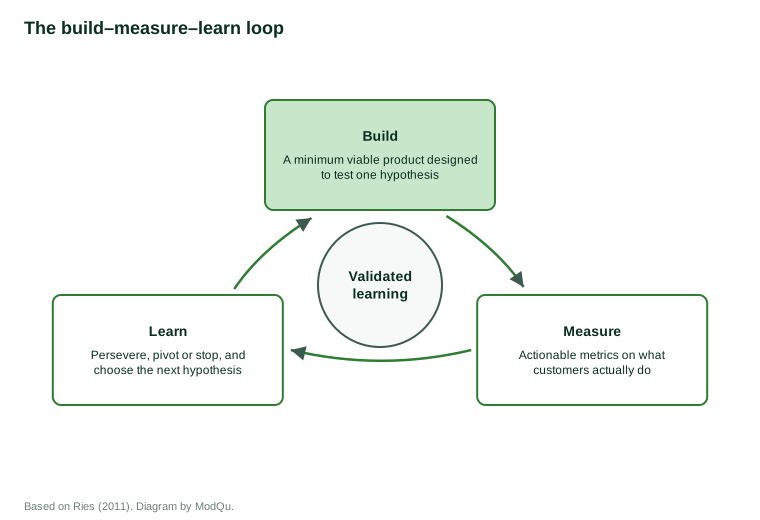
Build, measure, learn. The venture proceeds through repeated cycles, shown in Figure 1. The team builds the smallest thing that can test a hypothesis, measures how customers respond and learns whether the hypothesis holds.
The minimum viable product. Ries (2011) defined the minimum viable product as the version of a new product that allows a team to collect the maximum amount of validated learning about customers with the least effort. It need not be a working product. It might be a landing page describing a product that does not yet exist, a video demonstration or a service delivered manually behind an automated-looking front end. The point is to test demand before investing in building.
Actionable metrics. Ries warned against vanity metrics, such as total sign-ups, which tend to rise regardless of whether the business is working. Actionable metrics, such as the proportion of new customers who return or pay, show whether specific changes are having an effect. Croll and Yoskovitz (2013) argued that each stage of a venture has one metric that matters most, and that teams should focus on it.
Pivot or persevere. After each cycle, the team decides whether to continue with its strategy or to pivot, changing one fundamental element of the business model while keeping what has been learned. Ries (2011) emphasised that pivots should be based on evidence, and Eisenmann et al. (2012) described the method as hypothesis-driven entrepreneurship, in which the pivot decision is the moment of learning.
Asking customers the right questions
Customer conversations are a central source of evidence, but they are easy to get wrong. Rob Fitzpatrick (2013) observed that people tend to be polite about other people's ideas, so asking "would you buy this?" produces encouraging but unreliable answers. He recommended asking about customers' past behaviour and current problems instead, such as how they solve the problem today and what it costs them. Evidence of commitment, such as a pre-order or a request for a follow-up meeting, is more reliable than praise.
What the evidence shows
The method has been widely adopted, but rigorous evidence on its effects has only recently appeared. Camuffo et al. (2020) conducted a randomised trial with Italian start-ups, training half to formulate and test hypotheses in a scientific way. Trained firms were more likely to pivot or to abandon unpromising ideas, and those that continued earned more revenue. Leatherbee and Katila (2020) studied early-stage teams and found that those using lean start-up practices were more likely to change their business ideas, suggesting that hypothesis-based probing helped them recognise weaknesses.
Koning et al. (2022) studied thousands of technology start-ups and found that those that adopted A/B testing tools went on to perform better, with more product launches and greater growth, than similar firms that did not. Kerr et al. (2014) argued more broadly that entrepreneurship is a process of experimentation and that falling costs of early experiments have changed how new ventures are financed and developed.
Limits and criticisms
The method has limits. Felin et al. (2020) argued that the lean start-up focuses on incremental, customer-driven learning and can neglect the role of a distinctive theory about where value lies. Customers can tell a team whether a product solves a problem they already recognise, but they are less able to evaluate genuinely new ideas. Contigiani and Levinthal (2019) noted that the method draws on older ideas about experimentation and learning, and that its effects depend on the setting. In industries where products cannot be tested cheaply, such as pharmaceuticals or heavy engineering, the method applies only in modified form.
Experiments can also mislead. A minimum viable product that is too crude may fail because of its quality, not because the underlying idea is wrong. Small samples of early adopters may not represent the wider market. And a team that pivots too readily may never give an idea a fair test. The opposite risk is persevering too long. Barry Staw (1976) showed that people who have committed to a course of action tend to escalate their commitment when it fails, which is why lean start-up practitioners recommend setting criteria for pivoting before the results are known. Gans et al. (2019) added that because many possible strategies cannot all be tested, choosing which hypotheses to test is itself a strategic judgement.
A hypothetical example
Two founders believe that small restaurants would pay for software that predicts how much food to order each day. Instead of building the software, they offer a manual service to ten restaurants, producing forecasts in a spreadsheet and sending them each morning. After a month, they measure two things: whether the restaurants used the forecasts and whether food waste fell. Most restaurants stopped reading the forecasts after the first week. Interviews reveal that owners already know roughly what to order; their real difficulty is managing last-minute staff changes. The founders pivot to a scheduling tool, having spent a month and very little money learning that their first idea was not what customers needed. Kohavi et al. (2020) note that most ideas fail when tested; the advantage of testing early is that failure is cheap.
Lessons for research
The lean start-up offers several lessons for anyone using research to guide new products or services, inside a start-up or an established firm:
- Write hypotheses down before testing them, with the result that would count as failure.
- Prefer behaviour to opinion. What people do, pay or commit to is stronger evidence than what they say they would do.
- Test the riskiest assumption first, not the easiest one.
- Use metrics that can show the idea is not working, rather than totals that rise regardless.
- Combine small experiments with larger studies. Early tests reveal problems quickly; representative research shows how far a result applies.
Conclusion
The lean start-up turns the founding of a business into a structured inquiry. By treating each element of a business model as a hypothesis, testing it with the smallest possible experiment and deciding on the evidence whether to persevere or pivot, it reduces the cost of being wrong. Recent research suggests that this scientific approach helps founders abandon weak ideas sooner and improves the performance of those that continue. Its limits lie in settings where testing is expensive, where customers cannot judge truly new ideas, or where small samples mislead.
References
Blank, S. (2013a). The four steps to the epiphany: Successful strategies for products that win (2nd ed.). K&S Ranch.
Blank, S. (2013b). Why the lean start-up changes everything. Harvard Business Review, 91(5), 63–72.
Camuffo, A., Cordova, A., Gambardella, A., & Spina, C. (2020). A scientific approach to entrepreneurial decision making: Evidence from a randomized control trial. Management Science, 66(2), 564–586. https://doi.org/10.1287/mnsc.2018.3249
Contigiani, A., & Levinthal, D. A. (2019). Situating the construct of lean start-up: Adjacent conversations and possible future directions. Industrial and Corporate Change, 28(3), 551–564. https://doi.org/10.1093/icc/dtz013
Croll, A., & Yoskovitz, B. (2013). Lean analytics: Use data to build a better startup faster. O'Reilly.
Eisenmann, T., Ries, E., & Dillard, S. (2012). Hypothesis-driven entrepreneurship: The lean startup (Background Note 812-095). Harvard Business School.
Felin, T., Gambardella, A., Stern, S., & Zenger, T. (2020). Lean startup and the business model: Experimentation revisited. Long Range Planning, 53(4), Article 101889. https://doi.org/10.1016/j.lrp.2019.06.002
Fitzpatrick, R. (2013). The mom test: How to talk to customers and learn if your business is a good idea when everyone is lying to you. CreateSpace.
Gans, J. S., Stern, S., & Wu, J. (2019). Foundations of entrepreneurial strategy. Strategic Management Journal, 40(5), 736–756. https://doi.org/10.1002/smj.3010
Kerr, W. R., Nanda, R., & Rhodes-Kropf, M. (2014). Entrepreneurship as experimentation. Journal of Economic Perspectives, 28(3), 25–48. https://doi.org/10.1257/jep.28.3.25
Kohavi, R., Tang, D., & Xu, Y. (2020). Trustworthy online controlled experiments: A practical guide to A/B testing. Cambridge University Press. https://doi.org/10.1017/9781108653985
Koning, R., Hasan, S., & Chatterji, A. (2022). Experimentation and start-up performance: Evidence from A/B testing. Management Science, 68(9), 6434–6453. https://doi.org/10.1287/mnsc.2021.4209
Leatherbee, M., & Katila, R. (2020). The lean startup method: Early-stage teams and hypothesis-based probing of business ideas. Strategic Entrepreneurship Journal, 14(4), 570–593. https://doi.org/10.1002/sej.1373
Ohno, T. (1988). Toyota production system: Beyond large-scale production. Productivity Press.
Osterwalder, A., & Pigneur, Y. (2010). Business model generation. Wiley.
Ries, E. (2011). The lean startup. Crown Business.
Staw, B. M. (1976). Knee-deep in the big muddy: A study of escalating commitment to a chosen course of action. Organizational Behavior and Human Performance, 16(1), 27–44. https://doi.org/10.1016/0030-5073(76)90005-2
Womack, J. P., Jones, D. T., & Roos, D. (1990). The machine that changed the world. Rawson Associates.