
Investigation · Market and consumer investigation
Investigating a Market Before Entry
Entering a new market is a bet made with incomplete information. This article explains how to investigate a market before committing to it: what questions to ask, which sources to use, how to test assumptions, and why so many market entries fail despite careful planning.
When a business decides to sell in a new country, launch into a new customer segment or open a new line of business, it commits money and reputation on the basis of what it believes about that market. Some of those beliefs are well founded. Others are assumptions carried over from the home market, optimistic forecasts, or claims made by consultants and partners with an interest in the deal going ahead. Investigating a market before entry means testing those beliefs against evidence while it is still cheap to change course.
This article treats market entry research as an investigation. It sets out the questions to be answered, the main sources of evidence, the methods for testing assumptions, and the common reasons that well-researched entries still fail.
Why market entries fail
Market entry has a high failure rate, and the failures are often instructive. When Walmart entered Germany in the late 1990s, it found that practices that worked in the United States, from staff greeting customers to its approach to suppliers and labour relations, did not fit German retailing, and it withdrew in 2006 after heavy losses (Christopherson, 2007). Target entered Canada in 2013 with over a hundred stores and closed them all less than two years later, after problems with supply chains, pricing and stock that left shelves empty and customers disappointed (Castaldo, 2016).
Research helps explain such failures. Zaheer (1995) described the "liability of foreignness": the additional costs that a foreign firm faces because it is unfamiliar with the local environment, lacks local relationships and may be treated differently by customers, suppliers and governments. Johanson and Vahlne (1977) proposed that firms internationalise gradually, increasing their commitment as they gain knowledge of a market, because knowledge of foreign markets is acquired mainly through experience. In a later revision, they argued that the critical knowledge concerns relationships and networks within the market, so that a firm's main disadvantage is being an outsider (Johanson & Vahlne, 2009).
Decision biases add to these structural difficulties. Kahneman and Lovallo (1993) showed that managers tend to take an "inside view" of their own projects, building forecasts from the specifics of the plan and neglecting the record of similar projects, which leads to optimistic estimates. Lovallo and Kahneman (2003) argued that this optimism, rather than rational risk-taking, explains many failed ventures, and recommended "reference class forecasting", which starts from the outcomes of comparable projects. Flyvbjerg (2006) showed how this approach reduces forecasting error in large projects. A market entry investigation is partly a defence against the inside view.
The questions to answer
A market entry investigation should begin with explicit questions. The specific questions vary, but most fall into five groups.
- Demand. Who would buy, what problem would the product solve for them, how many such buyers are there, and how much would they pay?
- Competition. Who already serves these customers, how well, and how would they respond to a new entrant?
- Access. How would the business reach customers: through which channels, partners and distributors, and at what cost?
- Rules and institutions. What laws, regulations, standards, taxes and informal practices govern the market, and how reliably are they applied?
- Capability. Can the business deliver in this market, with its current products, supply chain and people, at a cost that leaves a profit?
Each question can be stated as a hypothesis. "Small manufacturing firms in this region will pay a subscription for our maintenance software" is a claim that evidence can support or refute. Writing the claims down makes clear what the investigation has to establish and prevents later disagreements about what was assumed.
Measuring the opportunity
Estimates of market size are often the first figures produced and the most misleading. A common approach divides the market into the total addressable market, the share that the business could serve with its product and channels, and the share it could realistically obtain in a defined period.
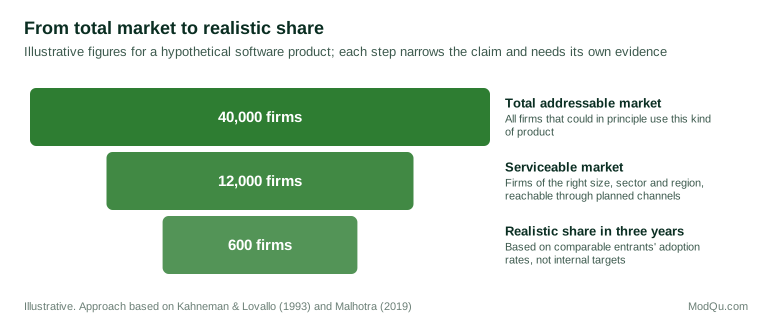
The top-level figure is usually easy to find and of little use on its own. The narrowing steps are where the investigation does its work: establishing which customers can actually be reached, and estimating what share of them will buy. The final step should be anchored on evidence from comparable cases, such as the adoption rates achieved by similar products or by the business itself in other markets, not on the share needed to make the plan work.
Market size estimates should also be checked by building them in two independent ways. A "top-down" estimate starts from published industry totals and applies percentages. A "bottom-up" estimate starts from the number of identifiable customers, their likely purchases and the price. When the two differ greatly, the difference reveals which assumptions need more investigation.
Estimates are also vulnerable to anchoring. Tversky and Kahneman (1974) showed that people's numerical estimates are pulled towards a starting value, even when that value is arbitrary. In market research, the anchor is often the first figure that appears in a planning document, such as a consultant's estimate or a target set by senior management. Later estimates tend to be adjusted from it rather than built afresh. A practical safeguard is to have the bottom-up estimate prepared by people who have not seen the top-down figure or the target, and to compare the two only afterwards. Where they differ, the investigation should establish why, rather than splitting the difference.
Sources of evidence
Secondary sources
Published sources provide the starting point: government statistics on population, income, trade and business activity; industry reports; company filings of competitors; trade association data; and academic research. These sources are relatively cheap and quick to use, but they have limits. Categories in official statistics may not match the product, data may be several years old, and industry reports vary greatly in method and quality.
Even widely used international data can mislead. The World Bank's Doing Business reports ranked countries on the ease of starting and operating a business and were widely used in investment decisions (World Bank, 2020). In 2021 the World Bank discontinued the series after an investigation found irregularities in the data for several countries. The episode is a reminder that every source, however authoritative, should be checked for how its figures were produced.
Primary research
Primary research collects evidence directly from the market. Surveys can estimate the share of potential customers with a problem, their current solutions and their willingness to pay, provided that the sample is drawn from the right population and the questions are well designed (Groves et al., 2009; Malhotra, 2019). Interviews with potential customers, distributors, industry experts and former employees of competitors give depth that surveys cannot. Christensen et al. (2016) argue that the most useful customer research asks what "job" the customer is trying to get done and what currently stands in the way, rather than asking customers to evaluate a product they have not used.
Observation is often more reliable than asking. Visiting shops, watching how products are sold and used, attending trade fairs and examining competitors' products and prices reveal what people actually do, which may differ from what they say. The gap between stated intentions and behaviour is large in many markets, so claims that customers "would buy" a product should be treated as weak evidence until they are tested by actual purchases.
Field experiments
The strongest evidence comes from testing the market directly at a small scale. A business can sell through a single distributor, run a pilot with a few customers, test prices online or open one location before committing to many. Ries (2011) and Blank (2013) popularised this approach for start-ups as building a minimum viable product and learning from customer response, but the principle applies equally to established firms entering new markets. Small tests are the most direct way to replace assumptions with evidence, and their cost is usually small compared with the cost of a failed full-scale entry. A test should be designed in advance with a clear measure of success, such as a conversion rate or a repeat purchase rate, so that the result cannot be reinterpreted afterwards to fit the plan.
Understanding distance
Markets that look similar in economic statistics can differ in ways that matter greatly. Ghemawat (2001) proposed that the distance between markets has four dimensions: cultural, administrative, geographic and economic. Each can make a market harder to enter than its size suggests.
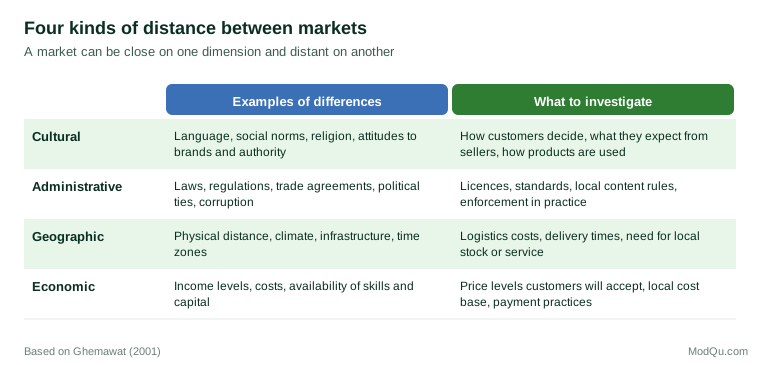
Cultural differences are often underestimated because they are less visible than tariffs or transport costs. Hofstede (2001) documented systematic differences between national cultures in values such as attitudes to hierarchy, uncertainty and individualism. Such frameworks are useful for raising questions but should not substitute for direct evidence about the particular customers and partners involved.
Institutional differences can be equally important. Khanna et al. (2005) and Khanna and Palepu (2010) argue that many emerging markets have "institutional voids": gaps in the intermediaries that make markets work in developed economies, such as reliable credit information, market research firms, distribution networks and effective courts. A business that relies on these intermediaries at home may find that it has to build substitutes, or partner with local firms that have done so.
Investigating competitors and partners
Competitors can be studied through their products, prices, advertising, job advertisements, filings and the views of their customers and former staff. The aim is to understand not only what they offer now but how they are likely to respond to a new entrant. Porter (1980, 2008) set out a framework for analysing the forces that shape competition in an industry: the rivalry among existing competitors, the threat of new entrants, the power of suppliers and buyers, and the threat of substitutes. Applied to a target market, it helps identify where profits are likely to be made and where they will be competed away.
Many market entries depend on local partners such as distributors, agents, franchisees or joint venture partners. These relationships require their own investigation into the partner's capabilities, reputation, ownership and integrity, since a partner's misconduct can expose the entrant to legal liability and reputational harm.
Pulling the evidence together
At the end of the investigation, the evidence should be organised around the original questions. For each one, the investigator should state what was found, how strong the evidence is, and what remains uncertain. A useful discipline is to identify the few assumptions on which the business case most depends, and to show what the outcome would be if each turned out to be wrong. If the plan works only when every assumption holds, it is fragile.
It is also useful to compare the forecast with the record of comparable entries, following the reference class approach. If similar businesses entering similar markets have typically taken five years to break even, a plan that assumes two years needs strong evidence for why this case is different (Lovallo & Kahneman, 2003).
A short example
The following hypothetical case illustrates the approach. A company that sells maintenance scheduling software to small factories in its home country considers entering a neighbouring country. Published statistics show about 40,000 manufacturing firms in the target country, and the sales team proposes a goal of 2,000 customers within three years.
The investigation tests the main assumptions. Statistics and registry data show that only about 12,000 firms are in the size range and sectors the product serves. Interviews with thirty factory managers find that many already use maintenance modules in their accounting software, and that purchasing decisions are often made by owners who are wary of foreign suppliers. A small online advertising test generates enquiries at about half the rate achieved at home. The company's own record shows that it took four years to reach 1,500 customers in its home market, where it was already known.
On this evidence, the company revises its target to around 600 customers in three years, decides to enter through a partnership with a local accounting software provider, and plans a one-year pilot before committing to a local office. The original plan would have overstated revenue by a factor of three.
Conclusion
Investigating a market before entry is a way of finding out, before it becomes expensive, which beliefs about the market are true. It means stating the assumptions on which the plan depends, testing each against the best available evidence, anchoring forecasts on the record of comparable cases, and running small experiments before large commitments. The firms that enter markets successfully are rarely those that are certain they will succeed. They are those that have found out what they do not know and planned accordingly.
References
Blank, S. (2013). Why the lean start-up changes everything. Harvard Business Review, 91(5), 63–72.
Castaldo, J. (2016, January 26). The last days of Target. Canadian Business.
Christensen, C. M., Hall, T., Dillon, K., & Duncan, D. S. (2016). Know your customers' "jobs to be done". Harvard Business Review, 94(9), 54–62.
Christopherson, S. (2007). Barriers to 'US style' lean retailing: The case of Wal-Mart's failure in Germany. Journal of Economic Geography, 7(4), 451–469. https://doi.org/10.1093/jeg/lbm010
Flyvbjerg, B. (2006). From Nobel Prize to project management: Getting risks right. Project Management Journal, 37(3), 5–15. https://doi.org/10.1177/875697280603700302
Ghemawat, P. (2001). Distance still matters: The hard reality of global expansion. Harvard Business Review, 79(8), 137–147.
Groves, R. M., Fowler, F. J., Jr., Couper, M. P., Lepkowski, J. M., Singer, E., & Tourangeau, R. (2009). Survey methodology (2nd ed.). Wiley.
Hofstede, G. (2001). Culture's consequences: Comparing values, behaviors, institutions and organizations across nations (2nd ed.). Sage.
Johanson, J., & Vahlne, J.-E. (1977). The internationalization process of the firm: A model of knowledge development and increasing foreign market commitments. Journal of International Business Studies, 8(1), 23–32. https://doi.org/10.1057/palgrave.jibs.8490676
Johanson, J., & Vahlne, J.-E. (2009). The Uppsala internationalization process model revisited: From liability of foreignness to liability of outsidership. Journal of International Business Studies, 40(9), 1411–1431. https://doi.org/10.1057/jibs.2009.24
Kahneman, D., & Lovallo, D. (1993). Timid choices and bold forecasts: A cognitive perspective on risk taking. Management Science, 39(1), 17–31. https://doi.org/10.1287/mnsc.39.1.17
Khanna, T., Palepu, K. G., & Sinha, J. (2005). Strategies that fit emerging markets. Harvard Business Review, 83(6), 63–76.
Khanna, T., & Palepu, K. G. (2010). Winning in emerging markets: A road map for strategy and execution. Harvard Business Press.
Lovallo, D., & Kahneman, D. (2003). Delusions of success: How optimism undermines executives' decisions. Harvard Business Review, 81(7), 56–63.
Malhotra, N. K. (2019). Marketing research: An applied orientation (7th ed.). Pearson.
Porter, M. E. (1980). Competitive strategy: Techniques for analyzing industries and competitors. Free Press.
Porter, M. E. (2008). The five competitive forces that shape strategy. Harvard Business Review, 86(1), 78–93.
Ries, E. (2011). The lean startup: How today's entrepreneurs use continuous innovation to create radically successful businesses. Crown Business.
Tversky, A., & Kahneman, D. (1974). Judgment under uncertainty: Heuristics and biases. Science, 185(4157), 1124–1131. https://doi.org/10.1126/science.185.4157.1124
World Bank. (2020). Doing business 2020: Comparing business regulation in 190 economies. World Bank. https://doi.org/10.1596/978-1-4648-1440-2
Zaheer, S. (1995). Overcoming the liability of foreignness. Academy of Management Journal, 38(2), 341–363. https://doi.org/10.5465/256683