
Tell us how you save
Tell us how you save and invest and how confident you feel about retiring. Your answers are combined with other people's and reported only as totals.
Start the saving, investing and retirement surveyAbout 5 minutes. No account needed. You can stop at any time.
What saving and investing cover
Saving means setting money aside instead of spending it. Investing means putting that money into something expected to grow over time, such as shares, bonds or funds, accepting some risk of loss. Most households do both at different times and for different goals:
- an emergency fund for unexpected costs such as car repairs or job loss;
- short-term goals, such as a holiday, a car or a down payment;
- long-term goals, mainly retirement, and for some families children's education.
Where people keep their money depends on the goal. Emergency money usually sits in a savings account where it is easy to reach. Retirement money is usually invested for growth over decades.
The accounts people use
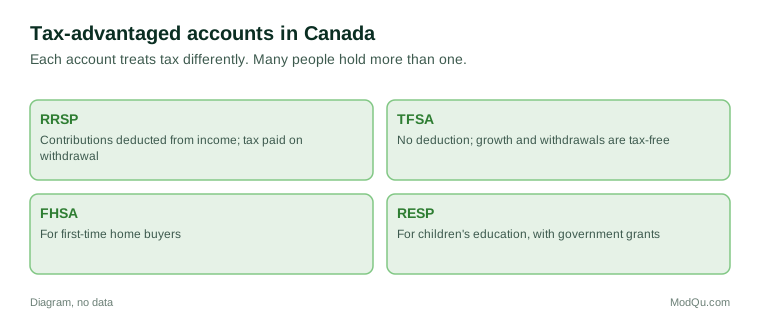
Governments encourage saving through tax-advantaged accounts. In Canada, the main ones are:
- the Registered Retirement Savings Plan (RRSP), where contributions can be deducted from taxable income and tax is paid when money is withdrawn, usually in retirement;
- the Tax-Free Savings Account (TFSA), where contributions are not deductible but growth and withdrawals are tax-free;
- the First Home Savings Account (FHSA), for first-time home buyers;
- the Registered Education Savings Plan (RESP), for children's education, which can attract government grants.
Other countries have their own versions, such as 401(k) plans and IRAs in the United States. Many people hold more than one type and are unsure which to prioritize.
Example
A 28-year-old with a modest income puts savings into a TFSA because withdrawals are tax-free and they may need the money for a home. Their older colleague, in a higher tax bracket, contributes to an RRSP first to reduce this year's income tax. Both are making sensible choices for their situation.
Workplace pensions and savings plans
Many employees save through work. The main types are:
- Defined benefit pensions, which promise a set income in retirement based on salary and years of service. These are common in the public sector and less common in private companies than they used to be.
- Defined contribution pensions, where the employer and employee contribute and the retirement income depends on how the investments perform.
- Group RRSPs and savings plans, often with an employer match.
An employer match is one of the most valuable benefits available, but some employees do not join or contribute too little to receive the full match.
Example (hypothetical figures)
An employer matches 50% of employee contributions up to 6% of salary. An employee earning $60,000 who contributes 6% ($3,600) receives $1,800 from the employer. A colleague who contributes 2% ($1,200) receives only $600 and gives up $1,200 a year in matching money.
Investing: what people choose and why
People invest in a wide range of products:
- Guaranteed investment certificates (GICs) and term deposits, which pay a fixed rate for a set period.
- Mutual funds, often bought through a bank or adviser.
- Exchange-traded funds (ETFs), which trade on stock exchanges and often track an index at low cost.
- Individual shares and bonds.
- Real estate, either directly or through funds.
Choices depend on risk tolerance, knowledge, time horizon and who is helping. Fees matter a great deal over long periods: a difference of one percentage point a year can add up to a large sum over decades.
Advisers, robo-advisers and doing it yourself
People manage their investments in three main ways:
- through a financial adviser at a bank, an investment firm or an independent practice;
- through a robo-adviser, an online service that builds and manages a portfolio based on a questionnaire, usually at lower cost;
- on their own, through an online brokerage account.
Trust, cost, confidence and the size of the savings all play a part. Some people move between these approaches as their savings grow or their life changes.
Example
A recently divorced 52-year-old who had left investing to their former spouse books a meeting with a bank adviser. They want someone to explain their options in plain language before making any decisions, even though they know an online service would cost less.
How confident people feel about retirement
Retirement confidence varies widely. People who have a workplace pension, own their home and have no debt tend to feel more secure. People who are self-employed, rent, or started saving late tend to feel less secure.
Common worries include outliving savings, rising costs of living, health and long-term care costs, and whether government pensions will be enough. In Canada, government retirement income includes the Canada Pension Plan (CPP), or the Quebec Pension Plan in Quebec, and Old Age Security (OAS), with the Guaranteed Income Supplement for people with low incomes.
Saving habits and what helps
People who save regularly often describe simple habits rather than detailed plans:
- Paying themselves first: an automatic transfer to savings on payday, before money can be spent.
- Separate accounts for separate goals, so the holiday fund is not mixed with the emergency fund.
- Rounding up: apps and bank features that round each purchase up and save the difference.
- Raising contributions with pay rises, so savings grow without a drop in take-home pay.
- Reviewing once a year, for example at tax time or on a birthday.
Automatic saving works because it removes the need to decide each month. Research on retirement plans has found that enrolling employees automatically, with the option to opt out, greatly increases the number who save.
Example
A couple who never seemed to have money left at the end of the month set up a $150 automatic transfer to a savings account on each payday. After a year they have a small emergency fund for the first time, and they say they did not notice the money leaving their chequing account.
Barriers to saving
The most common barriers people mention are:
- not having money left over after essential costs;
- debt payments taking priority;
- uncertainty about where to start or which account to use;
- distrust of financial institutions or advisers;
- a sense that retirement is too far away to think about.
Questions that banks, investment firms, employers and governments want answered include how many people save regularly, what stops others, which accounts people understand, and how confident people feel about retiring when they want to.
Key terms
- RRSPA Canadian retirement account where contributions reduce taxable income now and withdrawals are taxed later.
- TFSAA Canadian account where investment growth and withdrawals are tax-free.
- Employer matchMoney an employer adds to an employee's retirement savings when the employee contributes.
- Defined benefit pensionA pension that promises a set income based on salary and years of service.
- ETFAn exchange-traded fund, a basket of investments that trades on a stock exchange.
- GICA guaranteed investment certificate that pays a fixed rate for a set term.
- Robo-adviserAn online service that builds and manages an investment portfolio automatically.
- Risk toleranceHow much loss in value an investor is willing and able to accept.
Full glossary: retirement planning terms on EditingTests.com.
Saving, investing and retirement vocabulary test
How well do you know the language of this topic? Try 8 quick questions. Your score is shown straight away and is not saved.
What the saving, investing and retirement survey asks
This survey is part of ModQu's Money and Banking survey. The saving, investing and retirement part takes about five minutes and covers:
- Whether you save regularly, and roughly what share of your income.
- Which savings and retirement accounts you have.
- Whether you have a workplace pension or savings plan, and whether you receive an employer match.
- Who, if anyone, helps you with investments: an adviser, an online service or no one.
- How confident you are that you will be able to retire when you want to.
- What, if anything, stops you from saving more.
After that you can choose to continue with other short parts of the Money and Banking survey, such as everyday banking or digital payments and wallets, or stop.
Ready to take part?
Your answers help show what people really think and do. Results are only ever reported as totals; no one can see your individual answers.
Start the surveyQuestions about this survey
Who can take part?
Adults aged 25 and over.
Do I have to give my name?
No. You may be asked for your age group, region and similar details so results can be broken down, but not your name. ModQu never asks for passwords, card numbers or account numbers.
How are the results used?
Answers are combined into totals and percentages and published in ModQu reports. Individual answers are never shown.
Is the vocabulary test part of the survey?
No. It is optional and separate, and your score is not stored.