
Share your experience of remote and hybrid work
Tell us how many days you work from home, how many you would prefer and how far you would go to keep that. Your answers are combined with other people's and reported only as totals.
Start the remote and hybrid work surveyAbout 5 minutes. No account needed. You can stop at any time.
The main work arrangements
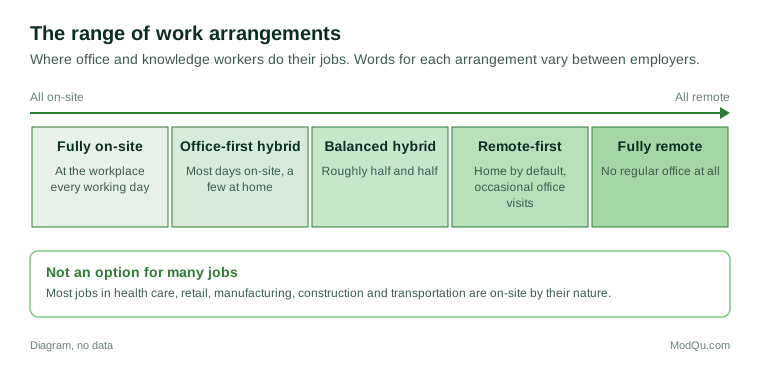
Work arrangements now cover a range, and the words used for them vary between employers.
- Fully on-site: working at the employer's location every working day. Most jobs in health care, retail, manufacturing, construction, hospitality and transportation are on-site by their nature.
- Hybrid: splitting the week between home and a workplace. Hybrid can mean set days chosen by the employer, a minimum number of office days, or days chosen by each team or person.
- Remote-first or fully remote: working from home or anywhere, with occasional or no office visits. Some fully remote workers live far from any office.
- Flexible location: working from home, an office, a co-working space or elsewhere as needed.
A related idea is flexible hours, which is about when work is done rather than where. Some jobs offer one without the other.
Remote work existed before 2020, but the COVID-19 pandemic made it common almost overnight for office-based work. In the years since, many employers have settled on hybrid arrangements, and some have asked staff to return to the office for more days.
What workers value
Workers who can work from home often give similar reasons for wanting to:
- No commute, saving time and money;
- Flexibility to handle family duties, appointments and household tasks;
- Focus, with fewer interruptions for some kinds of work;
- Comfort and control over their work environment;
- Choice of where to live, including farther from expensive city centres.
Many also say they value time in the office for some things: meeting colleagues, learning from others, collaborating on complex work, separating home from work, and the social side of a workplace.
Preferences vary widely. Some people want to work from home every day; others want to be in the office most of the time; many want a mix. Living situation matters: someone with a quiet home office has a different experience from someone working at a kitchen table in a shared apartment.
Example
Two analysts on the same team have different preferences. One, a parent with a long commute, wants to come in one day a week. The other, who lives alone in a small apartment and joined the company recently, wants to come in four days to meet people and learn from senior colleagues. Their team agrees on two shared office days and lets each person choose the rest.
What employers weigh
Employers weigh several concerns when setting work arrangements:
- Collaboration and innovation, which some leaders believe happen best in person;
- Training and mentoring of new and junior staff;
- Culture and belonging, and keeping teams connected;
- Productivity and accountability;
- Recruiting and retention, since flexibility is attractive to many candidates;
- Real estate costs, which can fall if less office space is needed;
- Security and privacy of information handled at home;
- Fairness between staff who can and cannot work remotely.
Productivity: what the debate is about
Whether remote work makes people more or less productive is one of the most argued-over questions. Part of the difficulty is that productivity is hard to measure in many office jobs, and studies measure different things in different settings.
Points often made in the debate include:
- remote workers may save commuting time and have fewer interruptions;
- some kinds of work, such as brainstorming, onboarding and solving unexpected problems, may suffer when people are apart;
- hybrid arrangements may capture some of the benefits of both;
- what people say about their own productivity may not match what their managers or output measures show;
- results differ by job, by person, by how well the arrangement is managed, and by how long it has been in place.
Questions that businesses want answered here include how workers rate their own productivity in each setting, how much flexibility matters when choosing a job, and how arrangements affect people's plans to stay.
Costs and the home setup
Working from home moves some costs from the employer to the worker, and saves others.
Workers may spend more on home heating, electricity and internet, furniture, and equipment. They may save on commuting, parking, lunches and work clothes. Employers may provide laptops, monitors or an allowance for home office equipment, and some pay a monthly stipend.
In Canada, workers who work from home may be able to claim some home office expenses on their income tax under rules set by the Canada Revenue Agency. The rules have changed over time and depend on the arrangement with the employer, so people check the current rules or ask a tax professional.
Example (hypothetical figures)
A hybrid worker works from home three days a week instead of commuting by transit. Each office day costs $7 in fares and about $15 for lunch and coffee, so $22 a day. Over three home days a week for 46 weeks, they save 138 days × $22 = $3,036 a year. They estimate extra home heating, electricity and internet costs of about $50 a month, or $600 a year, so they are about $2,400 a year ahead.
Challenges of remote and hybrid work
Remote and hybrid work brings problems that people often raise:
- Isolation and loneliness, especially for people living alone;
- Blurred boundaries between work and home, with work spilling into evenings;
- Visibility: worry that remote workers are overlooked for promotion, sometimes called proximity bias;
- Meeting overload, with video calls filling the day;
- Hybrid friction, such as coming to the office only to spend the day on video calls with people who stayed home;
- Technology problems and slow home internet, especially in rural areas.
Example
A project manager works remotely full-time and receives good reviews. When a promotion goes to a colleague who is in the office every day, they wonder whether being seen in person counted more than their results. Their manager says it did not, but the doubt stays, and they start coming in two days a week.
Return to office and what people disagree about
Since around 2022, many employers, including some governments and large companies, have increased the number of days staff must be in the office. Some workers have accepted the change, some have pushed back through unions or petitions, and some have changed jobs to keep remote work.
The arguments on each side are well known. Supporters of more office time point to collaboration, mentoring, culture and the health of downtown businesses. Supporters of remote work point to commuting time, worker preferences, recruiting from a wider area, and lower office costs. There is also disagreement about who should decide: employers, teams, or individual workers.
Remote and hybrid work also raises fairness questions. Many workers cannot work from home at all. Some see flexibility as a benefit that mainly goes to higher-paid office workers, and argue that front-line workers should get other kinds of flexibility, such as more control over their schedules.
Key terms
- Hybrid workSplitting working time between home and a workplace.
- Remote-firstAn organization that treats remote work as the default.
- Return to officeAn employer's requirement for staff to spend more days on-site.
- Proximity biasFavouring people who are physically present over those working remotely.
- Co-working spaceA shared office where people from different organizations rent desks.
- Asynchronous workWorking without needing everyone to be online at the same time.
- Hot-deskingUsing any available desk rather than having an assigned one.
- Home office stipendAn allowance from an employer to cover work-from-home costs.
Full glossary: workforce management terms on EditingTests.com.
Remote and hybrid work vocabulary test
How well do you know the language of this topic? Try 8 quick questions. Your score is shown straight away and is not saved.
What the remote and hybrid work survey asks
This survey is part of ModQu's Work and Careers survey. The remote and hybrid work part takes about five minutes and covers:
- How many days a week you work from home, and how many on-site.
- How many days you would prefer to work from home.
- How you rate your productivity at home and in the office.
- What your employer requires, and how you feel about it.
- Whether you would change jobs to keep or gain remote work.
- The costs and savings of working from home for you.
After that you can choose to continue with other short parts of the Work and Careers survey, such as job satisfaction or job searching and hiring, or stop.
Ready to take part?
Your answers help show what people really think and do. Results are only ever reported as totals; no one can see your individual answers.
Start the surveyQuestions about this survey
Who can take part?
Office-based and knowledge workers.
Do I have to give my name?
No. You may be asked for your age group, region and similar details so results can be broken down, but not your name. ModQu never asks for passwords, card numbers or account numbers.
How are the results used?
Answers are combined into totals and percentages and published in ModQu reports. Individual answers are never shown.
Is the vocabulary test part of the survey?
No. It is optional and separate, and your score is not stored.
My job cannot be done from home. Should I take part?
Yes. The survey asks on-site workers about the flexibility they have and want, and their views on remote work.