
Share your views on public health
Tell us how much you trust public health advice, whether you got a flu shot and where you get health information. Your answers are combined with other people's and reported only as totals.
Start the public health surveyAbout 5 minutes. No account needed. You can stop at any time.
This page describes public health and how people respond to it. It is not medical advice. For advice about your own health, speak to a health professional.
What public health covers
Medicine mainly treats individual patients. Public health focuses on preventing illness and injury across whole communities. Its main areas include:
- Disease prevention and control: vaccination programs, tracking outbreaks, and controlling infections such as influenza, measles and sexually transmitted infections.
- Health promotion: encouraging healthy eating, physical activity, mental health and not smoking.
- Environmental health: safe drinking water, food safety inspections of restaurants, air quality and extreme heat.
- Injury prevention: road safety, falls among older adults, drowning and poisoning.
- Health surveillance: collecting and analysing data on illness, deaths, risk factors and health differences between groups.
- Emergency preparedness: planning for pandemics, disasters and other health emergencies.
- Health equity: reducing unfair differences in health between groups, such as by income, location or background.
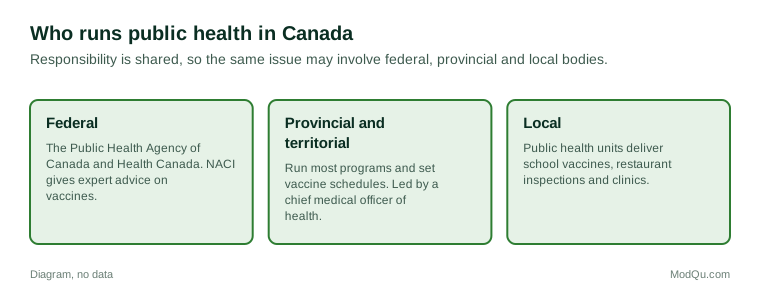
Who runs public health in Canada
Public health in Canada is shared between several levels:
- Federal: the Public Health Agency of Canada (PHAC) leads national work on infectious and chronic disease and emergency preparedness, and Health Canada regulates drugs, vaccines, food and consumer products. The National Advisory Committee on Immunization (NACI) gives expert advice on vaccines.
- Provincial and territorial: provinces and territories run most public health programs and set their own vaccine schedules. Each has a chief medical officer of health or equivalent.
- Local: public health units or regional health authorities deliver programs such as school vaccination, restaurant inspections and sexual health clinics, led by local medical officers of health.
- Indigenous communities have their own health organizations and agreements with federal and provincial governments.
In the United States, public health is shared between federal agencies such as the Centers for Disease Control and Prevention (CDC), state health departments and local health departments. The World Health Organization (WHO) coordinates international work.
Vaccination
Vaccination is one of the best-known parts of public health. Routine programs in Canada cover childhood vaccines, school-based programs and adult vaccines such as seasonal influenza, with recommendations for some groups for vaccines such as those against pneumococcal disease and shingles. Schedules and which vaccines are publicly funded vary by province and territory.
People's decisions about vaccines are shaped by:
- advice from a doctor, nurse or pharmacist;
- how serious they think the disease is and how likely they are to catch it;
- confidence in vaccine safety and the system that approves vaccines;
- convenience, such as getting a flu shot at a pharmacy;
- past experiences and what friends, family and online sources say.
Vaccine hesitancy describes delay or refusal of vaccines despite their availability. It ranges from people who have questions and want more information to a small group who reject vaccines altogether.
Example
A parent with a newborn is unsure about the routine vaccine schedule after reading worrying posts online. At the two-month visit, the nurse practitioner answers each question, explains what is in the vaccines and how side effects are monitored, and offers a printed schedule. The parent decides to go ahead and says being listened to made the difference.
How people respond to public health advice
Public health advice ranges from everyday guidance, such as washing hands and wearing sunscreen, to rules during emergencies, such as closures and mask requirements. Whether people follow advice depends on:
- trust in the people and agencies giving it;
- clarity: whether the advice is simple and consistent;
- cost and practicality: whether people can afford and manage to follow it;
- perceived risk to themselves and their families;
- fairness: whether rules seem to fall harder on some groups than others;
- social norms: what people around them are doing.
The COVID-19 pandemic made public health a daily topic for several years. It also showed how views on public health measures can become divided along political and social lines, and how changing advice as evidence grows can be read by some people as inconsistency.
Example
During a heat wave, a public health unit issues a heat warning advising people to check on older neighbours. A woman in an apartment building knocks on the doors of two older residents who live alone. One has no air conditioning, so she helps them get to a nearby cooling centre for the afternoon.
Prevention habits
Surveys about public health often ask about everyday prevention habits, such as:
- getting a seasonal flu shot and keeping other vaccines up to date;
- staying home when sick;
- handwashing;
- screening tests, such as for some cancers, recommended at certain ages;
- physical activity, diet, alcohol use and smoking or vaping;
- sun protection;
- dental check-ups.
Many people intend to do more than they actually do, and access matters: people without a regular family doctor or nurse practitioner may miss reminders for screening.
Example (hypothetical figures)
A local public health unit wants to know how many adults got a flu shot this season. In a survey of 1,200 adults, 504 say they did. That is 504 ÷ 1,200 = 42%. Among the 300 respondents aged 65 or over, 189 say they did, which is 63%. The unit uses the gap to plan more outreach to younger adults with chronic conditions.
Where people get health information
People get health information from many sources, including:
- doctors, nurses, pharmacists and other health professionals;
- government and public health websites and social media accounts;
- news organizations;
- search engines, video sites and social media;
- friends and family;
- workplace and school communications.
Health misinformation spreads quickly online. Public health agencies increasingly work with community leaders, faith groups and local organizations to reach people who do not follow official channels.
Example
A public health unit notices low uptake of a vaccine clinic in one neighbourhood. Staff learn that many residents get information through a community radio station and a local place of worship. The unit arranges a radio interview with a doctor who speaks the community's main language and holds a pop-up clinic at the place of worship after weekly services.
What people disagree about
People disagree about how far public health measures should limit personal choice, whether vaccines should ever be required for school or work, how much to spend on prevention compared with treatment, how to tax or regulate products such as tobacco, alcohol and sugary drinks, and whether drinking water should be fluoridated. Questions that public agencies want answered include how much people trust public health advice, whether they got a flu shot this year and where they get health information.
Key terms
- Public healthWork to protect and improve the health of whole populations.
- Vaccine hesitancyDelay or refusal of vaccines despite their availability.
- Medical officer of healthA physician who leads public health in a region or province.
- SurveillanceOngoing collection and analysis of health data to track disease and risks.
- OutbreakMore cases of a disease than expected in a place or group over a period of time.
- Herd immunityProtection of a population when enough people are immune that a disease cannot spread easily.
- ScreeningTesting people without symptoms to find disease early.
- Health equityFairness in health, with no avoidable differences between groups.
Full glossary: public health terms on EditingTests.com.
Public health vocabulary test
How well do you know the language of this topic? Try 8 quick questions. Your score is shown straight away and is not saved.
What the public health survey asks
This survey is part of ModQu's Government and Public Services survey. The public health part takes about five minutes and covers:
- How much you trust public health advice from different sources.
- Whether you got a flu shot this year, and your views on other vaccines.
- Which prevention habits you keep, such as screening, exercise or sun protection.
- Where you get health information, and which sources you trust most.
- How you felt about public health measures during recent health emergencies.
- Whether you have a regular family doctor or nurse practitioner.
After that you can choose to continue with other short parts of the Government and Public Services survey, such as local services or trust in government, or stop.
Ready to take part?
Your answers help show what people really think and do. Results are only ever reported as totals; no one can see your individual answers.
Start the surveyQuestions about this survey
Who can take part?
Adults.
Do I have to give my name?
No. You may be asked for your age group, region and similar details so results can be broken down, but not your name. ModQu never asks for passwords, card numbers or account numbers.
How are the results used?
Answers are combined into totals and percentages and published in ModQu reports. Individual answers are never shown.
Is the vocabulary test part of the survey?
No. It is optional and separate, and your score is not stored.