
Share how you judge value
Tell us how you decide whether something is good value, whether you trust sale prices and which products you think are overpriced. Your answers are combined with other people's and reported only as totals.
Start the price perception and value for money surveyAbout 5 minutes. No account needed. You can stop at any time.
What price perception means
Price perception is how people see and judge a price, rather than the price itself. Two people can look at the same price and see it very differently, depending on what they expected, what they paid before, what others charge and how much they want the product.
Value for money is a judgment about whether what people get is worth what they pay. It balances price against quality, quantity, durability, convenience, service and how much the product matters to them. A cheap product that breaks quickly can be poor value; an expensive product used every day for years can be good value.
How people judge prices
People rarely know the "right" price for most things. Instead, they compare against reference points:
- What they paid last time: a rise is noticed, especially for frequent purchases such as bread, milk and fuel.
- What other shops charge, checked in person or online.
- The original price shown next to a sale price.
- Prices of similar products on the same shelf.
- What feels normal, based on memory and experience.
- What friends paid.
These reference points can be shifted. A high "was" price makes a sale price look like a bargain. An expensive option on a menu makes the second most expensive one look reasonable.
Example
A shopper sees a jacket marked "was $200, now $120". She feels she is saving $80 and buys it. Later she sees the same jacket at another shop for $115, never discounted. She realizes the "was" price may never have been charged, and feels misled.
Sales and discounts
Many people say they do not fully trust sale prices. Concerns include:
- Inflated original prices that were rarely or never charged.
- Permanent sales, where an item seems always to be on offer.
- Price rises before big sales events, so the discount is smaller than claimed.
- Multi-buy offers that encourage buying more than needed.
- Countdown timers and "only 2 left" messages online, which create pressure.
Consumer laws in many countries require that a "was" price must have been genuinely charged for a reasonable period. In the European Union, for example, shops must show the lowest price in the previous 30 days when announcing a price reduction.
Pack sizes and unit prices
People often assume that larger packs are cheaper per unit, but this is not always true. Sometimes a smaller pack, or two smaller packs on offer, cost less per kilogram than a "family size" pack. Unit prices on shelf labels, required in many countries, help shoppers compare. Many people do not use them, or find them hard to read.
Example (hypothetical figures)
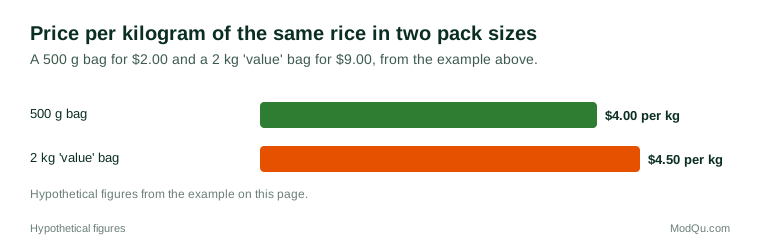
A shelf shows a 500 g bag of rice for $2.00 and a 2 kg "value" bag for $9.00. The small bag costs $4.00 per kilogram and the large bag $4.50 per kilogram, so the large bag is about 12.5% more expensive per kilogram. A shopper who buys the large bag assuming it is cheaper pays $1.00 more for the same 2 kg.
Psychological pricing
Sellers use pricing techniques based on how people perceive numbers:
- Charm prices ending in .99 or .95, which can make a price feel lower than the next round number.
- Price anchoring, showing a high price first so others seem reasonable.
- Decoy options, such as a medium size priced just below a large one, to steer people to the large.
- Bundling several products for one price, making it hard to judge each.
- Subscriptions that show a low monthly price instead of a high yearly total.
- Drip pricing, where extra fees are added during checkout, such as booking or service fees.
Regulators in several countries have acted against drip pricing and hidden fees, requiring the full price to be shown from the start.
Price and quality
Many people use price as a sign of quality, especially when they cannot judge quality directly, such as for wine, cosmetics or medicines. A product that is much cheaper than others may be seen as poor quality, even when it is not. Store brands, which are often cheaper than well-known brands, have gained trust in many countries as people find their quality acceptable.
Which products seem overpriced
When asked which products are overpriced, people often name:
- items with large price differences between shops or online;
- products sold where there is little choice, such as food at airports, stadiums and cinemas;
- printer ink, phone accessories and spare parts;
- branded medicines compared with generic ones;
- concert and event tickets with added fees;
- some cosmetics, fashion and luxury goods;
- everyday essentials that have risen in price quickly.
Example
A family notices that their weekly grocery bill has risen noticeably over a year, even though they buy the same things. They start writing down prices of ten regular items and find that some have risen far more than others. They switch four of them to store brands and buy the rest only on offer.
Price perception during inflation
When prices rise quickly, people become more aware of prices and more likely to compare, switch to cheaper brands, buy less, or shop at discount stores. People often perceive inflation as higher than official figures, partly because they notice price rises on frequent purchases, such as food and fuel, more than on things they buy rarely.
How value is measured
Surveys measure price perception and value in several ways:
- asking how people rate the value for money of brands or shops;
- asking what price people would expect to pay, or would consider too cheap or too expensive;
- testing how many people would buy at different prices;
- asking people to choose between product options with different features and prices.
What people disagree about
People disagree about whether discounts help shoppers or mislead them, whether charm prices still work, whether high prices for well-known brands reflect quality or only marketing, whether governments should act on rising prices, and how much responsibility shoppers should take for comparing prices.
Questions that brand owners, retailers, researchers and consumer bodies want answered include how people decide whether something is good value, whether they trust sale prices, which products they think are overpriced, and how they react to price rises.
Key terms
- Price perceptionHow people see and judge a price.
- Value for moneyWhether what people get is worth what they pay.
- Reference priceA price people compare against, such as what they paid last time.
- Charm priceA price ending in .99 or .95.
- Price anchoringShowing a high price first so others seem reasonable.
- Drip pricingAdding extra fees during the buying process.
- Unit priceThe price per standard amount, such as per kilogram.
- Decoy optionAn option priced to make another choice look better.
Full glossary: retail analytics terms on EditingTests.com.
Price perception and value for money vocabulary test
How well do you know the language of this topic? Try 8 quick questions. Your score is shown straight away and is not saved.
What the price perception and value for money survey asks
This survey is part of ModQu's Brands and Advertising survey. The price perception and value for money part takes about five minutes and covers:
- How you decide whether something is good value for money.
- Whether you trust sale prices and "was" prices, and why.
- Whether you check unit prices or compare shops.
- Which products you think are overpriced.
- How you have changed what you buy as prices have risen.
After that you can choose to continue with other short parts of the Brands and Advertising survey, such as brand awareness or brand loyalty, or stop.
Ready to take part?
Your answers help show what people really think and do. Results are only ever reported as totals; no one can see your individual answers.
Start the surveyQuestions about this survey
Who can take part?
Adults.
Do I have to give my name?
No. You may be asked for your age group, region and similar details so results can be broken down, but not your name. ModQu never asks for passwords, card numbers or account numbers.
How are the results used?
Answers are combined into totals and percentages and published in ModQu reports. Individual answers are never shown.
Is the vocabulary test part of the survey?
No. It is optional and separate, and your score is not stored.