
Share your experience of mail and parcels
Tell us how often you send mail or parcels, whether you have had a parcel lost or stolen and which delivery options you prefer. Your answers are combined with other people's and reported only as totals.
Start the postal and delivery services surveyAbout 5 minutes. No account needed. You can stop at any time.
What postal and delivery services cover
Postal and delivery services carry letters, documents and parcels from one place to another. They include:
- The national postal service, which in Canada is Canada Post, a federal Crown corporation. It delivers letters and parcels to every address in the country and has a legal monopoly on delivering most letters.
- Courier and parcel companies, private firms that deliver parcels and urgent documents, often with tracking and guaranteed delivery times.
- Retailer delivery networks, where large online sellers deliver many of their own parcels.
- Local and gig delivery, such as same-day delivery by drivers using apps, and food and grocery delivery.
In the United States the national service is the United States Postal Service, and most countries have a similar national post alongside private couriers.
Letters and parcels
The mix of what is sent has changed a great deal:
- Letter mail has been falling for years, as bills, statements and personal messages move online. People still send cards, legal and government documents, cheques and some bills by mail.
- Parcels have grown with online shopping. Most parcels now go from businesses to homes, rather than between people.
- Returns are a large part of parcel traffic, especially for clothing.
Many households still rely on mail for government cheques, tax documents, health cards and voting information, and some people, especially older adults and people without reliable internet, depend on it more than others.
How mail is delivered in Canada
Canadian addresses receive mail in different ways:
- Door-to-door delivery, mostly in older urban neighbourhoods.
- Community mailboxes, groups of locked boxes serving a street or neighbourhood, with a parcel locker for larger items.
- Apartment lobby mailboxes.
- Post office boxes at a local post office, common in rural areas and small towns.
- Rural route delivery to a roadside mailbox.
Mail is collected, sorted at processing plants and sent across the country by truck, train and air. Labour disputes have interrupted postal service in Canada at times, which affects businesses and households that rely on mail.
Delivery options for parcels
People receiving parcels often have several options:
- Delivery to the door, with or without a signature.
- Safe drop in a chosen place, such as a side door or porch.
- Delivery to a post office, pharmacy or convenience store counter for pickup.
- Parcel lockers in apartment buildings, stores and transit stations.
- Scheduled delivery windows or redirecting a parcel while it is in transit.
Senders choose between speed, cost and tracking. Faster delivery and signature confirmation cost more.
Example
A person working long shifts keeps missing parcel deliveries and finding notices that their packages have gone to a post office counter across town. They start selecting a parcel locker in the grocery store near their apartment at checkout. They now pick up parcels on their way home with a code sent by text.
Lost, damaged and stolen parcels
Common problems people report with deliveries include:
- Porch piracy: parcels stolen from doorsteps after delivery.
- Parcels marked delivered but not received, sometimes left at the wrong address.
- Damaged items from rough handling or poor packaging.
- Missed delivery notices left without an attempt to knock or ring.
- Delays, especially around holidays, in bad weather and during labour disruptions.
- Scam texts and emails that pretend to be from a delivery company and ask for a fee or personal information.
Who is responsible for a lost parcel depends on the terms of sale and shipping. Often the seller handles the claim with the carrier; for parcels people send themselves, the claim is usually with the carrier, subject to the coverage purchased.
Example
A parcel tracking page says a package was delivered at 2:14 p.m., but there is nothing at the door. The resident checks with neighbours, then looks at a photo the driver took, which shows a different house number. They contact the seller, who sends a replacement and files a claim with the carrier.
Example (hypothetical figures)
A small online seller ships 400 parcels a month. They compare two options: $14.50 per parcel with tracking only, or $16.25 with tracking and signature confirmation. Signature confirmation would cost an extra $1.75 per parcel, or $700 a month. In the past year, the seller lost about $350 a month to parcels reported as missing, so they keep tracking only and add signature confirmation for orders over a set value.
Rural, remote and northern service
Delivery is more difficult and costly in rural and remote areas. People in these communities often:
- pick up mail from a post office rather than receiving it at home;
- wait longer for parcels;
- pay more for shipping, or find that some sellers will not ship to them;
- rely on mail for prescriptions and essential goods.
In the far north, the federal Nutrition North Canada program subsidizes some foods and essential items shipped to eligible isolated communities, which shows how delivery costs shape daily life there.
Example
A family in a small coastal town receives most of their online orders at the local post office, which is open a few hours each day. When a parcel requires a signature and arrives on a day they are working away, it waits at the counter. The family says the local postal clerk, who knows everyone in town, is the most reliable part of the system.
The future of mail
Postal services in many countries face the same pressures: falling letter volumes, rising costs, competition in parcels and debates about what level of service should be guaranteed. Options discussed in Canada and elsewhere include fewer delivery days for letters, more community mailboxes, higher stamp prices, new services at post offices and greater use of parcel lockers. Each option has supporters and critics.
What people disagree about
People disagree about whether the national postal service should be required to deliver to every address at the same price, whether door-to-door delivery should be kept, how much public money should support mail service, and how to deal with stolen parcels. Questions that businesses and public agencies want answered include how often people send mail or parcels, whether they have had a parcel lost or stolen and which delivery company they trust most.
Key terms
- Crown corporationA company owned by the government but run at arm's length.
- Community mailboxA group of locked mailboxes serving a street or neighbourhood.
- Parcel lockerA self-service locker where parcels are left for pickup with a code.
- Tracking numberA number used to follow a parcel's progress through the delivery system.
- Signature confirmationA delivery option that needs someone to sign for the parcel.
- Porch piracyTheft of parcels left outside homes.
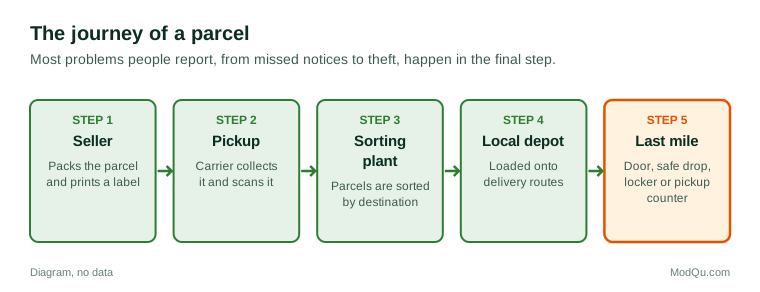
- Last mileThe final step of delivery, from a local depot to the recipient.
- Return labelA prepaid shipping label used to send an item back to a seller.
Full glossary: postal logistics terms on EditingTests.com.
Postal and delivery services vocabulary test
How well do you know the language of this topic? Try 8 quick questions. Your score is shown straight away and is not saved.
What the postal and delivery services survey asks
This survey is part of ModQu's Government and Public Services survey. The postal and delivery services part takes about five minutes and covers:
- How often you send letters, cards and parcels, and how often you receive parcels.
- How mail and parcels are delivered to your home.
- Whether you have had a parcel lost, damaged or stolen in the last year, and what happened.
- Which delivery options you prefer, such as door delivery, lockers or pickup points.
- Which delivery companies you trust most, and why.
- How satisfied you are with postal service where you live.
After that you can choose to continue with other short parts of the Government and Public Services survey, such as local services or trust in government, or stop.
Ready to take part?
Your answers help show what people really think and do. Results are only ever reported as totals; no one can see your individual answers.
Start the surveyQuestions about this survey
Who can take part?
Adults.
Do I have to give my name?
No. You may be asked for your age group, region and similar details so results can be broken down, but not your name. ModQu never asks for passwords, card numbers or account numbers.
How are the results used?
Answers are combined into totals and percentages and published in ModQu reports. Individual answers are never shown.
Is the vocabulary test part of the survey?
No. It is optional and separate, and your score is not stored.