
Share your views on pay and benefits
Tell us whether you feel paid fairly, which benefits you value most and what you think about pay transparency. Your answers are combined with other people's and reported only as totals.
Start the pay and benefits surveyAbout 5 minutes. No account needed. You can stop at any time.
What "pay and benefits" covers
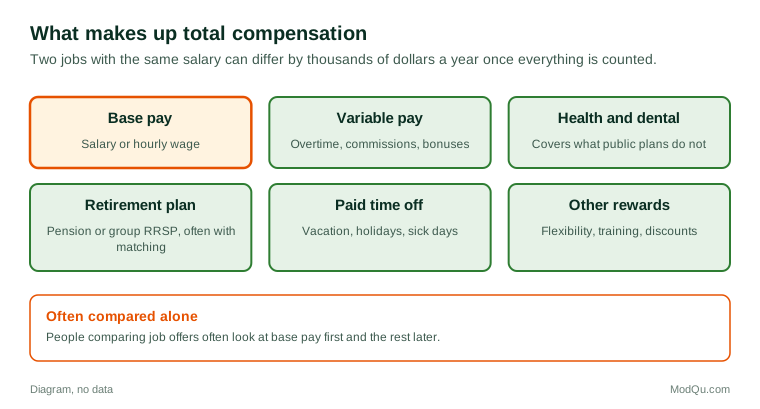
The full value of a job is often called total compensation or total rewards. It includes:
- Base pay: a salary or an hourly wage.
- Variable pay: overtime, shift premiums, commissions, bonuses and profit sharing.
- Benefits: health and dental coverage, life and disability insurance, retirement plans and other support.
- Paid time off: vacation, statutory holidays, sick days and personal days.
- Other rewards: flexible hours, remote work, training, tuition support, discounts and equity in the company.
People often compare jobs by base pay alone, but two jobs with the same salary can differ by thousands of dollars a year once benefits and time off are counted.
How pay is set
Pay depends on several things:
- The job market: what other employers pay for similar work in the same area.
- The job: its skills, responsibilities, risks and qualifications.
- The person: experience, performance and sometimes how well they negotiated.
- The employer: its size, industry, budget and pay policies.
- Collective agreements: in unionized workplaces, pay is set through bargaining between the union and the employer.
- Laws: each province and territory sets a minimum wage, and there is a federal minimum wage for federally regulated workplaces such as banks, airlines and telecommunications.
Larger employers often use pay bands or salary ranges for each level of job, with a minimum, a midpoint and a maximum. A person's position in the band may depend on experience and performance. Many unionized and public-sector jobs have pay steps, with automatic increases for each year of service up to a top rate.
Raises and bonuses
Pay changes over time in a few ways:
- Cost-of-living adjustments, meant to keep pay in line with inflation;
- Merit increases, linked to performance reviews;
- Step increases, by years of service;
- Promotions, moving to a higher job level;
- Market adjustments, when an employer finds its pay has fallen behind the market;
- Bonuses, one-time payments linked to individual, team or company results.
A raise that is lower than inflation means pay buys less than before, even though the number on the pay stub went up. The difference between the raise and inflation is the change in real wages.
Example (hypothetical figures)
A worker earning $60,000 receives a 3% raise, bringing their salary to $61,800. Over the same year, prices rose by 4%. To keep the same buying power, they would have needed $62,400. In real terms, their pay fell by about 1%, even though their salary increased by $1,800.
Many people find it more effective to change jobs than to wait for raises, especially when the job market is tight. Others value the security and steady increases of staying.
The main benefits
Benefits in Canada work alongside public programs. Provincial health insurance covers medically necessary hospital and doctor services, so employer health plans mainly cover what public plans do not. Common benefits include:
- Extended health: prescription drugs, vision care, physiotherapy, massage therapy, mental health counselling and other services, usually with some cost sharing.
- Dental: check-ups, cleanings and some treatments, often with yearly maximums.
- Life insurance and disability insurance, which replace some income if a worker dies or cannot work.
- Retirement plans: a defined benefit pension, which promises a set income in retirement, a defined contribution pension, where the employer and employee contribute and the final amount depends on investment returns, or a group registered retirement savings plan (RRSP), often with employer matching.
- Health spending accounts or wellness accounts, a set amount each year for health or wellness costs.
- Employee assistance programs, offering confidential counselling and advice.
- Parental leave top-ups, which add to government benefits during maternity and parental leave.
Not everyone has these benefits. Part-time, temporary, contract and gig workers, and people at many small businesses, often have few or none.
Example
Two job offers both pay $70,000. The first includes extended health and dental for the worker's family, a pension with a 5% employer match and four weeks' vacation. The second has no benefits and two weeks' vacation. The family has a child who needs braces and a partner who takes a costly prescription. Once they estimate these costs, the first offer is worth much more to them.
Paid time off
In Canada, minimum vacation time, statutory holidays and sick leave are set by provincial and territorial employment standards, and by the federal Canada Labour Code for federally regulated workplaces. The minimums differ between jurisdictions. For example, many provinces start at two weeks' paid vacation after a year of work and increase it with longer service, and the federal code provides paid sick days for federally regulated workers. Employers can offer more than the minimum, and many do.
Workers value time off in different ways. Some would trade pay for more vacation; others would rather have the money. Questions that businesses want answered here include which benefits workers value most, how they would trade pay for benefits or time off, and whether they understand what their benefits are worth.
Feeling paid fairly
Whether people feel paid fairly often depends less on the amount than on comparisons. Workers compare their pay with:
- colleagues doing similar work;
- people in the same job at other employers;
- what they believe their work is worth to the employer;
- their own past pay and the cost of living.
Researchers call this pay equity or pay fairness in the everyday sense, and the related idea of internal equity (fair pay inside an organization) and external equity (fair pay compared with the market).
Canada also has laws on pay equity in a specific sense: equal pay for work of equal value regardless of gender. The federal Pay Equity Act applies to federally regulated employers, and several provinces have their own pay equity laws. The gender pay gap, the difference between the average or median pay of men and women, is measured by Statistics Canada and others, and its causes are widely studied.
Example
A customer service representative learns that a new hire in the same role is earning more than they are, because the market rate rose and new hires were offered more. Their own pay has only increased by small yearly raises. They raise it with their manager, who agrees to a market adjustment, but they say the discovery made them trust the company less.
Pay transparency and what people disagree about
Pay transparency means sharing information about pay openly, for example publishing salary ranges in job postings, explaining how pay is set, or allowing workers to discuss their pay. British Columbia has passed a pay transparency law requiring pay ranges in job postings, and Ontario has passed similar requirements; other provinces are considering rules.
Supporters say transparency helps close unfair gaps, saves time for job seekers, and builds trust. Critics and some employers worry about wide ranges that tell candidates little, tension among staff who learn colleagues earn more, and less room to negotiate. People also disagree about how much of a raise is fair each year, whether pay should be tied to performance, and how much employers should be expected to provide in benefits when public programs cover some needs.
Key terms
- Total compensationThe full value of pay, benefits, time off and other rewards.
- Base payThe fixed salary or hourly wage, before bonuses and overtime.
- Pay bandThe range of pay, from minimum to maximum, for a level of job.
- Real wagesPay adjusted for inflation, showing what it can buy.
- Defined benefit pensionA pension that promises a set retirement income based on a formula.
- Defined contribution pensionA pension where contributions are set and the final amount depends on investment returns.
- Pay equityEqual pay for work of equal value regardless of gender, or fair pay more generally.
- Pay transparencySharing pay information openly, such as ranges in job postings.
Full glossary: compensation analytics terms on EditingTests.com.
Pay and benefits vocabulary test
How well do you know the language of this topic? Try 8 quick questions. Your score is shown straight away and is not saved.
What the pay and benefits survey asks
This survey is part of ModQu's Work and Careers survey. The pay and benefits part takes about five minutes and covers:
- Whether you feel you are paid fairly, and compared with whom.
- How your pay has changed in the past year, and how that compares with prices.
- Which benefits you have and which you value most.
- Whether you would trade some pay for more benefits or time off.
- Whether employers should publish pay ranges.
- What would most improve your pay and benefits.
After that you can choose to continue with other short parts of the Work and Careers survey, such as job satisfaction or remote and hybrid work, or stop.
Ready to take part?
Your answers help show what people really think and do. Results are only ever reported as totals; no one can see your individual answers.
Start the surveyQuestions about this survey
Who can take part?
Employed adults.
Do I have to give my name?
No. You may be asked for your age group, region and similar details so results can be broken down, but not your name. ModQu never asks for passwords, card numbers or account numbers.
How are the results used?
Answers are combined into totals and percentages and published in ModQu reports. Individual answers are never shown.
Is the vocabulary test part of the survey?
No. It is optional and separate, and your score is not stored.
Will I be asked my exact salary?
You may be asked for a pay range rather than an exact figure, and you can choose not to answer any question.