
Share your experience of parking
Tell us how hard parking is where you live and go, how you pay and what you spend. Your answers are combined with other people's and reported only as totals.
Start the parking surveyAbout 5 minutes. No account needed. You can stop at any time.
Why parking matters
A car spends most of its life parked. That makes parking a large part of how cities are built, what driving costs, and how people decide whether to drive at all. When parking is free and easy, people are more likely to drive. When it is scarce or expensive, they may walk, cycle, take transit, or not make the trip.
For drivers, parking raises everyday questions: Where will I park? How much will it cost? How far will I have to walk? Will I get a ticket? For businesses, it affects how easily customers can reach them. For cities, it affects traffic, land use, revenue and the look of streets.
Kinds of parking
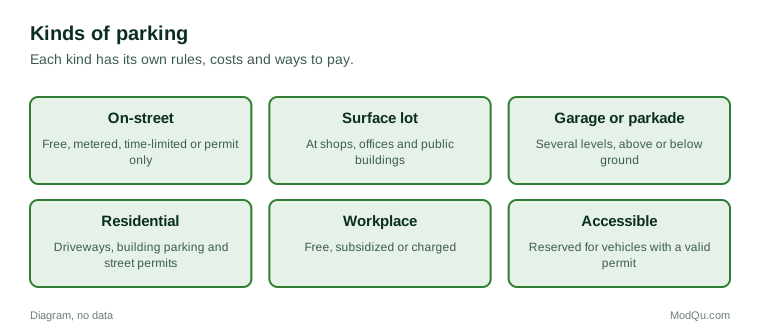
Parking comes in several forms:
- On-street parking, along the curb, which may be free, metered, time-limited or for permit holders only.
- Surface lots, open parking lots at shops, offices and public buildings.
- Parking garages (also called parkades or parking structures), with several levels, above or below ground.
- Residential parking, including driveways, garages, condominium and apartment parking, and street permits.
- Workplace parking, which may be free, subsidized or charged to employees.
- Park-and-ride lots at transit stations.
- Accessible parking, wider spaces near entrances reserved for vehicles displaying a valid disability permit.
- Special-use spaces, such as loading zones, taxi stands, car-share spaces and EV charging spots.
Finding a spot
Finding parking can take time, especially in busy downtowns, near hospitals and universities, and in older neighbourhoods built before most households owned cars. Drivers sometimes circle a block looking for a free or cheap spot on the street rather than paying for a nearby garage, which adds to traffic.
Common ways people deal with the search include:
- leaving early to allow time to park;
- choosing a garage or lot ahead of time;
- using an app or a website that shows available spaces or lets drivers reserve one;
- parking farther away and walking;
- avoiding the trip, or going at a different time.
Example
A person visiting a relative in hospital spends 15 minutes circling for street parking, then gives up and pays for the hospital garage. On later visits they reserve a spot in a nearby private garage through an app, which costs less per day and saves the search, though the walk is longer.
What parking costs
The cost of parking is easy to see when it is paid at a meter, and easy to miss when it is bundled into rent, a mortgage, store prices or a workplace. Even "free" parking has a cost, paid by someone: the land, construction, snow clearing and upkeep.
What drivers pay directly can include:
- hourly or daily rates at meters, lots and garages;
- monthly parking at work or in a downtown garage;
- residential permits to park on the street in some neighbourhoods;
- condominium or apartment parking, sold or rented with or separately from a unit;
- event and airport parking, often at higher rates;
- tickets and towing when rules are broken.
Prices vary widely between cities and between neighbourhoods. Some cities use demand-based pricing, raising meter rates where and when parking is in high demand and lowering them where it is not, with the aim of keeping a few spaces free on each block.
Example (hypothetical figures)
A downtown worker drives three days a week. Daily parking costs $22, so three days for 4.3 weeks a month comes to about $284. A monthly pass costs $260. Because the pass is cheaper even at three days a week, they buy it, and then start driving five days a week since the extra days now seem free.
Parking apps and how people pay
How people pay for parking has changed a lot. Coins and paper tickets are still accepted in some places, but many cities and lot operators now use:
- pay stations that take cards, serving many spaces on a block;
- mobile parking apps, which let drivers pay by entering a zone number and plate, get reminders before time runs out, and add time remotely;
- licence plate recognition, where cameras record plates at the entrance and exit of a garage, and the driver pays by plate rather than by ticket;
- reservation apps for booking spaces in advance in garages, lots and sometimes private driveways.
Some drivers like apps because they avoid running back to a meter. Others find it annoying to need a different app in different cities or lots, or worry about service fees and about the data the apps collect.
Questions that businesses want answered here include which payment methods drivers use and prefer, how many use parking apps, and whether drivers would pay more for a guaranteed space.
Tickets, towing and permits
Parking rules are enforced by city bylaw officers, police, or private companies on private property. Common reasons for tickets include an expired meter, parking beyond the time limit, parking without a permit, blocking a driveway or fire hydrant, and parking in a no-stopping zone during rush hour.
On private lots, enforcement can be stricter and more confusing, with signs that drivers miss and charges that may be issued as "parking notices" by a private company. The rules on what private operators can charge and how they can collect differ by province and city. Many cities allow drivers to dispute a city ticket through a review or a hearing.
Winter adds its own rules in much of Canada. Many cities ban overnight street parking or require drivers to move their cars on certain streets during snow clearing.
Example
A driver parks on a residential street for the evening and wakes to find their car has been towed. A snow-clearing parking ban had been announced the day before. They pay the ticket and the towing and storage fees, then sign up for the city's text alerts for snow bans.
Accessible parking
Accessible parking spaces are wider and close to entrances, so people with disabilities can get in and out of vehicles, use mobility aids and reach buildings. In Canada, provinces issue accessible parking permits to eligible people, and the permit is displayed in the vehicle being used to drive or carry the permit holder.
Common complaints include people parking in accessible spaces without a permit, permits being misused, too few accessible spaces, and spaces blocked by snow. Fines for misuse are often higher than for other parking offences.
Trends and what people disagree about
Parking is one of the most argued-about topics in local politics. Points of disagreement include:
- Minimum parking requirements: many cities have required new buildings to include a set number of parking spaces. Several Canadian cities, including Toronto and Edmonton, have removed or reduced these requirements, arguing that they raise housing costs and encourage driving. Others worry that removing them will push cars onto streets.
- Street space: whether curb space should be used for parking, bike lanes, patios, bus lanes or loading zones.
- Pricing: whether parking should be priced to match demand, kept cheap to support local shops, or kept free.
- Residential permits: who should be entitled to park on a street, and at what price.
Some shop owners believe most of their customers arrive by car and need nearby parking, while some studies of local shopping streets have found that many customers arrive on foot, by bike or by transit. Surveys of both shoppers and shop owners are one way to test these beliefs locally.
Key terms
- Metered parkingPaid parking at the curb, charged by time.
- Parking minimumsRules requiring new buildings to provide a set number of parking spaces.
- Demand-based pricingChanging parking rates by time and place to match demand.
- Residential permitA permit allowing residents to park on certain streets.
- Licence plate recognitionCameras that read plates to manage entry, payment or enforcement.
- Accessible parking permitA provincial permit allowing use of spaces reserved for people with disabilities.
- Loading zoneCurb space set aside for loading and unloading goods or passengers.
- ParkadeA Canadian term for a multi-level parking garage.
Full glossary: parking technology terms on EditingTests.com.
Parking vocabulary test
How well do you know the language of this topic? Try 8 quick questions. Your score is shown straight away and is not saved.
What the parking survey asks
This survey is part of ModQu's Cars and Getting Around survey. The parking part takes about five minutes and covers:
- How hard it is to find parking where you live, work and shop.
- Where you usually park, and whether you pay for it.
- How much you spend on parking in a typical month.
- Whether you use a parking app, and how you prefer to pay.
- Whether you have had a parking ticket or been towed in the past year.
- Your views on parking prices and rules in your area.
After that you can choose to continue with other short parts of the Cars and Getting Around survey, such as buying a car or electric vehicles, or stop.
Ready to take part?
Your answers help show what people really think and do. Results are only ever reported as totals; no one can see your individual answers.
Start the surveyQuestions about this survey
Who can take part?
Drivers.
Do I have to give my name?
No. You may be asked for your age group, region and similar details so results can be broken down, but not your name. ModQu never asks for passwords, card numbers or account numbers.
How are the results used?
Answers are combined into totals and percentages and published in ModQu reports. Individual answers are never shown.
Is the vocabulary test part of the survey?
No. It is optional and separate, and your score is not stored.
I rarely drive. Can I take part?
Yes. You can tell us how parking affects your choice not to drive, and your views on parking in your area.