
Share your mortgage experience
Tell us how you found your mortgage, what you compared and how you feel about your next renewal. Your answers are combined with other people's and reported only as totals.
Start the mortgages and home loans surveyAbout 5 minutes. No account needed. You can stop at any time.
What a mortgage is
A mortgage is a loan used to buy property, with the property itself as security. If the borrower cannot repay, the lender can take legal steps to sell the property to recover the loan. Most mortgages are repaid in regular payments that cover both interest and part of the amount borrowed, called the principal.
Two time periods matter:
- Amortization: the total time it would take to repay the whole loan, often 25 years and sometimes longer.
- Term: the length of the current contract, after which the mortgage must be renewed. In Canada, terms of one to five years are common, and a five-year term is a frequent choice. In the United States, many mortgages are fixed for the whole amortization, often 30 years.
This difference means Canadian borrowers face a renewal several times over the life of a mortgage, each time at whatever rates apply then.
Down payments and mortgage insurance
Buyers pay part of the price themselves as a down payment and borrow the rest. In Canada, a buyer who puts down less than 20% of the price usually needs mortgage default insurance, which protects the lender, not the borrower, if the borrower defaults. The insurance premium is usually added to the mortgage.
Saving the down payment is often the hardest step for first-time buyers. Many combine savings with registered accounts designed for home buying, gifts from family, or the proceeds from selling a previous home.
Example (hypothetical figures)
A first-time buyer finds a home for $500,000. With a 10% down payment of $50,000, they borrow $450,000 and need default insurance. With 20% down ($100,000), they borrow $400,000 and do not. The extra $50,000 would take them about four more years to save, so they weigh paying the insurance against waiting while prices may change.
Fixed or variable rate
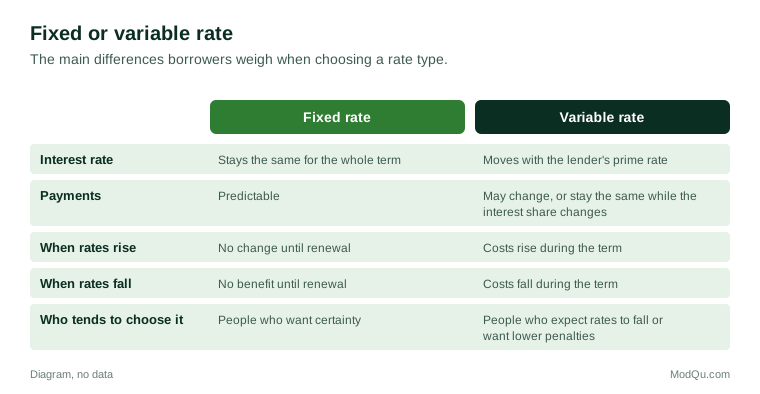
The biggest choice for many borrowers is the type of interest rate:
- A fixed rate stays the same for the term. Payments are predictable.
- A variable rate moves with the lender's prime rate, which follows the central bank's policy rate. With some variable mortgages the payment changes; with others the payment stays the same but more or less of it goes to interest.
- A hybrid mortgage splits the loan between fixed and variable.
People choose for different reasons. Some want certainty and pick fixed. Others expect rates to fall, or want lower prepayment penalties, and pick variable. Many say afterwards they did not fully understand how their variable mortgage would behave when rates rose.
Example
In the same year, two neighbours take out similar mortgages. One chooses fixed for five years for peace of mind. The other chooses variable because it starts lower. Rates rise sharply during the term. The fixed-rate borrower's payment does not change. The variable-rate borrower's payment stays the same at first, but almost all of it goes to interest, and at renewal they face a much higher payment to stay on schedule.
Banks, credit unions and mortgage brokers
Borrowers can go directly to a lender or use a mortgage broker:
- Banks and credit unions offer their own mortgages. Many borrowers go to the bank where they already have their accounts.
- Mortgage brokers compare offers from several lenders, including some that do not deal directly with the public. Brokers are usually paid by the lender.
- Online lenders and comparison sites show posted rates and allow applications online.
How many lenders people compare varies widely. Some accept their bank's first offer. Others compare several quotes and negotiate. Lenders want to know what makes borrowers shop around, and how much a rate difference must be before someone moves.
Qualifying and the stress test
Lenders look at income, debts, credit history and the property itself. In Canada, federally regulated lenders must also apply a stress test: borrowers must show they could still afford payments at a qualifying rate higher than the rate they are offered. The test aims to make sure borrowers could cope if rates rose.
Debt ratios matter too. Lenders compare housing costs and total debt payments with income. A buyer with a car loan and credit card debt may qualify for a smaller mortgage than one with no other debt.
Renewing, refinancing and breaking a mortgage
At the end of each term the borrower renews, either with the same lender or by switching to another. Renewal letters often arrive a few months before the term ends. Many borrowers sign the renewal offer without comparing, even though they could negotiate or move.
Refinancing means replacing the mortgage before the term ends, for example to borrow more against the home. Breaking a mortgage early usually triggers a prepayment penalty. For fixed-rate mortgages this penalty can be large, and it is calculated differently by different lenders.
Example
A family sells their home and buys another in a new city two years into a five-year fixed term. Their lender charges a penalty to break the mortgage. They learn they could have avoided it by "porting" the mortgage to the new home, a feature their mortgage offered but no one had explained.
Paying a mortgage off faster
Most mortgages allow some extra repayment each year without penalty, called prepayment privileges. Common options include:
- lump-sum payments up to a set share of the original amount each year;
- increasing the regular payment by a set percentage;
- switching to more frequent payments, such as accelerated biweekly payments, which add the equivalent of one extra monthly payment each year.
Every extra dollar of principal repaid early saves the interest that would have been charged on it for the rest of the amortization. People decide whether to use these options based on their other debts, their savings goals and how secure their income feels.
Example (hypothetical figures)
A borrower with a monthly payment of $2,000 switches to accelerated biweekly payments of $1,000. Over a year they make 26 payments, or $26,000, instead of $24,000. The extra $2,000 a year goes straight to principal and shortens the amortization by several years over the life of the loan.
What worries borrowers
Common concerns include:
- payment increases at renewal after a period of rising rates;
- being unable to qualify to switch lenders;
- not understanding penalties, terms and conditions;
- the effect of job loss or illness on payments;
- whether to put spare money toward the mortgage or into savings and investments.
These concerns shape what borrowers do: whether they choose shorter terms, make extra payments, or look for advice.
Key terms
- AmortizationThe total time it will take to repay the whole mortgage.
- TermThe length of the current mortgage contract before renewal.
- PrincipalThe amount borrowed, not counting interest.
- Down paymentThe part of the purchase price the buyer pays upfront.
- Default insuranceInsurance that protects the lender if a borrower with a small down payment cannot pay.
- Prime rateThe benchmark rate lenders use to set variable rates.
- Stress testA check that a borrower could afford payments at a higher rate.
- Prepayment penaltyA charge for paying off or breaking a mortgage early.
Full glossary: mortgage lending terms on EditingTests.com.
Mortgages and home loans vocabulary test
How well do you know the language of this topic? Try 8 quick questions. Your score is shown straight away and is not saved.
What the mortgages and home loans survey asks
This survey is part of ModQu's Money and Banking survey. The mortgages and home loans part takes about five minutes and covers:
- Whether you have a mortgage, are planning to buy, or have recently paid one off.
- Whether you used a broker or went directly to a lender, and why.
- How many lenders or offers you compared.
- Which rate type and term you chose, and what influenced the choice.
- How worried you are about your next renewal, and what you plan to do.
- What would make you switch lenders.
After that you can choose to continue with other short parts of the Money and Banking survey, such as everyday banking or digital payments and wallets, or stop.
Ready to take part?
Your answers help show what people really think and do. Results are only ever reported as totals; no one can see your individual answers.
Start the surveyQuestions about this survey
Who can take part?
Homeowners and people planning to buy.
Do I have to give my name?
No. You may be asked for your age group, region and similar details so results can be broken down, but not your name. ModQu never asks for passwords, card numbers or account numbers.
How are the results used?
Answers are combined into totals and percentages and published in ModQu reports. Individual answers are never shown.
Is the vocabulary test part of the survey?
No. It is optional and separate, and your score is not stored.