
Share your views on local food
Tell us whether you have bought from a farmers market this year, whether you would pay more for local food and how much it matters where food was grown. Your answers are combined with other people's and reported only as totals.
Start the farm and local food surveyAbout 5 minutes. No account needed. You can stop at any time.
What "local food" means
"Local food" has no single meaning. People use it for food grown nearby, food from their own province, or food from Canada as opposed to imports. Definitions include:
- a distance, such as within 100 or 160 km of where it is sold;
- a province or region, such as food grown in Ontario or in the Maritimes;
- a country, food grown or made in Canada;
- a relationship, food bought directly from the person who grew or made it.
For labelling, the Canadian Food Inspection Agency's interim policy says "local" means food produced in the province or territory where it is sold, or within 50 km of the provincial or territorial border. Many provinces run their own programs with logos for food grown in the province. Shoppers often have a narrower idea in mind, such as a nearby farm.
"Local" is also different from other claims. Local food is not automatically organic, and organic food is not automatically local.
Ways people buy from farms
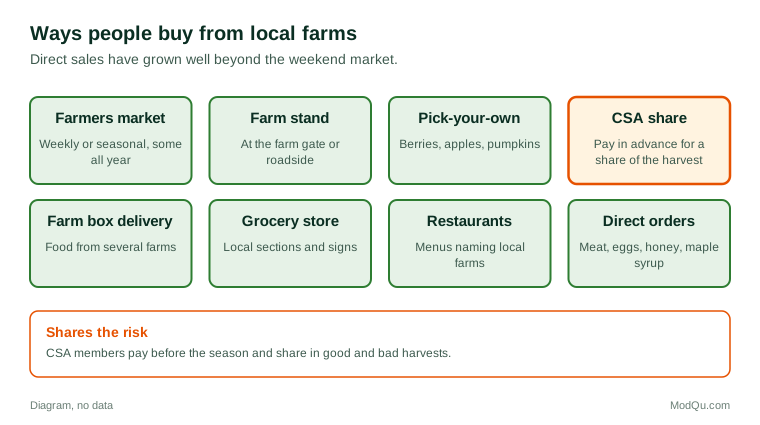
People buy farm and local food through many channels:
- Farmers markets: weekly or seasonal markets where farmers and food makers sell directly. Many Canadian cities and towns have one, and some run all year, indoors in winter.
- Farm stands and farm stores: selling at the farm gate or roadside, often on an honour system for small stands.
- Pick-your-own farms for berries, apples, pumpkins and other crops.
- Community supported agriculture (CSA): customers pay a farm at the start of the season and receive a share of the harvest, usually a weekly box. They share in good and bad harvests.
- Online farm boxes and local delivery services that gather food from several farms.
- Grocery stores with local sections or signs showing local produce.
- Restaurants that buy from local farms and say so on their menus.
- Directly from the farm for meat, eggs, honey and maple syrup, often by order.
Example
A family buys a CSA share from a vegetable farm 40 km from their home. From June to October they pick up a box every Thursday at a church parking lot in town. They like the freshness and meeting the farmer, but in a wet summer the boxes have more greens and fewer tomatoes than they expected, and they learn to cook with kale.
Why people buy local
People give many reasons for buying local food:
- Freshness and taste, since produce may be picked closer to when it is sold.
- Supporting local farmers and the local economy.
- Knowing where food comes from and how it was grown, and being able to ask the grower.
- Environmental reasons, such as shorter transport distances, although the overall environmental impact of food depends on much more than distance.
- Food security, keeping farmland and farming skills in the region.
- Seasonal eating and variety, including heritage varieties not found in supermarkets.
- The experience: markets as social events, outings to farms with children.
- Animal welfare, for people who want to know how animals were raised.
Prices and willingness to pay
Local food is sometimes more expensive than supermarket food and sometimes cheaper, especially in season, when produce is plentiful. Prices at markets reflect small-scale production, labour and the cost of selling directly.
Whether people will pay more for local food is one of the main questions for farms and grocers. Many shoppers say they would pay a bit more, but what they say and what they do at the till can differ, and price still decides many purchases.
Example (hypothetical figures)
A shopper buys strawberries in June. At the supermarket, imported strawberries cost $4.99 for a 454 g box. At the farmers market, local strawberries cost $7.00 for a 1 L basket, which holds about 600 g. Per 100 g, the imported berries cost about $1.10 and the local berries about $1.17, so the difference is smaller than the sticker prices suggest. By July, at the peak of the season, the farm stand sells a 4 L flat for $20, about $0.83 per 100 g.
Questions that businesses want answered here include how many people buy from farmers markets and farms, how much more they would pay for local food, and which local products matter most to them.
Seasons in Canada
Canada's climate shapes local food. In much of the country the outdoor growing season for many crops runs only from late spring to early fall. Local options in winter include:
- storage crops such as potatoes, carrots, onions, squash and apples;
- greenhouse produce, such as tomatoes, cucumbers, peppers and lettuce, which Canada grows in large amounts;
- preserved foods, canned, frozen or dried;
- meat, eggs, dairy, grains, honey and maple syrup, which are available all year;
- indoor and vertical farms, which grow greens and herbs in controlled conditions.
Many households buy more local food in summer and fall and rely more on imports in winter and spring.
Example
A couple tries to eat mostly local food for a year. From July to October it is easy and inexpensive. By February they are eating stored squash and potatoes, greenhouse tomatoes, frozen berries they picked in summer and local cheese. They decide to keep buying imported citrus and bananas, and to buy local whenever it is in season.
Barriers to buying local
People who would like to buy more local food give reasons why they do not:
- Price, especially for meat and specialty products.
- Convenience: markets on set days and times, and farm stands outside town.
- Limited choice, especially out of season.
- Not knowing what is local in a grocery store when labels are unclear.
- Payment: some small vendors accept only cash or e-transfer, though card readers are now common.
- Access: fewer markets in some neighbourhoods and rural areas, and in northern and remote communities.
Some cities and charities run programs, such as market coupons for low-income households, to help more people buy fresh local food.
What people disagree about
Local food raises real debates:
- Environment: food miles, the distance food travels, are only part of its environmental impact. How food is grown, stored and transported can matter more. A greenhouse tomato grown nearby in winter may use more energy than one shipped from a warm climate.
- Price and fairness: local food can be out of reach for some households, which raises questions about who it serves.
- Trade: some see buying local as supporting Canadian farmers; others note Canada also exports a great deal of food and benefits from trade.
- Labels: whether the "local" definition used in stores matches what shoppers expect.
- Scale: whether small local farms can feed cities, or mainly complement larger farms.
Key terms
- Local foodFood produced near where it is sold, defined in different ways.
- Farmers marketA market where farmers and food makers sell directly to customers.
- CSACommunity supported agriculture, where customers pay a farm in advance for a share of the harvest.
- Farm-gate salesSelling directly from the farm.
- Food milesThe distance food travels from where it is grown to where it is eaten.
- In seasonGrown and harvested locally at that time of year.
- Storage cropA crop that keeps for months after harvest, such as potatoes or squash.
- Food securityReliable access to enough affordable, nutritious food.
Full glossary: agricultural cooperatives terms on EditingTests.com.
Farm and local food vocabulary test
How well do you know the language of this topic? Try 8 quick questions. Your score is shown straight away and is not saved.
What the farm and local food survey asks
This survey is part of ModQu's Food and Drink survey. The farm and local food part takes about five minutes and covers:
- Whether you have bought from a farmers market, farm stand or CSA this year.
- How often you buy local food, and which kinds.
- Whether you would pay more for local food, and how much more.
- How important it is to you to know where food was grown.
- What stops you buying more local food.
- How you tell whether food in a store is local.
After that you can choose to continue with other short parts of the Food and Drink survey, such as eating habits or coffee, tea and beverages, or stop.
Ready to take part?
Your answers help show what people really think and do. Results are only ever reported as totals; no one can see your individual answers.
Start the surveyQuestions about this survey
Who can take part?
Adults.
Do I have to give my name?
No. You may be asked for your age group, region and similar details so results can be broken down, but not your name. ModQu never asks for passwords, card numbers or account numbers.
How are the results used?
Answers are combined into totals and percentages and published in ModQu reports. Individual answers are never shown.
Is the vocabulary test part of the survey?
No. It is optional and separate, and your score is not stored.
I live far from any farm. Can I take part?
Yes. The survey also asks about local food in grocery stores and what would make it easier to buy.