
Share your experience of banking
Tell us how you bank, what you pay and what you would change. Your answers are combined with other people's and reported only as totals.
Start the everyday banking surveyAbout 5 minutes. No account needed. You can stop at any time.
What everyday banking covers
Everyday banking means the accounts and services people use to receive money, hold it and pay for things. For most households it centres on one main account, usually a chequing account (called a checking account in the United States), into which pay or benefits are deposited and from which bills, rent and card purchases are paid.
Around that main account sit a number of related services:
- Savings accounts that hold money not needed right away and usually pay some interest.
- Debit cards that take money straight from the account at a till or online.
- Transfers between accounts and to other people, including e-transfers and wire transfers.
- Bill payments and automatic payments, such as a monthly pre-authorized debit for a phone plan or insurance.
- Overdraft protection, which lets the account go below zero up to a limit, usually for a fee and interest.
- Channels: branches, ATMs, telephone banking, online banking and mobile apps.
Everyday banking is different from borrowing (mortgages, loans and credit cards) and from investing, although the same bank often provides all three. The main account matters to banks because it is where the relationship starts: a customer who has their pay deposited at one bank is more likely to take a mortgage or a credit card there too.
How people choose a bank
Many people do not actively choose their first bank. They open an account where their parents banked, where a school or employer pointed them, or at the branch closest to home. Later choices are more deliberate, and the reasons people give tend to fall into a few groups:
- Cost: monthly account fees, transaction limits, and whether fees are waived for keeping a minimum balance.
- Convenience: a branch or ATM nearby, a mobile app that works well, and fast transfers.
- Trust and safety: the bank's size and reputation, deposit insurance, and how it handles fraud.
- Offers: sign-up bonuses, student or newcomer packages, and bundles with credit cards.
- Service: being able to speak to a person when something goes wrong.
Example
A student opens a no-fee student account at a large bank on campus. Five years later, now working, they are moved to a standard account with a monthly fee. They compare an online-only bank with no fee, a credit union near their new apartment and their current bank's fee-waiver option. They stay, because their pay, rent and phone bill are already set up there and the fee can be waived by keeping a minimum balance.
The example shows a pattern that survey research on banking often explores: the reasons people give for choosing a bank are not always the reasons they stay. Convenience and habit keep many customers in place even when they say cost matters most.
Branches, apps and how people bank day to day
Most routine banking has moved from branches to phones and computers. Checking a balance, paying a bill, depositing a cheque by photo and sending money to a friend can all be done in an app. Branches are now used mainly for larger or more complicated tasks: opening an account, getting a mortgage, sorting out a problem, or getting a bank draft.
That shift is not even across the population. Older customers, people in rural areas, small business owners who handle cash, and people who are less confident online may still rely on branches, and branch closures affect them most. Others want the opposite: an app that does everything, with no reason ever to visit a branch.
Example
A retired couple use online banking for bills but visit their branch every month to deposit cash from a part-time market stall and to talk to the same advisor. When the branch announces it will close, they consider moving to a credit union that still has a branch in town, even though they are happy with the bank's app.
Questions that businesses want answered here include how often people visit a branch, what they still need a branch for, which app features matter most, and how people would react if their branch closed.
Fees and what people pay
Account fees are one of the most visible parts of everyday banking. Common charges include:
- a monthly account or package fee, sometimes waived above a minimum balance;
- fees per transaction once a monthly limit is passed;
- non-sufficient funds (NSF) fees when a payment bounces because there is not enough money;
- overdraft fees and interest;
- fees for using another bank's ATM, or a foreign ATM while travelling;
- fees for paper statements, bank drafts and wire transfers.
People are often unsure what they pay in a year because fees are small and spread out. A survey can measure both what people think they pay and what they would accept, which is useful to banks pricing new accounts and to groups that compare banks for consumers.
Example (hypothetical figures)
A customer pays a monthly fee of $16.95, which is waived in any month the balance stays above $4,000. They keep the balance up for eight months of the year. In the other four months they pay $67.80 in total, plus one $48 NSF fee after an automatic payment went out the day before payday. Asked to guess, they say they pay "about $20 a year".
Switching banks
Switching a main bank account is uncommon. Many people say they are dissatisfied with fees or service but stay for years. The figure below shows why: moving a main account is a series of steps, and the hardest is moving every deposit and automatic payment to the new account.
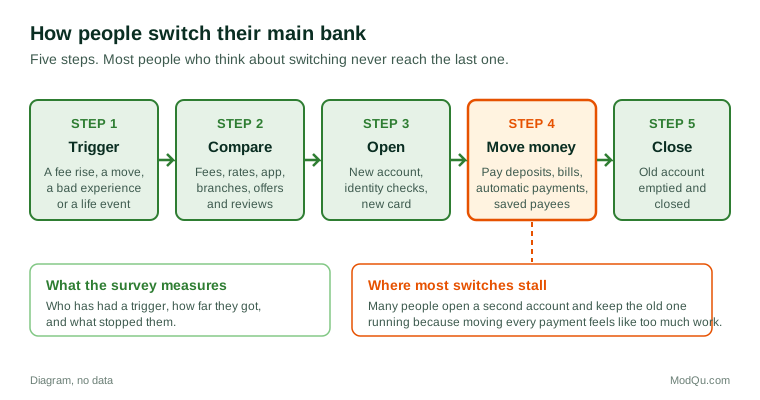
Common triggers for switching are a new or higher fee, a poor response to a problem or fraud, a move to a new city, a life event such as marriage or a first job, and a strong sign-up offer. Common reasons for not switching are the effort of moving payments, worry that something will be missed, and a sense that all banks are much the same.
Example
After a fraud case on their debit card took three weeks to resolve, a customer opens an account at another bank that advertises faster fraud refunds. Six months later both accounts are still open: their pay goes to the new bank, but their mortgage payment and two subscriptions still come out of the old one.
Trust, safety and fraud
People trust banks to keep their money safe, and that trust rests partly on deposit insurance. In Canada, the Canada Deposit Insurance Corporation (CDIC) protects eligible deposits at member institutions up to set limits if a member fails; in the United States the equivalent is the Federal Deposit Insurance Corporation (FDIC), and many credit unions are covered by provincial or national schemes. Many customers are not sure whether their own savings are covered or how much is protected.
Trust is also shaped by how a bank handles fraud. Scam calls, fake texts that look like they come from a bank, and card fraud are a daily concern for many people. What a bank does when a customer is defrauded, and how quickly it acts, often affects loyalty more than fees do.
Big banks, credit unions and online-only banks
Everyday banking is offered by several kinds of institution:
- Large national banks with wide branch and ATM networks and a full range of products.
- Credit unions and co-operative banks, owned by their members, often local, and often seen as more personal.
- Online-only banks with no branches, which usually offer lower fees or higher savings rates.
- Financial technology companies that offer payment apps, prepaid cards and accounts, sometimes through a partner bank.
Many people use more than one: a main account at a large bank, a high-interest savings account online, and a payment app for splitting bills with friends.
Key terms
- Chequing accountAn account for everyday deposits and payments.
- Direct depositPay or benefits paid straight into an account.
- Pre-authorized debitA payment a company takes from your account on a schedule you agreed to.
- NSF feeA charge when a payment fails because there is not enough money in the account.
- OverdraftSpending past a zero balance up to an agreed limit, usually with fees and interest.
- HoldA delay before deposited money, such as a cheque, can be used.
- Deposit insuranceProtection of eligible deposits, up to a limit, if a member bank fails.
- Transit numberThe number that identifies a bank branch in Canada.
Full glossary: retail banking terms on EditingTests.com.
Everyday banking vocabulary test
How well do you know the language of this topic? Try 8 quick questions. Your score is shown straight away and is not saved.
What the everyday banking survey asks
This survey is part of ModQu's Money and Banking survey. The everyday banking part takes about five minutes and covers:
- Which bank or credit union you use for your main account, and for how long.
- How you bank: branch, app, online, phone or ATM, and how often.
- What you pay in fees, and what you think you pay.
- How satisfied you are, and what you would change.
- Whether you have thought about switching, and what happened.
- Your experience of fraud or scams, if any.
After that you can choose to continue with other short parts of the Money and Banking survey, such as digital payments and wallets or credit cards and borrowing, or stop.
Ready to take part?
Your answers help show what people really think and do. Results are only ever reported as totals; no one can see your individual answers.
Start the surveyQuestions about this survey
Who can take part?
Adults with a bank or credit union account.
Do I have to give my name?
No. You may be asked for your age group, region and similar details so results can be broken down, but not your name. ModQu never asks for passwords, card numbers or account numbers.
How are the results used?
Answers are combined into totals and percentages and published in ModQu reports. Individual answers are never shown.
Is the vocabulary test part of the survey?
No. It is optional and separate, and your score is not stored.