
Share your economic outlook
Tell us whether you think the economy will get better or worse, whether your household is better off than a year ago and what worries you most. Your answers are combined with other people's and reported only as totals.
Start the economic outlook surveyAbout 5 minutes. No account needed. You can stop at any time.
What "economic outlook" means
A person's economic outlook is what they expect to happen to the economy and to their own finances in the coming months or years. It covers:
- The national economy: growth, recession, jobs and wages.
- Prices: whether prices will rise faster or slower.
- Interest rates: whether borrowing will become more or less expensive.
- Personal finances: whether the household will be better or worse off.
- Jobs: how secure one's own job is and how easy it would be to find another.
- Big purchases: whether it is a good time to buy a car, home or appliance.
Economists also make forecasts, but this page is about what ordinary people expect, which can differ from expert forecasts.
How people form expectations
People base their outlook on:
- their own recent experience of prices, pay and bills;
- news coverage of the economy;
- what friends, family and colleagues say;
- signs in their area, such as shops opening or closing and job advertisements;
- views about the government in power;
- past experience of recessions or periods of high inflation.
People's views of the national economy and of their own finances often differ. Many say the national economy is doing badly while their own household is doing "about the same".
Example
A plumber says the economy is "in trouble" because she hears about job cuts in the news. Her own business has more work than ever because people are repairing rather than replacing. She expects her household finances to improve next year even though she expects the country's economy to get worse.
How confidence is measured
Many countries publish regular consumer confidence or consumer sentiment surveys. These ask a sample of households the same questions each month or quarter, such as:
- Will your household be better or worse off in a year?
- Will the economy be better or worse in a year?
- Is now a good time to make major purchases?
- Do you expect prices to rise faster, slower or the same?
Answers are turned into an index, often by subtracting the share of pessimistic answers from the share of optimistic ones. Changes in the index over time are watched closely by central banks, governments and businesses.
Example (hypothetical figures)
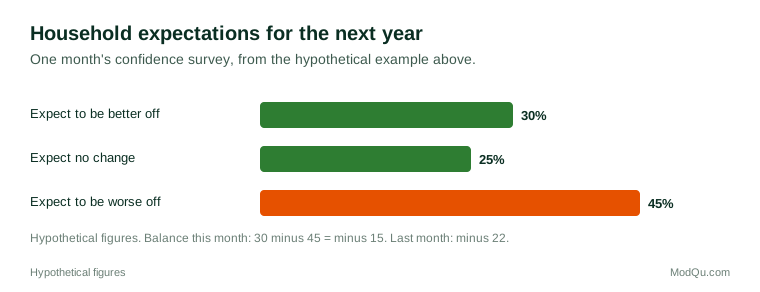
In a month's survey, 30 percent of households expect to be better off next year, 45 percent expect to be worse off and 25 percent expect no change. The balance is 30 minus 45, which is minus 15. Last month the balance was minus 22, so confidence improved by 7 points even though more households are still pessimistic than optimistic.
The figure below shows these hypothetical results.
Why expectations matter
Expectations can affect the economy itself:
- people who expect hard times may spend less and save more, which slows the economy;
- people who expect prices to rise may buy sooner or ask for higher pay;
- businesses use confidence data to plan stock, hiring and investment;
- central banks watch inflation expectations when setting interest rates.
This is why confidence surveys are among the most closely watched economic indicators.
What makes people optimistic or worried
Common sources of optimism include rising pay, falling prices or interest rates, a strong local job market and personal events such as a promotion. Common worries include:
- rising prices and bills;
- job security and layoffs;
- high interest rates and debt;
- housing costs;
- pensions and retirement savings;
- taxes;
- global events such as conflicts and pandemics.
Example
A recent graduate is optimistic about her own career but worried about housing. She expects her pay to rise but thinks she will not be able to buy a home for at least ten years. She has started saving a fixed amount each month and is sharing a flat to keep costs down.
Differences between groups
Outlook often differs by age, income, region, employment status and political views. People who support the government in power often rate the economy more positively than those who do not, even when their personal situations are similar. People in regions with closing industries may be gloomier than those in growing cities.
Expectations and reality
Public expectations and economic results do not always match. People may remain gloomy after an economy recovers, or optimistic just before a downturn. Comparing expectations with what actually happens helps researchers understand how people learn from experience.
What people disagree about
- Whether the economy is improving or getting worse.
- Who is responsible for economic problems.
- Whether official figures reflect ordinary people's experience.
- Which policies would help most.
- How worried people should be about debt.
Why surveys ask about economic outlook
Questions that media organizations, policy groups, banks, businesses and governments want answered include whether people expect the economy to get better or worse, whether households are better off than a year ago and what worries people most. Answers are grouped and you do not need to give exact income figures.
Household finances and the wider economy
People's views of the economy are often shaped by a few prices they see often, such as fuel, bread, rent and energy bills. A large rise in one of these can make people feel the economy is doing badly even when overall inflation is falling. Wages matter too: people judge whether their pay keeps up with prices. Economists distinguish between nominal wages, the amount on the payslip, and real wages, which account for inflation. Many households feel worse off when real wages fall, even if nominal pay rises. Surveys that ask both about the national economy and about the household's own situation help separate these effects.
Key terms
- Consumer confidenceHow optimistic households are about the economy and their finances.
- RecessionA period when the economy shrinks, often defined by falling output for two quarters in a row.
- InflationA general rise in prices over time.
- Inflation expectationsWhat people think inflation will be in the future.
- IndexA single number that summarizes many measurements and tracks change over time.
- BalanceThe share of positive answers minus the share of negative answers.
- Economic indicatorA statistic used to judge the state of the economy.
- Job securityHow likely a person is to keep their job.
Full glossary: economic forecasting terms on EditingTests.com.
Economic outlook vocabulary test
How well do you know the language of this topic? Try 8 quick questions. Your score is shown straight away and is not saved.
What the economic outlook survey asks
This survey is part of ModQu's Politics and Current Affairs survey. The economic outlook part takes about five minutes and covers:
- Whether you think the economy will get better or worse next year.
- Whether your household is better or worse off than a year ago.
- What you expect for prices and interest rates.
- How secure you feel in your job, if you work.
- Whether now is a good time for big purchases.
- What worries you most about the economy.
After that you can choose to continue with other short parts of the Politics and Current Affairs survey, such as political engagement or trust in political parties, or stop.
Ready to take part?
Your answers help show what people really think and do. Results are only ever reported as totals; no one can see your individual answers.
Start the surveyQuestions about this survey
Who can take part?
Adults.
Do I have to give my name?
No. You may be asked for your age group, region and similar details so results can be broken down, but not your name. ModQu never asks for passwords, card numbers or account numbers.
How are the results used?
Answers are combined into totals and percentages and published in ModQu reports. Individual answers are never shown.
Is the vocabulary test part of the survey?
No. It is optional and separate, and your score is not stored.
Do I need to give my exact income?
No. Questions about money use ranges, and every question can be skipped.
Can I take part if I am retired or not working?
Yes. Everyone's economic outlook matters, whatever their work situation.