
Share your views on world affairs
Tell us how closely you follow world news, which countries you think have most influence and whether your country should help others more. Your answers are combined with other people's and reported only as totals.
Start the international affairs surveyAbout 5 minutes. No account needed. You can stop at any time.
What international affairs covers
International affairs means relations between countries and the events and issues that cross borders. It includes:
- Diplomacy: talks, agreements and alliances between governments.
- Trade: buying and selling goods and services across borders, and the rules that govern it.
- Security: defence, conflict, peacekeeping and arms control.
- Development and aid: support from richer to poorer countries.
- Global issues: climate change, pandemics, migration, food and energy supplies.
- International organizations: bodies such as the United Nations, regional unions and specialized agencies.
- Human rights and international law.
How people follow world events
People learn about world events from television and radio news, newspapers and websites, social media, international broadcasters, friends and family abroad and, increasingly, video and podcasts. Interest often rises when an event affects people directly, such as a war that raises fuel prices, a disaster in a country where relatives live, or a major sporting event.
Example
A taxi driver follows news from three countries: the one he lives in, the one he was born in and the one where his daughter studies. He uses a different news app for each and says he often sees the same event described very differently.
How people form views of other countries
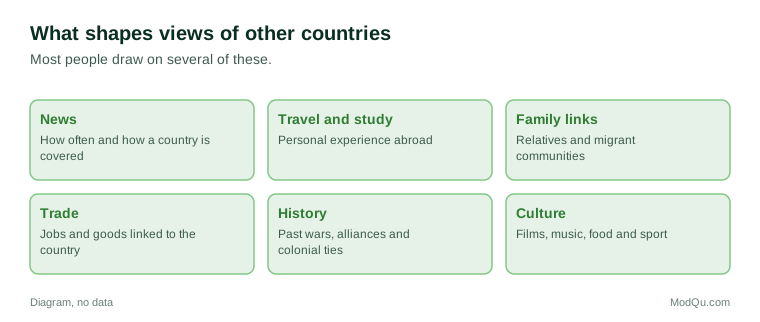
Views of other countries are shaped by:
- news coverage and how often a country appears in it;
- personal travel, study or work abroad;
- family links and migrant communities;
- trade and economic ties;
- history, including past wars and colonial relations;
- culture: films, music, food and sport;
- a country's actions on issues people care about.
Views can change quickly after major events, and people in different countries often see the same country very differently.
The figure below sets out these influences.
Influence and power
Survey questions often ask which countries people think have the most influence in the world, and whether that influence is mostly positive or negative. Answers differ by region, age and political views. People may also be asked whether they think their own country has more or less influence than in the past.
Aid and helping other countries
Countries give aid for health, education, disaster relief, infrastructure and economic development, through governments, international organizations and charities. Views on aid differ:
- In favour: moral duty, saving lives, reducing poverty and conflict, building good relations, and preventing problems such as disease from spreading.
- Against or doubtful: money is needed at home, aid may be wasted or misused, or it may create dependence.
People often overestimate how much of their national budget goes to aid.
Example (hypothetical figures)
In a survey, people guess that 15 percent of their national budget goes to foreign aid, on average. In the hypothetical country in the example, the true share is 1 percent. When told the real figure, the share who say aid should be cut falls from 52 percent to 34 percent.
Trade and global connections
Trade links bring cheaper goods, wider choice and export jobs, but can also bring job losses in industries that face foreign competition. Views on trade often depend on whether people work in industries that gain or lose. Disruptions such as conflicts, pandemics or blocked shipping routes show how prices and supplies depend on events far away.
Example
A family that runs a small furniture workshop used to buy timber locally. When a cheaper imported supply became available, they switched, cutting costs. When shipping delays left them without stock for two months, they went back to buying part of their timber locally, even at a higher price.
International organizations
People's views of international bodies such as the United Nations, the World Health Organization and regional unions range from strong support to deep scepticism. Supporters value cooperation on problems no country can solve alone. Critics say such bodies are slow, costly or limit national decisions. Many people know little about how these organizations work or who funds them.
Migration and international affairs
Migration links international affairs with daily life. People leave countries because of conflict, poverty, climate effects or opportunity, and their arrival affects host communities. Views on migration are often among the most divided issues in surveys about international affairs.
What people disagree about
- Whether their country should focus on problems at home or play a larger role abroad.
- How much aid to give and through which channels.
- Whether trade agreements help or harm ordinary workers.
- How much power international organizations should have.
- How to respond to conflicts in other countries.
Why surveys ask about international affairs
Questions that media organizations, policy groups, universities, governments and international bodies want answered include how closely people follow world news, how they see other countries and international organizations, and whether their country should help others more. Answers are grouped and every question can be skipped.
Global issues and shared problems
Some problems cannot be solved by one country alone. Climate change, pandemics, financial crises, ocean pollution, refugee movements and cyber crime cross borders. Surveys often ask whether people think their country should work with others on these issues, through treaties, shared funding or international agencies, or act mainly on its own. Many people support cooperation in principle but disagree on how much it should cost and how much control should be shared. Views can shift quickly after events such as a pandemic or a major disaster, when the effects of events abroad are felt at home.
Key terms
- DiplomacyManaging relations between countries through talks and agreements.
- Foreign aidMoney, goods or services given by one country to help another.
- AllianceA formal agreement between countries to support each other, often in defence.
- SanctionsPenalties such as trade limits placed on a country to change its behaviour.
- MultilateralInvolving several countries working together.
- BilateralInvolving two countries.
- TreatyA formal written agreement between countries.
- Soft powerInfluence a country gains through culture, values and attraction rather than force.
Full glossary: international relations terms on EditingTests.com.
International affairs vocabulary test
How well do you know the language of this topic? Try 8 quick questions. Your score is shown straight away and is not saved.
What the international affairs survey asks
This survey is part of ModQu's Politics and Current Affairs survey. The international affairs part takes about five minutes and covers:
- How closely you follow world news, and from which sources.
- Which countries you think have the most influence today.
- How you view other countries and international organizations.
- Whether your country should help other countries more, less or the same.
- How world events have affected your own life, such as prices or family.
- Which global issues worry you most.
After that you can choose to continue with other short parts of the Politics and Current Affairs survey, such as political engagement or trust in political parties, or stop.
Ready to take part?
Your answers help show what people really think and do. Results are only ever reported as totals; no one can see your individual answers.
Start the surveyQuestions about this survey
Who can take part?
Adults.
Do I have to give my name?
No. You may be asked for your age group, region and similar details so results can be broken down, but not your name. ModQu never asks for passwords, card numbers or account numbers.
How are the results used?
Answers are combined into totals and percentages and published in ModQu reports. Individual answers are never shown.
Is the vocabulary test part of the survey?
No. It is optional and separate, and your score is not stored.
Do I need to know a lot about world affairs to take part?
No. The survey asks about your views and interest, and "not sure" is always a valid answer.
Will the survey ask about my citizenship?
It may ask which country you live in so results can be grouped by region, but not about your citizenship or documents.