
Share your views on protest
Tell us whether you have joined a protest, what it was about and whether you think protest rights should be limited. Your answers are combined with other people's and reported only as totals.
Start the protests and demonstrations surveyAbout 5 minutes. No account needed. You can stop at any time.
What counts as protest
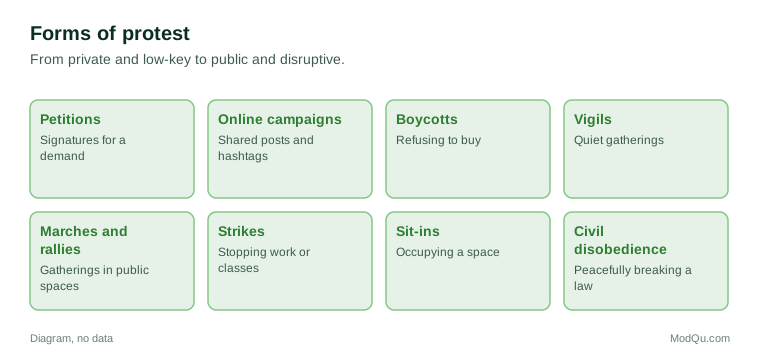
A protest is a public expression of objection, support or demand, usually aimed at governments, businesses or other institutions. Forms include:
- Marches and rallies: gatherings in public spaces with speeches, signs and chants.
- Vigils: quiet gatherings, often with candles, to mourn or show solidarity.
- Strikes and walkouts: workers or students stopping work or classes.
- Sit-ins and occupations: staying in a place to draw attention.
- Boycotts: refusing to buy from a company or country.
- Petitions: collecting signatures for a demand.
- Online campaigns: hashtags, shared posts and digital petitions.
- Civil disobedience: deliberately breaking a law peacefully to protest against it or against an injustice.
The figure below arranges these by how public and disruptive they are.
Why people protest
Common reasons include:
- opposing a law, policy or decision;
- supporting a cause such as workers' rights, the environment, peace or equality;
- responding to an event such as a police killing, a disaster or an election result;
- showing solidarity with people in another country;
- local issues such as a hospital closure, a new road or a factory;
- feeling that other channels, such as voting or contacting officials, have not worked.
Example
A group of parents organize a march after their town council announces it will close the only public swimming pool. About three hundred people take part, many for the first time. The council delays the closure and sets up a consultation.
Who takes part
Research in several countries suggests that people who protest are often more interested in politics, more connected to groups such as unions, student bodies or community organizations, and more likely to know other protesters. Younger people often take part more than older people, though some large protests draw people of all ages. Many people protest only once or twice in their lives, about an issue that affects them directly.
Example
A retired engineer had never joined a protest until a plan to build on a local nature reserve. He joins a weekly vigil at the site and helps write submissions to the planning authority. He says he is uncomfortable with chanting but feels he had to do something.
Why people stay away
Reasons for not protesting include:
- disagreeing with the cause or the methods;
- fear of violence, arrest or losing a job;
- lack of time, childcare or transport;
- health or disability;
- feeling that protests do not change anything;
- living in a place where protest is risky or banned.
The right to protest
International human rights law protects freedom of peaceful assembly and freedom of expression. Many national constitutions do the same. These rights are usually not absolute. Authorities may set conditions, for example on:
- the route, time and size of marches;
- noise and blocking of roads or buildings;
- protests near certain places such as hospitals, schools or parliaments;
- the need to notify police in advance;
- face coverings or the use of certain symbols.
How much protest is allowed, and how police respond, differs greatly between countries. In some, peaceful protest is widely tolerated; in others, protesters face arrest, fines or violence.
Effects of protest
Protests can raise awareness, change public opinion, pressure decision-makers and build movements. They can also have no visible effect, or lead to a backlash against the cause. Researchers debate which features make protests more effective, such as size, persistence, peaceful methods and links to other forms of action like voting and lobbying.
Example (hypothetical figures)
Over a year, a campaign holds 12 marches. Average turnout is 2,000 people, so total attendance is 24,000, though many attend more than once. The campaign's online petition gathers 85,000 signatures. The government agrees to review the policy after the petition passes a threshold that triggers a debate.
Disruption and public opinion
Some protests deliberately cause disruption, such as blocking roads, to gain attention. Public reactions differ: some people say disruption is necessary to be heard; others say it harms public support for the cause and affects people who are not responsible. Surveys often find that people support the right to protest in general more than they support particular disruptive tactics.
What people disagree about
- Where the limits of the right to protest should be.
- Whether disruptive tactics help or harm causes.
- How police should handle protests.
- Whether online campaigns are as effective as street protests.
- Whether workers should have the right to strike in essential services.
Why surveys ask about protest
Questions that media organizations, policy groups, universities and public bodies want answered include how many people have joined a protest, what about, what stops others, and whether people think protest rights should be widened or limited. Answers are grouped and every question can be skipped.
Protest and the workplace
Some people worry that taking part in a protest could affect their job, for example if they appear in photos or videos online. Rules on whether employers can act against staff for lawful protest outside work differ between countries. Public servants, police and members of the armed forces often face extra limits on political activity. Workers who strike usually do so under labour laws that set rules on ballots, notice and picketing; these rules vary widely. Some people prefer forms of protest, such as signing petitions or donating to campaigns, that keep their involvement less visible.
Key terms
- ProtestA public expression of objection, support or demand.
- DemonstrationA public gathering or march to express a view.
- Freedom of assemblyThe right to gather peacefully with others.
- Civil disobedienceDeliberately and peacefully breaking a law to protest.
- BoycottRefusing to buy from or deal with a company, product or country.
- StrikeWorkers stopping work to press demands.
- VigilA quiet gathering, often with candles, to mourn or show solidarity.
- Counter-protestA protest held to oppose another protest.
Full glossary: public affairs terms on EditingTests.com.
Protests and demonstrations vocabulary test
How well do you know the language of this topic? Try 8 quick questions. Your score is shown straight away and is not saved.
What the protests and demonstrations survey asks
This survey is part of ModQu's Politics and Current Affairs survey. The protests and demonstrations part takes about five minutes and covers:
- Whether you have joined a protest, march or demonstration.
- What it was about, and how you heard about it.
- Other forms of action you have taken, such as boycotts, strikes or petitions.
- What stops you from protesting, if anything.
- Whether you think protest rights should be widened, kept the same or limited.
- Your views on disruptive tactics and on how police handle protests.
After that you can choose to continue with other short parts of the Politics and Current Affairs survey, such as political engagement or trust in political parties, or stop.
Ready to take part?
Your answers help show what people really think and do. Results are only ever reported as totals; no one can see your individual answers.
Start the surveyQuestions about this survey
Who can take part?
Adults.
Do I have to give my name?
No. You may be asked for your age group, region and similar details so results can be broken down, but not your name. ModQu never asks for passwords, card numbers or account numbers.
How are the results used?
Answers are combined into totals and percentages and published in ModQu reports. Individual answers are never shown.
Is the vocabulary test part of the survey?
No. It is optional and separate, and your score is not stored.
Will the survey ask which protests I attended?
It asks about the topic in general terms. You never need to give dates, places or names.
Can I take part if I have never protested?
Yes. Views of people who have never protested are an important part of the results.