
Share how you follow political news
Tell us where you get political news, how often you check it and whether you sometimes avoid it. Your answers are combined with other people's and reported only as totals.
Start the following the news on politics surveyAbout 5 minutes. No account needed. You can stop at any time.
Where people get political news
Main sources of political news include:
- Television: national and local news bulletins, current affairs programmes and debates.
- Radio: news bulletins and phone-in programmes.
- Newspapers and magazines, in print and online.
- News websites and apps, including those of broadcasters and digital-only outlets.
- Social media, where people see news shared by outlets, politicians, journalists, friends and others.
- Video platforms and podcasts, including long interviews and commentary.
- Messaging apps, where news is shared in family and community groups.
- Conversations with family, friends and colleagues.
Most people use several sources. The mix depends on age, country, habits and interest.
How habits are changing
In many countries, the share of people who read printed newspapers has fallen, and television news audiences have aged. More people, especially younger adults, now get news first from social media, video and podcasts. Many people meet news "on the way" while doing something else online, rather than going to a news site on purpose.
Example
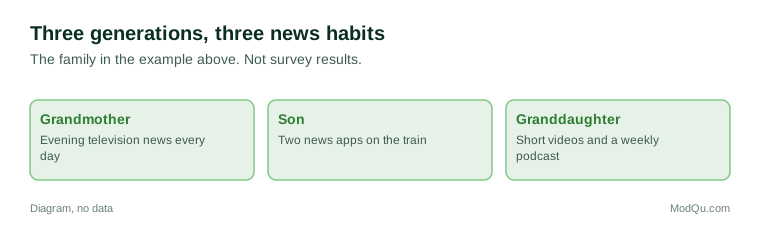
A grandmother watches the evening television news every day. Her son reads two news apps on the train. Her granddaughter follows politics mostly through short videos and a weekly podcast. When a major election result comes in, all three end up watching the same live broadcast together.
The figure below shows how one family's habits differ across three generations.
How often people check
Some people check political news several times a day; others once a week or less. Habits often change around major events such as elections, crises and scandals, when many people check much more often. Push notifications on phones mean some people receive news alerts whether they look for them or not.
Example (hypothetical figures)
A person tracks their news use for a week. They open news apps 21 times, spending an average of 4 minutes each time, or 84 minutes in total. They also watch 3 half-hour television bulletins, 90 minutes. Their total time with news is 174 minutes, just under 3 hours.
Why some people avoid political news
A growing number of people in many countries say they sometimes or often avoid the news, especially political news. Reasons include:
- it has a negative effect on their mood;
- there is too much of it;
- it is repetitive or focused on conflict;
- they feel powerless to change anything;
- they do not trust it;
- it leads to arguments with family or friends;
- it is hard to follow.
Some people avoid news only at certain times, such as before bed, or only certain topics.
Example
A nurse stops checking political news on weekdays after finding it made her anxious before shifts. She reads a weekly summary on Sunday mornings and says she feels better informed than when she checked constantly.
How people judge political news
People use different signals to decide whether to trust political news:
- the outlet's reputation and their own past experience with it;
- whether a story cites sources and evidence;
- whether other outlets report the same thing;
- who shared it and why;
- whether it separates fact from opinion;
- whether it seems designed to make them angry.
Misleading political content can spread quickly, especially during elections. Fact-checking organizations and some platforms add context or labels to false claims.
News and political views
What people watch and read can shape and reflect their political views. Some people choose sources that match their views; others try to read across the spectrum. Researchers debate how much news use changes opinions and how much people choose news that confirms what they already think.
Local and national news
Coverage of local politics has shrunk in many places as local newspapers have closed or cut staff. Some areas now have little or no local political reporting. New local websites, community radio and newsletters have filled gaps in some areas.
What people disagree about
- Whether social media is a good source of political news.
- Whether news focuses too much on conflict and personalities.
- Whether public broadcasters should be funded by the public.
- How to support local news.
- Whether avoiding the news is healthy or harmful to democracy.
Why surveys ask about following political news
Questions that media organizations, policy groups, universities and public bodies want answered include where people get political news, how often they check it, whether they avoid it and which sources they trust. Answers are grouped and every question can be skipped.
Political news during elections
Election campaigns bring a large rise in political coverage: debates, opinion polls, interviews, adverts and live results. Many people who rarely follow politics pay attention during these weeks. Others say campaign coverage is too focused on polls and personalities rather than policies. Some countries have rules on election coverage, such as equal airtime for parties on broadcast media, limits on political advertising, or a ban on publishing polls in the final days before voting. Online, political adverts may be targeted at particular groups, and some platforms publish libraries of political ads so that people can see who paid for them.
News for people with different needs
People with sight or hearing loss, people who read in a second language and people with limited internet access may find political news harder to follow. Subtitles, sign language, audio versions, plain-language summaries and news in several languages help reach more people. Public broadcasters in some countries are required to provide these services.
Key terms
- News sourceAn outlet or channel through which a person receives news.
- News avoidanceDeliberately avoiding news, sometimes or often.
- Push notificationAn alert sent to a phone by an app.
- Current affairsProgrammes or coverage that analyse news in depth.
- AlgorithmA set of rules a platform uses to decide what content to show.
- Fact-checkingChecking whether claims in news or by public figures are accurate.
- News desertAn area with little or no local news coverage.
- Incidental exposureComing across news while doing something else online.
Full glossary: broadcast news terms on EditingTests.com.
Following the news on politics vocabulary test
How well do you know the language of this topic? Try 8 quick questions. Your score is shown straight away and is not saved.
What the following the news on politics survey asks
This survey is part of ModQu's Politics and Current Affairs survey. The following the news on politics part takes about five minutes and covers:
- Where you get political news.
- How often you check it.
- Whether you sometimes avoid political news, and why.
- Which sources you trust most and least.
- How you check whether a political story is true.
- Whether you follow local as well as national politics in the news.
After that you can choose to continue with other short parts of the Politics and Current Affairs survey, such as political engagement or trust in political parties, or stop.
Ready to take part?
Your answers help show what people really think and do. Results are only ever reported as totals; no one can see your individual answers.
Start the surveyQuestions about this survey
Who can take part?
Adults.
Do I have to give my name?
No. You may be asked for your age group, region and similar details so results can be broken down, but not your name. ModQu never asks for passwords, card numbers or account numbers.
How are the results used?
Answers are combined into totals and percentages and published in ModQu reports. Individual answers are never shown.
Is the vocabulary test part of the survey?
No. It is optional and separate, and your score is not stored.
Will I be asked which news outlets I use?
Questions mostly ask about kinds of source, such as television or social media. Naming outlets is optional.
Can I take part if I never follow political news?
Yes. People who avoid political news are an important part of the results.