
Share your views on local politics
Tell us whether you know your local representative, whether you voted in your last local election and which local issue matters most to you. Your answers are combined with other people's and reported only as totals.
Start the local politics surveyAbout 5 minutes. No account needed. You can stop at any time.
What local government does
Local government is the level of government closest to residents. Its name and powers differ between countries: city or town councils, municipalities, districts, counties, communes or boroughs. Some countries have several layers. Services often provided or overseen locally include:
- rubbish and recycling collection;
- local roads, street lighting and pavements;
- parks, libraries, sports centres and community halls;
- planning permission for buildings and land use;
- local public transport;
- water and sewage, in some countries;
- schools, social care, public health and housing, in some countries;
- local policing and fire services, in some countries;
- business licences, markets and local events.
How local government is funded
Funding usually comes from a mix of local taxes, such as property taxes; fees and charges, such as parking and permits; and grants or shared taxes from national or regional governments. How much freedom councils have to raise money and decide spending varies widely. When national funding is cut or local costs rise, councils may raise local taxes or reduce services.
Example (hypothetical figures)
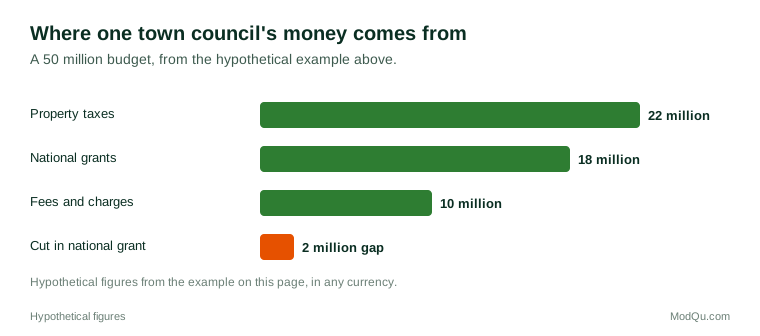
A town council has a budget of 50 million. It receives 22 million from property taxes, 18 million from national grants and 10 million from fees and charges. When the national grant is cut by 2 million, the council must raise local taxes, raise fees, cut services or use reserves to fill the gap.
The figure below charts these hypothetical figures.
Local representatives
Residents are usually represented by elected councillors, aldermen or similar officials, and in many places by an elected or appointed mayor. Representatives hold meetings, vote on budgets and plans, and help residents with problems. Many people do not know the name of their local representative, even though local decisions affect daily life.
Example
A man complains for months about a broken streetlight on his road by calling the main council number. A neighbour suggests emailing their local councillor directly. The councillor visits, reports the fault to the right department and the light is fixed within two weeks.
Local elections
Local elections choose councillors and, in some places, mayors. They may be held on the same day as national elections or separately. Turnout at separate local elections is often lower than at national ones in many countries. Reasons people give include:
- not knowing when the election is;
- not knowing who the candidates are or what they stand for;
- thinking local government has little power;
- less media coverage than national elections;
- local candidates not standing for national parties, which makes choices less familiar.
Taking part in local decisions
Beyond voting, residents can take part in local decisions by:
- attending or watching council meetings;
- responding to consultations on plans and budgets;
- joining residents' associations or neighbourhood groups;
- taking part in participatory budgeting, where residents vote on how part of a budget is spent;
- commenting on planning applications;
- volunteering on local boards and committees;
- contacting representatives about problems.
Example
A city sets aside part of its budget for residents to decide on. Neighbourhood groups propose projects, and residents vote online and at libraries. A group of teenagers proposes new lighting and seating at a skate park, which wins enough votes to be built.
Local issues people care about
Issues that often matter most locally include:
- housing costs and new developments;
- roads, traffic and parking;
- public transport;
- crime and safety;
- cleanliness, rubbish and recycling;
- schools and childcare;
- parks and green spaces;
- local taxes and how money is spent;
- local jobs and high streets.
Local news and information
Local news outlets have declined in many places, which can make it harder for residents to follow council decisions. Some councils publish meetings online, send newsletters or use social media. Community groups, local websites and neighbourhood messaging groups also share information, though quality varies.
Trust in local government
In many countries, people trust local government more than national government, perhaps because it is closer and more visible. Trust can fall when services decline, local taxes rise or decisions seem to ignore residents.
What people disagree about
- How much power should be held locally rather than nationally.
- Whether local elections should be held with national ones to raise turnout.
- Whether mayors should be directly elected.
- How to balance new housing with local concerns.
- How much residents should decide directly through participatory budgeting.
Why surveys ask about local politics
Questions that media organizations, policy groups, universities and local and national governments want answered include whether people know their local representative, whether they vote in local elections, how they take part and which local issues matter most. Answers are grouped and every question can be skipped.
Local politics in cities and rural areas
Local politics can look very different in a large city and a small village. Big cities may have powerful mayors, large budgets and professional councillors, while small communities may rely on part-time or unpaid representatives who are well known to residents. Rural councils often deal with issues such as roads, farm land, local schools and the loss of services such as banks and shops. City councils often focus on housing, transport, policing and pollution. In both, residents tend to know more about decisions that affect their own street or neighbourhood than about the council's wider plans.
Key terms
- Local governmentThe level of government closest to residents, such as a city or town council.
- CouncillorAn elected member of a local council.
- MayorThe head of a local government, elected or appointed depending on the place.
- MunicipalityA city, town or district with its own local government.
- Participatory budgetingA process in which residents decide how part of a public budget is spent.
- Planning permissionApproval from local government to build or change the use of land or buildings.
- Property taxA local tax based on the value of land or buildings.
- Public consultationA process in which a government asks residents for views before deciding.
Full glossary: local government administration terms on EditingTests.com.
Local politics vocabulary test
How well do you know the language of this topic? Try 8 quick questions. Your score is shown straight away and is not saved.
What the local politics survey asks
This survey is part of ModQu's Politics and Current Affairs survey. The local politics part takes about five minutes and covers:
- Whether you know who your local representative is.
- Whether you voted in your last local election, and why or why not.
- How you have taken part in local decisions, if at all.
- Which local issue matters most to you.
- How satisfied you are with local services.
- How you follow news about your local council.
After that you can choose to continue with other short parts of the Politics and Current Affairs survey, such as political engagement or trust in political parties, or stop.
Ready to take part?
Your answers help show what people really think and do. Results are only ever reported as totals; no one can see your individual answers.
Start the surveyQuestions about this survey
Who can take part?
Adults.
Do I have to give my name?
No. You may be asked for your age group, region and similar details so results can be broken down, but not your name. ModQu never asks for passwords, card numbers or account numbers.
How are the results used?
Answers are combined into totals and percentages and published in ModQu reports. Individual answers are never shown.
Is the vocabulary test part of the survey?
No. It is optional and separate, and your score is not stored.
Will the survey ask for my address?
No. It may ask about your general region or the size of your community so results can be grouped, never your address.
Can I take part if I do not vote locally?
Yes. Views of people who do not vote are an important part of the results.