
Inquiry · Public and formal inquiry
Facilitating Inquiry in High-Stakes or Politicized Environments
When stakes are high or a question has become political, inquiry is distorted by motivated reasoning, group pressure and fear. This article explains how those pressures work, what research shows about countering them, and practical methods for facilitating honest inquiry when people disagree sharply about the answer.
Some questions can be investigated calmly. Others arrive surrounded by pressure. A company must decide whether a product is safe after a run of complaints. A board must judge whether a major acquisition is failing. A city must choose whether to close a hospital, and every option will anger someone. In such settings the people involved often have reputations, jobs, money or deeply held values riding on the answer, and many have decided what the answer should be before the evidence is examined. Facilitating inquiry in these conditions is harder than in ordinary research, because the main threats to good reasoning come not from a lack of data but from the people and the pressures around it. This article explains how high stakes and politicisation distort inquiry and describes methods, supported by research, that help groups reason honestly when the temperature is high.
What makes an environment high-stakes or politicised
An inquiry becomes high-stakes when its outcome has serious consequences for the people involved: a decision that cannot easily be reversed, large sums of money, risks to health or safety, or accountability for past failure. It becomes politicised when positions on the question have become tied to group identity, so that agreeing or disagreeing with a conclusion signals loyalty to a side. The two conditions often occur together.
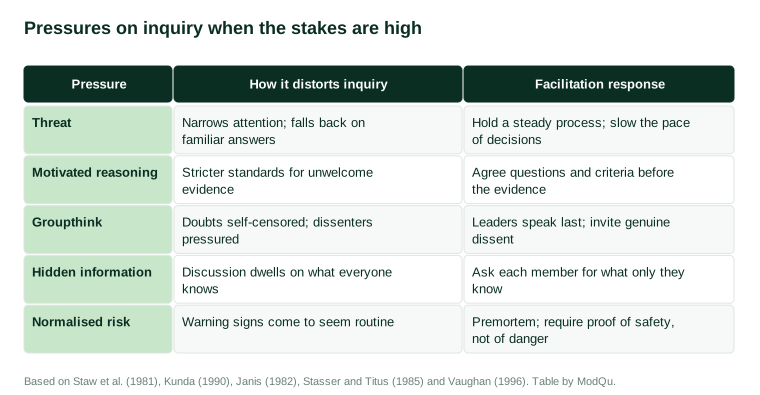
Both conditions change how people think. Barry Staw, Lance Sandelands and Jane Dutton (1981) reviewed research at the level of individuals, groups and organisations and described a threat-rigidity effect: when people and organisations perceive a threat, they tend to restrict the information they attend to, rely on familiar responses and concentrate control in fewer hands.
How pressure distorts inquiry
Motivated reasoning
Ziva Kunda (1990) reviewed evidence that people's goals shape their reasoning. When people want to reach a particular conclusion, they search memory and evidence selectively, apply stricter standards to unwelcome information and construct justifications that feel objective to them.
The classic demonstration is a study by Charles Lord, Lee Ross and Mark Lepper (1979). Supporters and opponents of capital punishment read descriptions of two studies, one appearing to support and one appearing to undermine the deterrent effect of the death penalty. Each side rated the study that agreed with its view as more convincing and found flaws in the other. After reading the same mixed evidence, both sides reported holding their original views more strongly. Charles Taber and Milton Lodge (2006) found similar patterns in political arguments: participants judged arguments that matched their prior views as stronger, spent more time arguing against those that did not, and, when free to choose, sought out information that confirmed what they already thought. These effects were strongest among the most politically knowledgeable participants.
Skill does not protect against motivated reasoning and may even amplify it. Kahan et al. (2017) gave participants a problem that required interpreting the results of a hypothetical experiment. When the experiment concerned a skin cream, more numerate participants were more likely to reach the correct answer. When the same numbers were presented as evidence about gun control, numerate participants were correct mainly when the right answer agreed with their political views.
Group pressure
Groups add pressures of their own. Irving Janis (1982) studied policy failures, including the Bay of Pigs invasion, and described groupthink: a mode of thinking in cohesive groups in which the desire for unanimity overrides realistic appraisal of alternatives. Its symptoms include an illusion of invulnerability, self-censorship of doubts, pressure on dissenters and the emergence of members who shield the group from unwelcome information.
Even without strong conformity pressure, groups tend to waste the information their members hold. Garold Stasser and William Titus (1985) asked groups to choose between candidates after members had read profiles in which some information was shared by all and some was held by only one person. Discussion focused on information everyone already had, and groups often failed to discover that the best candidate became clear only when the unshared information was pooled.
Discussion among the like-minded can also push groups further apart. Cass Sunstein (2002) reviewed evidence that when people deliberate mainly with others who share their views, the group typically moves towards a more extreme version of the position its members began with.
The normalisation of risk
Over time, pressure can change what an organisation treats as normal. Diane Vaughan (1996) reconstructed the decisions that led to the loss of the space shuttle Challenger in 1986. Engineers had repeatedly observed erosion of the seals in the rocket boosters on earlier flights, but because flights had succeeded, each deviation was gradually reclassified as an acceptable risk. Vaughan called this the normalisation of deviance. The Columbia Accident Investigation Board (2003), reporting on the loss of Columbia in 2003, concluded that similar organisational patterns had persisted: damage from falling foam had been seen on earlier missions and come to be treated as routine, and engineers' requests for images of the damaged wing were not acted on. In both cases, schedule pressure and a culture that required engineers to prove danger, rather than managers to prove safety, kept troubling evidence from receiving full scrutiny.
Figure 1 summarises these pressures and the facilitation responses that the rest of this article describes.
The facilitator's role
The person leading a contested inquiry, whether an external facilitator, an internal analyst or a chair, needs a clear view of their role. Roger Pielke (2007) distinguished four roles that experts can play in policy. A pure scientist provides knowledge without regard to the decision; a science arbiter answers specific factual questions put by decision makers; an issue advocate argues for a particular course of action; and an honest broker of policy alternatives clarifies and expands the range of options, setting out what the evidence implies for each. In politicised settings, Pielke argued, the honest broker is especially valuable, because advocacy disguised as neutral expertise damages the credibility of evidence for everyone.
Neutrality in this sense applies to the process, not to the evidence. A facilitator should not take sides on the conclusion, but should be firm about the rules by which evidence is gathered, examined and weighed. Ronald Heifetz (1994) described the leader's task in contested, adaptive problems as maintaining a holding environment: a setting in which people can face difficult questions without being overwhelmed, with the pressure kept high enough for work to happen but not so high that people retreat into defence.
Practices that help
Agree the question and the criteria before the evidence
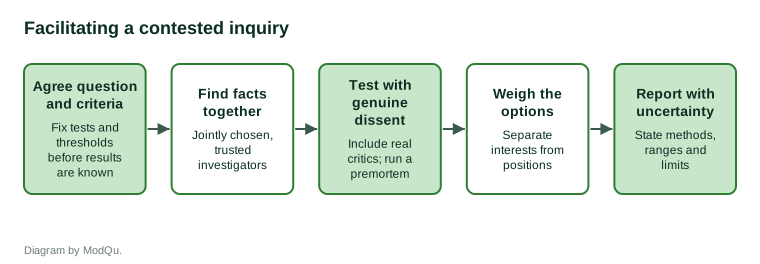
The most effective safeguard against motivated reasoning is to settle how evidence will be judged before anyone knows what it shows. Parties can agree in advance on the question, the data that will be examined, the methods of analysis and the thresholds that would justify each decision. Once these are fixed, it is much harder to discard an inconvenient result by questioning the method after the fact. Jennifer Lerner and Philip Tetlock (1999) reviewed research on accountability and found that it improves judgment mainly when people know before forming a view that they will have to justify their reasoning to an audience whose own views are unknown. When people know what the audience wants to hear, accountability tends to produce conformity instead. A facilitator can use this finding by making participants accountable for the quality of their process rather than for reaching any particular conclusion.
Separate interests from positions
Roger Fisher and William Ury (1981), in their work on principled negotiation, advised focusing on interests rather than positions, inventing options for mutual gain and insisting on objective criteria. A position is what someone says they want; an interest is the reason they want it. Two departments arguing over whether to withdraw a product may share an interest in protecting customers and the company's reputation, while differing in their estimates of the risk.
Find the facts together
Lawrence Susskind and Jeffrey Cruikshank (1987) described consensus-building approaches to public disputes in which the parties, rather than each commissioning its own experts, work together to define the technical questions, select investigators they all trust and review the results jointly. When each side brings its own study, the result is often a contest between experts that settles nothing. When the sides design the inquiry together, they are more likely to accept its findings, including findings they would not have chosen.
Researchers have adopted a similar approach to scientific disputes. Mellers et al. (2001) described an adversarial collaboration in which researchers who disagreed about a phenomenon agreed in advance on experiments that could settle the question, with a neutral arbiter. Daniel Kahneman and Gary Klein (2009), who came from opposing traditions in the study of expert intuition, worked together to identify the conditions under which intuitive judgments can be trusted. They found more agreement than either expected, and their joint conclusion carried more weight than either could have achieved alone.
Make dissent safe and genuine
Inquiry fails when people with relevant concerns do not speak. Amy Edmondson (1999) showed that teams learn more when members believe they can raise problems and admit mistakes without being punished, a condition she called psychological safety. In high-stakes settings, facilitators need to create this deliberately: by inviting concerns explicitly, protecting those who raise them, and having senior people withhold their own views until others have spoken, as Janis (1982) recommended.
Dissent must also be real to be useful. Nemeth et al. (2001) compared groups exposed to a person who genuinely disagreed with groups exposed to someone assigned to play devil's advocate. Authentic dissent stimulated more original thinking, while role-played dissent was less effective and could even lead people to bolster their initial view. Schulz-Hardt et al. (2006) found that groups whose members began with differing preferences were more likely to discover the best solution in a hidden-profile task, even when the dissenting members favoured the wrong option, because disagreement prompted more thorough discussion of the evidence. The lesson for facilitators is to seek out and include people who actually hold different views, rather than to simulate disagreement.
Imagine failure in advance
Gary Klein (2007) proposed the premortem. Before a decision is finalised, the group imagines that it has been implemented and has failed badly, and each member writes down the reasons why. Because the failure is presented as having already happened, the exercise gives people permission to voice doubts that would otherwise seem disloyal. In politicised settings, a premortem can be run for each option under consideration, so that no side's preferred course escapes scrutiny.
Reduce threats to identity
When a question has become tied to identity, accepting unwelcome evidence can feel like betraying one's group. Cohen et al. (2000) found that people evaluated evidence on contested issues, including capital punishment, more even-handedly after a self-affirmation exercise in which they reflected on a value important to them that was unrelated to the issue. Feeling secure in their identity made them more open to information that challenged their position. Facilitators can apply the principle informally: acknowledging the legitimate values behind each position, avoiding language that frames the inquiry as a contest between sides, and allowing people to change their minds without losing face.
Use deliberative designs
When a question involves a wider public, deliberative methods can counter polarisation. James Fishkin (2009) described deliberative polling, in which a random sample of citizens receives balanced briefing materials, discusses the issue in small moderated groups and questions experts from different perspectives. Participants' views often shift after deliberation, and they become better informed.
Figure 2 brings these practices together as a sequence for facilitating a contested inquiry.
Communicating contested findings
The final stage is reporting. In politicised settings, findings will be read by people looking for reasons to reject them. Clear statements of method, honest ranges of uncertainty and explicit acknowledgement of what the inquiry could not establish make a report harder to dismiss. Early research raised concern that correcting false beliefs might backfire: Nyhan and Reifler (2010) found that corrections of political misperceptions sometimes failed to reduce them and, among the most strongly committed, occasionally strengthened them. Later and larger studies have been more encouraging. Wood and Porter (2019) tested corrections on dozens of issues with more than 10,000 participants and found that backfire effects were rare; factual corrections generally moved beliefs towards accuracy, even among those predisposed to resist them.
An example
The following example is hypothetical. A consumer products company receives a cluster of complaints that a kitchen appliance overheats. The product team, which launched the appliance, believes the complaints reflect misuse; the quality team, which raised concerns before launch, believes there is a design fault. Senior leaders are divided, and the company's reputation is at stake.
A facilitator first meets each group separately to understand its interests: both want to protect customers and the brand, but the product team fears an unnecessary recall and the quality team fears a preventable injury. The facilitator then brings them together to agree the questions, the tests and the thresholds in advance: what failure rate under normal use would require a recall, and what evidence would show misuse. An independent laboratory, chosen jointly, carries out the tests. Before the results arrive, the group runs a premortem on both options, recall and no recall. When the results show a failure rate under normal use slightly above the agreed threshold for one production batch only, both sides accept a targeted recall.
Limits
These methods do not remove conflict, and some disputes are about values that no amount of evidence can resolve. Facilitation also depends on the willingness of those with power to accept findings they dislike; where a powerful party is determined to reach a fixed conclusion, process alone cannot prevent it.
Conclusion
High stakes and politicisation threaten inquiry by turning reasoning into advocacy and groups into camps. Research on motivated reasoning, groupthink, hidden information and organisational failure shows how predictable these distortions are. It also shows what helps: agreeing on questions and criteria before the evidence, separating interests from positions, investigating facts jointly, making dissent safe and genuine, imagining failure in advance, reducing threats to identity and reporting with candour about uncertainty. The aim is a process fair and rigorous enough that people who care deeply can still reach a conclusion they trust.
References
Cohen, G. L., Aronson, J., & Steele, C. M. (2000). When beliefs yield to evidence: Reducing biased evaluation by affirming the self. Personality and Social Psychology Bulletin, 26(9), 1151–1164. https://doi.org/10.1177/01461672002611011
Columbia Accident Investigation Board. (2003). Report of the Columbia Accident Investigation Board (Vol. 1). National Aeronautics and Space Administration.
Edmondson, A. (1999). Psychological safety and learning behavior in work teams. Administrative Science Quarterly, 44(2), 350–383. https://doi.org/10.2307/2666999
Fisher, R., & Ury, W. (1981). Getting to yes: Negotiating agreement without giving in. Houghton Mifflin.
Fishkin, J. S. (2009). When the people speak: Deliberative democracy and public consultation. Oxford University Press.
Heifetz, R. A. (1994). Leadership without easy answers. Belknap Press of Harvard University Press.
Janis, I. L. (1982). Groupthink: Psychological studies of policy decisions and fiascoes (2nd ed.). Houghton Mifflin.
Kahan, D. M., Peters, E., Dawson, E. C., & Slovic, P. (2017). Motivated numeracy and enlightened self-government. Behavioural Public Policy, 1(1), 54–86. https://doi.org/10.1017/bpp.2016.2
Kahneman, D., & Klein, G. (2009). Conditions for intuitive expertise: A failure to disagree. American Psychologist, 64(6), 515–526. https://doi.org/10.1037/a0016755
Klein, G. (2007). Performing a project premortem. Harvard Business Review, 85(9), 18–19.
Kunda, Z. (1990). The case for motivated reasoning. Psychological Bulletin, 108(3), 480–498. https://doi.org/10.1037/0033-2909.108.3.480
Lerner, J. S., & Tetlock, P. E. (1999). Accounting for the effects of accountability. Psychological Bulletin, 125(2), 255–275. https://doi.org/10.1037/0033-2909.125.2.255
Lord, C. G., Ross, L., & Lepper, M. R. (1979). Biased assimilation and attitude polarization: The effects of prior theories on subsequently considered evidence. Journal of Personality and Social Psychology, 37(11), 2098–2109. https://doi.org/10.1037/0022-3514.37.11.2098
Mellers, B., Hertwig, R., & Kahneman, D. (2001). Do frequency representations eliminate conjunction effects? An exercise in adversarial collaboration. Psychological Science, 12(4), 269–275. https://doi.org/10.1111/1467-9280.00350
Nemeth, C., Brown, K., & Rogers, J. (2001). Devil's advocate versus authentic dissent: Stimulating quantity and quality. European Journal of Social Psychology, 31(6), 707–720. https://doi.org/10.1002/ejsp.58
Nyhan, B., & Reifler, J. (2010). When corrections fail: The persistence of political misperceptions. Political Behavior, 32(2), 303–330. https://doi.org/10.1007/s11109-010-9112-2
Pielke, R. A., Jr. (2007). The honest broker: Making sense of science in policy and politics. Cambridge University Press. https://doi.org/10.1017/CBO9780511818110
Schulz-Hardt, S., Brodbeck, F. C., Mojzisch, A., Kerschreiter, R., & Frey, D. (2006). Group decision making in hidden profile situations: Dissent as a facilitator for decision quality. Journal of Personality and Social Psychology, 91(6), 1080–1093. https://doi.org/10.1037/0022-3514.91.6.1080
Stasser, G., & Titus, W. (1985). Pooling of unshared information in group decision making: Biased information sampling during discussion. Journal of Personality and Social Psychology, 48(6), 1467–1478. https://doi.org/10.1037/0022-3514.48.6.1467
Staw, B. M., Sandelands, L. E., & Dutton, J. E. (1981). Threat-rigidity effects in organizational behavior: A multilevel analysis. Administrative Science Quarterly, 26(4), 501–524. https://doi.org/10.2307/2392337
Sunstein, C. R. (2002). The law of group polarization. Journal of Political Philosophy, 10(2), 175–195. https://doi.org/10.1111/1467-9760.00148
Susskind, L., & Cruikshank, J. (1987). Breaking the impasse: Consensual approaches to resolving public disputes. Basic Books.
Taber, C. S., & Lodge, M. (2006). Motivated skepticism in the evaluation of political beliefs. American Journal of Political Science, 50(3), 755–769. https://doi.org/10.1111/j.1540-5907.2006.00214.x
Vaughan, D. (1996). The Challenger launch decision: Risky technology, culture, and deviance at NASA. University of Chicago Press.
Wood, T., & Porter, E. (2019). The elusive backfire effect: Mass attitudes' steadfast factual adherence. Political Behavior, 41(1), 135–163. https://doi.org/10.1007/s11109-018-9443-y