
Inquiry · Public and formal inquiry
From Personal Inquiry to Public Knowledge: Pathways of Legitimation and Dissemination
A finding that convinces one researcher is not yet knowledge. This article explains how private inquiry becomes public knowledge through sharing, criticism, publication, replication and uptake, what research shows about the strengths and weaknesses of each step, and what this means for anyone who wants their findings to be trusted and used.
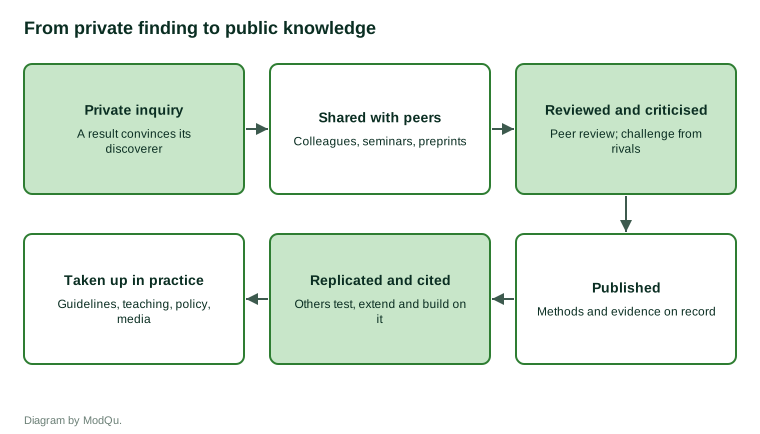
Every piece of public knowledge began as something one person or one team believed. A chemist sees an unexpected reaction; an analyst notices a pattern in customer data; a historian finds a letter that changes the accepted account of an event. At that moment, the finding is private. It may be correct or mistaken, and no one else has had a chance to check. For it to become public knowledge, something others can rely on, teach and act on, it must pass through a series of steps in which it is shared, examined, criticised, recorded and tested. Sociologists and historians of science have studied these steps in detail. Their work shows that public knowledge is not simply discovered and announced, but made credible through social processes that have both strengths and weaknesses. This article traces the pathway from personal inquiry to public knowledge and draws out lessons for anyone who wants their findings to be trusted and used.
Why private conviction is not enough
Individual inquirers, however careful, are subject to errors they cannot easily detect in themselves: mistaken assumptions, unnoticed flaws in method, wishful interpretation of ambiguous results. The philosopher Michael Polanyi (1962) described science as a "republic" in which each scientist's work is judged by others with relevant expertise, so that the community as a whole maintains standards that no individual could maintain alone. Naomi Oreskes (2019) argued that the trustworthiness of science comes not from any special method used by individual scientists but from the social processes by which their claims are critically examined by a diverse community. A claim becomes reliable because it has survived scrutiny from people with different perspectives and an interest in finding its flaws.
Robert Merton (1973), in an essay first published in 1942, described four norms that he believed governed the scientific community: communalism, the sharing of findings as common property; universalism, the evaluation of claims by impersonal criteria rather than by who made them; disinterestedness, the subordination of personal interest to the advancement of knowledge; and organised scepticism, the suspension of judgement until claims have been examined. Later research showed that scientists often fall short of these norms, but they describe the ideals against which the legitimacy of public knowledge is judged.
The pathway
Figure 1 sets out a simplified pathway from private finding to public knowledge. In practice, the steps overlap and loop back, and many findings fall away at each stage.
Sharing with peers
The first step is usually informal: describing the finding to colleagues, presenting it at a seminar or circulating a draft. This early exposure often reveals problems the inquirer had missed. Bruno Latour and Steve Woolgar (1979), in an ethnographic study of a biology laboratory, showed how claims were gradually strengthened or weakened through conversation, argument and the accumulation of supporting evidence before they reached print. A statement such as "X may be related to Y" could, through this process, become "X causes Y", and eventually a fact so taken for granted that it was no longer attributed to anyone.
Today, many fields share findings publicly at this stage through preprints, papers posted online before peer review. Preprints speed up the circulation of findings and allow wider early criticism, but they also allow unreviewed findings to reach the public and the media before they have been checked.
Review and criticism
The most formal step of legitimation is peer review, in which experts evaluate a manuscript before it is published. Harriet Zuckerman and Robert Merton (1971) studied the history and operation of peer review and described it as the central institution by which the scientific community certifies knowledge. Its origins lie in the seventeenth century, when the Royal Society began to publish Philosophical Transactions and to assess submissions before printing them.
The evidence on peer review is mixed. Richard Smith (2006), a former editor of the BMJ, argued that peer review is slow, expensive, inconsistent and poor at detecting errors and fraud. Peters and Ceci (1982) resubmitted twelve already-published psychology articles to the journals that had published them, with the authors' names and institutions changed to less prestigious ones. Only three of the resubmissions were recognised, and eight of the remaining nine were rejected, often for serious methodological flaws. Michael Mahoney (1977) found that reviewers rated identical manuscripts more favourably when the results supported their own theoretical views. Peer review nevertheless remains the main mechanism for filtering claims before they enter the published record, and most researchers believe it improves the work they submit.
Publication
Publication fixes a claim in a public record, with its methods and evidence available for others to examine. Steven Shapin and Simon Schaffer (1985), in their study of the seventeenth-century experiments of Robert Boyle, showed how detailed written reports allowed readers who had not been present to act as "virtual witnesses" of experiments, and so to judge the claims for themselves. The scientific paper, with its methods section and its references to earlier work, developed as a technology for making private inquiry publicly checkable.
The public record is also selective. Journals have long preferred positive, novel results, and authors respond by submitting them. Daniele Fanelli (2012) examined more than 4,600 papers published between 1990 and 2007 across disciplines and countries and found that the frequency of papers reporting support for the tested hypothesis grew by more than 22% over the period, so that by the end a large majority of published tests reported positive results. Findings that fail to confirm a hypothesis are less likely to be written up, submitted or accepted, so the published literature can make an effect look more consistent than it is. The volume of the record adds a further difficulty. Lutz Bornmann and Rüdiger Mutz (2015) traced the growth of the scientific literature through cited references and identified phases of increasingly rapid expansion, with growth rates of less than 1% a year before the mid-eighteenth century, 2–3% up to the interwar period and 8–9% a year in the most recent phase. No reader can follow more than a small fraction of it, which increases reliance on summaries, reviews and reputation.
Replication and citation
Publication is not the end of the process. Findings that matter are tested by others, extended and built upon. Derek de Solla Price (1965) studied networks of citations between scientific papers and showed how knowledge accumulates as new papers build on a relatively small set of recent, highly cited work. Citation is one sign that a finding has been accepted into the shared body of knowledge.
Recognition is not distributed evenly. Merton (1968) described the Matthew effect: eminent scientists receive disproportionate credit for work done jointly or simultaneously with less well-known colleagues, and their papers attract more attention. This means that the legitimacy of a claim can depend partly on who made it, contrary to the norm of universalism.
Replication is the most demanding test. The Open Science Collaboration (2015) attempted to replicate 100 studies published in leading psychology journals and found that fewer than half produced statistically significant results the second time. Similar efforts in other fields have produced similar findings. The lesson is that publication, even after peer review, is a provisional step in legitimation; confidence in a finding should grow as it is independently confirmed. John Ioannidis (2005) explained on statistical grounds why this caution is warranted: when studies are small, effects are modest, many hypotheses are tested and researchers have flexibility in analysis, a large share of published positive findings can be expected to be false. A single published study is best treated as a promising lead rather than a settled fact.
Uptake in practice
Finally, knowledge must reach those who can use it: practitioners, policymakers, businesses and the public. Carol Weiss (1979) distinguished several ways in which research is used in policy. Sometimes it directly solves a defined problem, but more often it works through enlightenment, gradually changing how decision makers understand an issue. Everett Rogers (2003) studied the diffusion of innovations and found that new ideas spread through social networks over time, adopted first by a small group of innovators and only later by the majority, depending on their perceived advantages, compatibility with existing practice and visibility.
Resistance to new knowledge
The pathway does not treat all claims equally. Findings that fit existing understanding pass through it easily, while findings that challenge it meet resistance. Thomas Kuhn (1962) argued that most research takes place within a paradigm, a shared set of assumptions, methods and exemplary problems. Results that do not fit the paradigm are at first treated as errors or anomalies, and only when anomalies accumulate does a community consider replacing its framework. Bernard Barber (1961) documented resistance by scientists themselves to discoveries that later became accepted, citing cases in which new ideas were rejected because of established theories, methodological preferences, religious beliefs, the low professional standing of the discoverer or the specialism from which the idea came. Mahoney's (1977) experiment, described above, showed the same tendency in miniature: reviewers judged identical methods more favourably when the results agreed with their own views.
Resistance is not always a fault. Most claims that contradict well-established knowledge turn out to be wrong, and a community that accepted every challenge would have no stable body of knowledge at all. The difficulty is that the same caution that filters out error also delays genuine advances. A healthy pathway makes it possible for a challenging finding to be heard, tested and, if it survives, accepted, even when it comes from an unexpected source.
Who counts as an expert?
The pathway to public knowledge passes through communities that decide who is qualified to judge. Thomas Gieryn (1983) described boundary-work: the ways in which scientists draw lines between science and non-science, to claim authority and exclude rivals. Such boundaries can protect standards, but they can also exclude valid knowledge held by people outside the profession. Harry Collins and Robert Evans (2007) proposed distinguishing types of expertise, including the contributory expertise of those who practise a field and the interactional expertise of those who understand it well enough to discuss it fluently, and argued that public decisions should draw on genuine expertise wherever it lies, including outside formal institutions. Sheila Jasanoff (1990) studied scientific advisory committees in government and showed how the boundary between science and policy is negotiated, with scientific advice gaining legitimacy partly through the procedures by which it is produced.
Communicating to the public
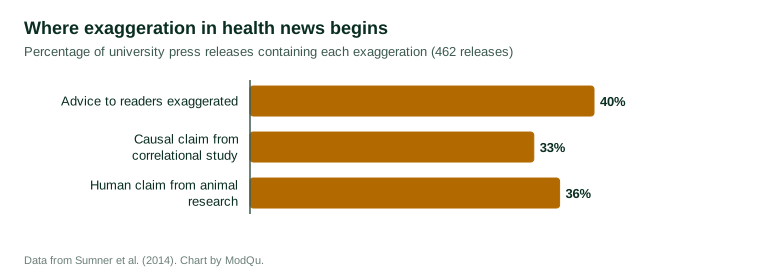
As findings move from specialist to public audiences, they change. Jeanne Fahnestock (1986) compared scientific papers with popular accounts of the same findings and found that popular accounts tended to remove qualifications, emphasise the novelty and certainty of findings and stress their practical significance. Sumner et al. (2014) analysed press releases issued by leading universities about health research and the news stories based on them. They found that a substantial proportion of press releases already contained exaggerations, such as advice to readers that went beyond the study, causal claims from correlational studies and claims about humans based on animal research. Figure 2 shows the results. When press releases exaggerated, news stories were much more likely to do so as well.
The speed at which claims spread also differs. Vosoughi et al. (2018) studied the spread of true and false news stories on a major social media platform and found that false stories spread further, faster and more widely than true ones, apparently because they were more novel and provoked stronger emotional reactions. The checks that operate within research communities do not operate in the same way in public communication.
Once a claim has spread, correcting it is difficult. Lewandowsky et al. (2012) reviewed research on misinformation and found that retractions rarely eliminate the influence of a false claim. People continue to rely on information they know to have been corrected, especially when the correction leaves a gap in their understanding of events. Corrections work better when they explain why the original claim was wrong, offer an alternative account to replace it and avoid repeating the false claim more than necessary. The implication for anyone disseminating findings is that accuracy at the first release matters more than the ability to issue a correction later.
Strengthening the pathway
In response to concerns about reliability, many research communities have adopted practices designed to make the pathway more robust. Nosek et al. (2015) proposed standards for transparency and openness, including sharing data, code and materials, pre-registering studies and encouraging replication. These practices make it easier for others to check findings at each stage, shifting legitimation from trust in the author or journal towards direct examination of the evidence. John Ziman (2000) argued that science works best when it combines open communication with critical scrutiny, and that changes in how research is funded and managed can weaken both.
Lessons for organisations
The pathway from private finding to public knowledge has a direct parallel inside organisations. An analyst's finding becomes organisational knowledge only when it is shared, checked, documented and acted upon. The same strengths and weaknesses apply. Inside a company, the stages are usually informal. Sharing with peers may be a conversation at a desk; review may be a manager's quick read; publication may be a slide deck circulated by email; and replication is often skipped altogether. Each shortcut saves time, but each also removes a check. The parallels to the problems described above are close. Internal reports are selective, because analyses that found nothing are rarely presented. Summaries lose their qualifications as they move up the organisation, so that "a modest association in one region" becomes "the app drives sales". Findings from senior or well-known staff are accepted more readily than those from newer colleagues, and findings that challenge an established strategy meet more resistance than those that support it.
None of this requires a formal publication system to fix. It requires that the organisation recognise the pathway its findings already travel and add a small number of deliberate checks at the points where errors most often enter. The practices below are drawn from the research described in this article.
- Share early. Present findings to colleagues before they are final. Early criticism is cheaper than later correction.
- Seek challenge. Ask someone with relevant expertise and no stake in the result to review the work.
- Document methods. A finding whose methods are recorded can be checked and repeated; one that exists only in a slide deck cannot.
- Replicate before relying. Test important findings again, with new data, before building major decisions on them.
- Communicate with care. Preserve qualifications and uncertainty when summarising findings for decision makers. Exaggeration often begins with those closest to the research.
- Judge claims by evidence, not status. The Matthew effect operates in organisations too; a finding from a junior analyst deserves the same scrutiny, and the same consideration, as one from a senior executive.
- Report what did not work. Record null and negative results as well as successes, so that the organisation's own record does not become as selective as a journal's.
A hypothetical example illustrates the pathway. An analyst at a retail company notices that customers who use the company's mobile app spend more. She presents the finding at a team meeting, where a colleague asks whether app users were already higher spenders before they downloaded it. She reanalyses the data and finds that most of the difference existed beforehand. A smaller effect remains, which she documents with her methods and shares with the marketing team. They run a controlled test, offering the app to a random half of a customer group, and confirm a modest increase in spending. Only then is the finding presented to the board, with an honest estimate of the effect and its uncertainty. Had the first observation gone straight to the board, the company might have invested heavily on the basis of a correlation.
Conclusion
Public knowledge is the product of a social process, not just of individual discovery. A private finding becomes public knowledge through sharing, criticism, publication, replication and uptake, each of which tests and strengthens it, and each of which can fail. Peer review is imperfect, recognition is unequal, replication is often neglected and public communication tends to exaggerate. Yet the overall process, at its best, makes knowledge more reliable than any individual could make it alone. For organisations, the lesson is that findings should travel the same pathway: shared early, challenged, documented, tested again and communicated honestly, before they are allowed to guide important decisions.
References
Barber, B. (1961). Resistance by scientists to scientific discovery. Science, 134(3479), 596–602. https://doi.org/10.1126/science.134.3479.596
Bornmann, L., & Mutz, R. (2015). Growth rates of modern science: A bibliometric analysis based on the number of publications and cited references. Journal of the Association for Information Science and Technology, 66(11), 2215–2222. https://doi.org/10.1002/asi.23329
Collins, H., & Evans, R. (2007). Rethinking expertise. University of Chicago Press.
de Solla Price, D. J. (1965). Networks of scientific papers. Science, 149(3683), 510–515. https://doi.org/10.1126/science.149.3683.510
Fahnestock, J. (1986). Accommodating science: The rhetorical life of scientific facts. Written Communication, 3(3), 275–296. https://doi.org/10.1177/0741088386003003001
Fanelli, D. (2012). Negative results are disappearing from most disciplines and countries. Scientometrics, 90(3), 891–904. https://doi.org/10.1007/s11192-011-0494-7
Gieryn, T. F. (1983). Boundary-work and the demarcation of science from non-science: Strains and interests in professional ideologies of scientists. American Sociological Review, 48(6), 781–795. https://doi.org/10.2307/2095325
Ioannidis, J. P. A. (2005). Why most published research findings are false. PLoS Medicine, 2(8), Article e124. https://doi.org/10.1371/journal.pmed.0020124
Jasanoff, S. (1990). The fifth branch: Science advisers as policymakers. Harvard University Press.
Kuhn, T. S. (1962). The structure of scientific revolutions. University of Chicago Press.
Latour, B., & Woolgar, S. (1979). Laboratory life: The social construction of scientific facts. Sage.
Lewandowsky, S., Ecker, U. K. H., Seifert, C. M., Schwarz, N., & Cook, J. (2012). Misinformation and its correction: Continued influence and successful debiasing. Psychological Science in the Public Interest, 13(3), 106–131. https://doi.org/10.1177/1529100612451018
Mahoney, M. J. (1977). Publication prejudices: An experimental study of confirmatory bias in the peer review system. Cognitive Therapy and Research, 1(2), 161–175. https://doi.org/10.1007/BF01173636
Merton, R. K. (1968). The Matthew effect in science. Science, 159(3810), 56–63. https://doi.org/10.1126/science.159.3810.56
Merton, R. K. (1973). The normative structure of science. In N. W. Storer (Ed.), The sociology of science: Theoretical and empirical investigations (pp. 267–278). University of Chicago Press. (Original work published 1942)
Nosek, B. A., Alter, G., Banks, G. C., Borsboom, D., Bowman, S. D., Breckler, S. J., Buck, S., Chambers, C. D., Chin, G., Christensen, G., Contestabile, M., Dafoe, A., Eich, E., Freese, J., Glennerster, R., Goroff, D., Green, D. P., Hesse, B., Humphreys, M., … Yarkoni, T. (2015). Promoting an open research culture. Science, 348(6242), 1422–1425. https://doi.org/10.1126/science.aab2374
Open Science Collaboration. (2015). Estimating the reproducibility of psychological science. Science, 349(6251), Article aac4716. https://doi.org/10.1126/science.aac4716
Oreskes, N. (2019). Why trust science? Princeton University Press.
Peters, D. P., & Ceci, S. J. (1982). Peer-review practices of psychological journals: The fate of published articles, submitted again. Behavioral and Brain Sciences, 5(2), 187–195. https://doi.org/10.1017/S0140525X00011183
Polanyi, M. (1962). The republic of science: Its political and economic theory. Minerva, 1(1), 54–73. https://doi.org/10.1007/BF01101453
Rogers, E. M. (2003). Diffusion of innovations (5th ed.). Free Press.
Shapin, S., & Schaffer, S. (1985). Leviathan and the air-pump: Hobbes, Boyle, and the experimental life. Princeton University Press.
Smith, R. (2006). Peer review: A flawed process at the heart of science and journals. Journal of the Royal Society of Medicine, 99(4), 178–182. https://doi.org/10.1177/014107680609900414
Sumner, P., Vivian-Griffiths, S., Boivin, J., Williams, A., Venetis, C. A., Davies, A., Ogden, J., Whelan, L., Hughes, B., Dalton, B., Boy, F., & Chambers, C. D. (2014). The association between exaggeration in health related science news and academic press releases: Retrospective observational study. BMJ, 349, Article g7015. https://doi.org/10.1136/bmj.g7015
Vosoughi, S., Roy, D., & Aral, S. (2018). The spread of true and false news online. Science, 359(6380), 1146–1151. https://doi.org/10.1126/science.aap9559
Weiss, C. H. (1979). The many meanings of research utilization. Public Administration Review, 39(5), 426–431. https://doi.org/10.2307/3109916
Ziman, J. (2000). Real science: What it is, and what it means. Cambridge University Press.
Zuckerman, H., & Merton, R. K. (1971). Patterns of evaluation in science: Institutionalisation, structure and functions of the referee system. Minerva, 9(1), 66–100. https://doi.org/10.1007/BF01553188