
Tell us how you use credit
Tell us which cards you hold, how you use them and how you feel about borrowing. Your answers are combined with other people's and reported only as totals.
Start the credit cards and borrowing surveyAbout 5 minutes. No account needed. You can stop at any time.
What consumer borrowing covers
Consumer borrowing is money people borrow for personal use rather than for a business. The main forms are:
- Credit cards, which let people borrow up to a limit and repay over time, with interest on any balance not paid in full by the due date.
- Lines of credit, which work like a credit card without the card: a set limit, interest only on what is used, and flexible repayment.
- Personal loans, which give a fixed amount repaid in regular instalments over a set term.
- Car loans and leases, usually arranged through a dealer or lender.
- Store and point-of-sale financing, such as "no interest for 12 months" offers on furniture and appliances, and buy now, pay later plans.
- Overdrafts on a bank account.
Mortgages and student loans are also borrowing but follow their own rules, and are covered on separate pages.
How people choose a credit card
Card offers compete on a few features, and people weigh them differently:
- Rewards: points, travel miles or cash back on spending.
- Annual fee: some cards charge nothing; premium cards may charge a substantial yearly fee in return for richer rewards and insurance.
- Interest rate: matters most to people who expect to carry a balance.
- Extras: travel insurance, purchase protection, extended warranties, airport lounge access.
- Acceptance: some card networks are accepted more widely than others, especially by small businesses.
Example
A couple who pay their card in full each month choose a card with an annual fee because the travel rewards and insurance are worth more to them than the fee. Their adult child, who sometimes carries a balance, picks a no-fee card with a lower interest rate instead. Both say they chose "the best card", but they mean different things.
Research on card choice often finds a gap between what people say matters and what they do. Many people say interest rates matter, but choose cards based on rewards, then carry a balance that costs more in interest than the rewards are worth.
How credit card interest and minimum payments work
A credit card statement shows the balance, the due date and a minimum payment. If the full balance is paid by the due date, most cards charge no interest on new purchases, because of the grace period. If any balance is left, interest is charged, often from the date of each purchase.
The minimum payment is usually a small percentage of the balance or a set dollar amount. Paying only the minimum keeps the account in good standing but means the balance falls very slowly. In Canada, statements must show how long it would take to repay the balance by making only the minimum payment.
Example (hypothetical figures)
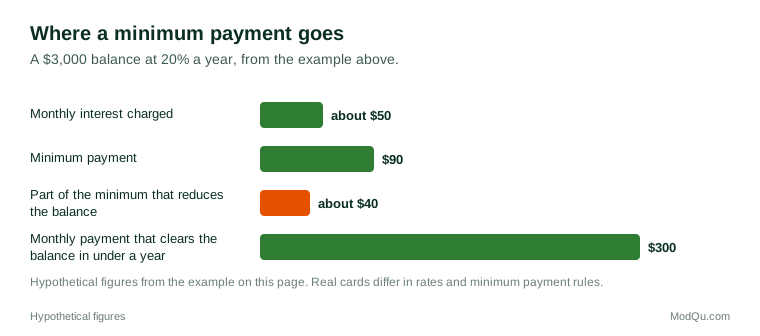
A cardholder has a $3,000 balance at 20% annual interest. Interest for one month is about $50 ($3,000 x 20% / 12). If their minimum payment is $90, only about $40 of it reduces the balance. Paying $300 a month instead clears the balance in under a year.
Carrying a balance and how people feel about debt
Some people use credit cards purely as a payment method and never pay interest. Others carry a balance for months or years. People carry balances for many reasons: an emergency expense, a drop in income, a large purchase, or spending that slowly runs ahead of income.
How people feel about their debt varies as much as the amounts. Some are comfortable with a manageable balance. Others feel stress and embarrassment, and avoid looking at statements. These feelings affect what people do: whether they ask for help, consolidate debt, or keep borrowing.
Example
A self-employed designer has an uneven income. In slow months they put business supplies and groceries on a credit card and pay it down when invoices are paid. They track it carefully and see the card as a short-term buffer. A friend in a similar position stops opening statements after the balance passes $8,000 and only seeks help when collection calls start.
Lines of credit and personal loans
When people need a larger amount or want lower interest than a credit card, they often look at a line of credit or a personal loan.
- A line of credit is flexible. It suits uneven needs such as home repairs spread over months. Interest rates are often lower than on credit cards, especially for secured lines backed by home equity.
- A personal loan has fixed payments and a fixed end date. It suits a single large expense or consolidating several debts into one payment.
People shop for these products in different ways. Some go straight to their own bank. Others compare online lenders and credit unions. Many accept the first offer they receive, which is one reason lenders want to understand how borrowers shop.
Credit scores and credit reports
Lenders use credit reports and credit scores to decide whether to lend and at what rate. In Canada, the two main credit bureaus are Equifax and TransUnion. A credit report lists accounts, balances, payment history and recent credit applications. A credit score summarizes that history as a number.
Many people are unsure what affects their score. Common factors include paying on time, how much of the available credit is used, how long accounts have been open, and how many new applications have been made recently. People can request their own credit report free of charge.
Example
A newcomer to Canada with a good credit history in another country finds that their history does not transfer. They start with a secured credit card, where a deposit sets the limit, and use it for small purchases paid in full each month to build a local credit record.
Getting help with debt
When debts become hard to manage, people have several options: talking to their lender about a payment plan, consolidating debts into one loan, getting advice from a non-profit credit counselling service, or, in more serious cases, a consumer proposal or bankruptcy through a Licensed Insolvency Trustee in Canada. Many people do not know these options exist, or wait until debts are severe before seeking help.
Questions that lenders, credit counsellors and policy makers want answered include how many people carry balances, how they feel about debt, when they look for help and what stops them.
Key terms
- Annual percentage rate (APR)The yearly cost of borrowing, expressed as a percentage.
- Grace periodThe time between the statement date and the due date when no interest is charged on purchases paid in full.
- Minimum paymentThe smallest amount you must pay by the due date to keep the account in good standing.
- Credit limitThe maximum amount you can borrow on a card or line of credit.
- Credit utilizationThe share of your available credit that you are using.
- Secured credit cardA card whose limit is backed by a cash deposit.
- Debt consolidationCombining several debts into one loan or payment.
- Credit reportA record of your borrowing and repayment history kept by a credit bureau.
Full glossary: consumer credit terms on EditingTests.com.
Credit cards and borrowing vocabulary test
How well do you know the language of this topic? Try 8 quick questions. Your score is shown straight away and is not saved.
What the credit cards and borrowing survey asks
This survey is part of ModQu's Money and Banking survey. The credit cards and borrowing part takes about five minutes and covers:
- How many credit cards you have and which features made you choose your main card.
- Whether you pay your card in full each month, and if not, roughly how much you carry.
- Which other kinds of borrowing you use, such as lines of credit, personal loans or store financing.
- How you compared lenders the last time you borrowed.
- How you feel about your current level of debt.
- Whether you have looked for help with debt, and where.
After that you can choose to continue with other short parts of the Money and Banking survey, such as everyday banking or digital payments and wallets, or stop.
Ready to take part?
Your answers help show what people really think and do. Results are only ever reported as totals; no one can see your individual answers.
Start the surveyQuestions about this survey
Who can take part?
Adults with a credit card or loan.
Do I have to give my name?
No. You may be asked for your age group, region and similar details so results can be broken down, but not your name. ModQu never asks for passwords, card numbers or account numbers.
How are the results used?
Answers are combined into totals and percentages and published in ModQu reports. Individual answers are never shown.
Is the vocabulary test part of the survey?
No. It is optional and separate, and your score is not stored.