
Share how rising prices affect you
Tell us which costs have risen most for you, what you have cut back on and how you manage. Your answers are combined with other people's and reported only as totals.
Start the cost of living surveyAbout 5 minutes. No account needed. You can stop at any time.
What the cost of living means
The cost of living is the amount of money needed to pay for the goods and services a household needs, such as housing, food, energy, transport, clothing, health care and education. When prices rise faster than incomes, people talk of a cost-of-living squeeze or crisis.
Official inflation figures measure the change in the price of a "basket" of goods and services that represents typical spending. Many people feel that official figures do not match their own experience, because each household spends money differently. A household that rents, drives a lot or spends most of its budget on food may face higher price rises than the average.
Costs that often rise most
The costs people most often mention are:
- Housing: rent, mortgage payments as interest rates change, property taxes and repairs.
- Food: especially staples such as bread, oil, dairy, meat and fresh produce.
- Energy: electricity, heating and cooking fuel.
- Transport: fuel, public transport fares and car insurance.
- Childcare and schooling: fees, uniforms and supplies.
- Health: medicines, insurance premiums and dental care, depending on the country.
- Debt: higher interest on loans and credit cards.
Example
A couple with two children notice that their weekly shop now costs much more for the same items. Their rent went up at renewal and their energy bills rose over the winter. Their pay rose too, but by less. They say that for the first time they are using savings to cover regular bills.
How people cut back
Common ways people adjust include:
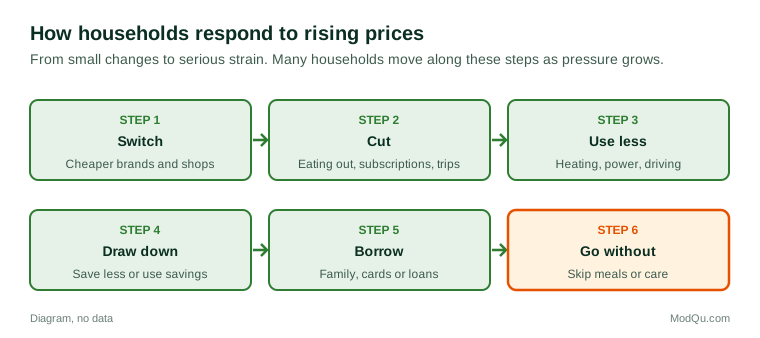
- switching to cheaper brands or discount shops;
- buying less meat or fresh food, or buying in bulk;
- eating out less and cancelling subscriptions;
- using less heating, electricity or water;
- driving less, walking or using public transport;
- delaying big purchases, holidays and home repairs;
- saving less or using savings;
- borrowing from family, using credit cards or taking loans;
- working extra hours or taking a second job.
The figure below groups these responses from small changes to serious strain.
Example (hypothetical figures)
A single adult's monthly costs rise from 1,800 to 2,050, an increase of 250. Their income rises by 80. They close the gap of 170 by cancelling two subscriptions (25), cooking at home more (70), using public transport twice a week instead of driving (45) and saving 30 less each month. 25 plus 70 plus 45 plus 30 is 170.
Who is hit hardest
Rising prices affect some groups more than others:
- Low-income households, which spend a larger share of income on food, energy and rent.
- Renters, especially where rents rise quickly.
- People with debt, when interest rates rise.
- Families with children, who face higher food, clothing and childcare costs.
- Older people on fixed incomes, if pensions do not rise with prices.
- People with disabilities or long-term illness, who may have extra costs for heating, transport or equipment.
- People in rural areas, who may rely more on cars and have fewer shopping choices.
Effects on health and wellbeing
Financial strain affects more than budgets. People report stress, worry, poor sleep and strain on relationships. Some skip meals, live in cold homes or delay medical or dental care. Food banks and community pantries in many countries report rising demand during periods of high prices.
Example
A retired teacher on a fixed pension starts heating only one room in winter and visits the public library on cold afternoons to stay warm. She says she is too proud to use the food bank but now accepts a weekly community meal at her place of worship.
How governments and employers respond
Responses differ by country and include:
- cash payments or tax cuts for lower-income households;
- caps or subsidies on energy prices;
- raising minimum wages, pensions and benefits in line with prices;
- rent controls or housing support;
- cutting taxes on fuel or food;
- interest rate rises by central banks to bring inflation down.
Employers may give pay rises, one-off payments, help with transport costs or more flexible working. People disagree about which responses work best and who should pay for them.
Cost of living and politics
The cost of living is often one of the top issues in elections. People's views of governments are strongly linked to how they feel about prices and their own finances. Surveys that ask about rising costs often also ask who people think is responsible: governments, central banks, businesses, global events or others.
What people disagree about
- Whether official inflation figures reflect real experience.
- Whether governments should cap prices or give cash help.
- Whether businesses are raising prices more than their costs justify.
- How to balance fighting inflation with protecting jobs.
- Who should receive help: everyone or only those most in need.
Why surveys ask about the cost of living
Questions that media organizations, policy groups, charities, businesses and governments want answered include which costs have risen most, what people have cut back on, how they manage and what help they want. Answers are grouped, and questions about money use ranges.
Cost of living around the world
Rising prices look different from place to place. In some countries, food takes up a large share of household spending, so a rise in grain or cooking oil prices hits hard. In others, housing and energy are the largest pressures. Countries whose currencies lose value against others may see sharp rises in the price of imported goods, fuel and medicines. Some households rely on money sent by relatives working abroad, which can buy more or less depending on exchange rates. Comparing experiences across countries helps show which pressures are global and which are local.
Key terms
- Cost of livingThe money needed to pay for the goods and services a household needs.
- InflationA general rise in prices over time.
- Consumer price indexAn official measure of the average change in prices for a basket of goods and services.
- Real incomeIncome adjusted for inflation, showing what it can actually buy.
- Fixed incomeIncome that does not change, such as some pensions.
- Food insecurityNot having reliable access to enough affordable, nutritious food.
- Energy povertyBeing unable to afford enough energy to heat, cool or power a home.
- Price capA legal limit on how much can be charged for a product or service.
Full glossary: economic policy terms on EditingTests.com.
Cost of living vocabulary test
How well do you know the language of this topic? Try 8 quick questions. Your score is shown straight away and is not saved.
What the cost of living survey asks
This survey is part of ModQu's Politics and Current Affairs survey. The cost of living part takes about five minutes and covers:
- Which costs have risen most for your household.
- What you have cut back on, and what you have stopped buying.
- How you manage rising prices, such as savings, borrowing or extra work.
- How rising costs have affected your health or wellbeing.
- What help, if any, you have received.
- Who you think is most responsible, and what should be done.
After that you can choose to continue with other short parts of the Politics and Current Affairs survey, such as political engagement or trust in political parties, or stop.
Ready to take part?
Your answers help show what people really think and do. Results are only ever reported as totals; no one can see your individual answers.
Start the surveyQuestions about this survey
Who can take part?
Adults.
Do I have to give my name?
No. You may be asked for your age group, region and similar details so results can be broken down, but not your name. ModQu never asks for passwords, card numbers or account numbers.
How are the results used?
Answers are combined into totals and percentages and published in ModQu reports. Individual answers are never shown.
Is the vocabulary test part of the survey?
No. It is optional and separate, and your score is not stored.
Do I need to give exact figures for my bills?
No. Questions use ranges, and every question can be skipped.
Can the survey help me with my bills?
No. It is an opinion survey and cannot give financial help, but local advice services and charities in many areas can.