
Share your snacking and baking habits
Tell us how often you snack between meals, where you buy bread and whether you are trying to snack more healthily. Your answers are combined with other people's and reported only as totals.
Start the baking and snacks surveyAbout 5 minutes. No account needed. You can stop at any time.
What this topic covers
This topic brings together two everyday parts of eating:
- Snacks: food eaten between meals, from fruit and nuts to chips, cookies, chocolate, granola bars, crackers, cheese, yogurt and popcorn.
- Baked goods: bread, rolls, bagels, tortillas, muffins, pastries, cakes, cookies and pies, whether bought from a bakery, a grocery store or a café, or baked at home.
Many baked goods are eaten as snacks, and many snacks are baked, so the two overlap.
How and why people snack
Snacking is common, and for many people it has replaced part of regular meals. People snack:
- between meals, mid-morning or mid-afternoon;
- in the evening, often while watching television;
- on the go, in the car, on transit or between activities;
- at work, from vending machines, shared treats or their own supplies;
- before or after exercise;
- with children, as after-school snacks.
The reasons people give include hunger, energy, habit, boredom, stress, social occasions and treating themselves. Many people say they snack more when working from home, because food is always nearby.
Example
An office worker who works from home three days a week notices that on home days they snack every hour or two, mostly on crackers and cookies from the kitchen. On office days they snack only once, on fruit they bring. They start keeping snacks out of sight and putting a portion on a plate, and say they snack less often.
Kinds of snacks
People often sort snacks into groups:
- Sweet: cookies, chocolate, candy, pastries and baked desserts.
- Salty or savoury: chips, crackers, pretzels, popcorn and nuts.
- Fresh: fruit, vegetables with dip, cheese and yogurt.
- Bars: granola, protein and cereal bars.
- Drinks used as snacks: smoothies, protein shakes and specialty coffees.
Snack makers have introduced many products with claims such as high protein, high fibre, less sugar, gluten-free or made with whole grains. People vary in how much they trust these claims.
Bread and where people buy it
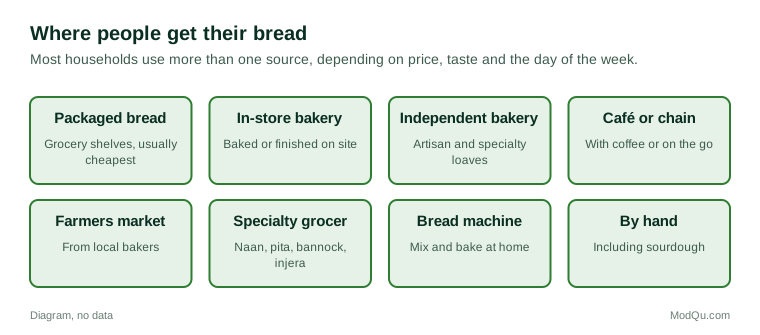
Bread is one of the most widely eaten baked goods. People buy it from:
- grocery store shelves, packaged sliced bread, often the cheapest and most common choice;
- in-store bakeries in supermarkets, with bread baked or finished on site;
- independent bakeries, selling artisan and specialty breads, often at higher prices;
- bakery chains and cafés;
- farmers markets;
- ethnic and specialty grocers, for breads such as naan, pita, bannock, injera, baguettes and challah;
- homemade, by hand or with a bread machine.
Choices depend on price, taste, freshness, how long bread keeps, family preferences, diet needs such as gluten-free, and convenience.
Example (hypothetical figures)
A household eats about two loaves a week. Packaged sliced bread costs $3.49 a loaf, or about $363 a year. Artisan sourdough from a local bakery costs $7.50 a loaf, or $780 a year. Baking at home costs about $1.20 a loaf for flour, yeast and salt, plus electricity, or about $125 a year, but takes time each week. The household buys packaged bread for weekday sandwiches and one bakery loaf on weekends, which works out to about $572 a year.
Questions that businesses want answered here include where people buy bread and baked goods, what they pay, and what would make them choose one option over another.
Baking at home
Home baking ranges from occasional cookies to regular bread-making. Many people took up baking during the COVID-19 pandemic, when sourdough and banana bread became widely shared hobbies, and some kept it up.
People bake at home for:
- enjoyment and relaxation;
- family traditions and holidays;
- control over ingredients, for allergies or health;
- cost, for some items;
- gifts and special occasions;
- teaching children.
Barriers include time, skill, the cost of ingredients such as butter, eggs and nuts, and kitchen space. Baking mixes and ready-to-bake doughs offer a middle option.
Example
A grandparent bakes cookies with their grandchildren every December using a family recipe. When one grandchild is diagnosed with a nut allergy, they adapt the recipe and start buying ingredients from a nut-free brand, reading every label. They say the tradition matters more to them than the exact recipe.
Healthier snacking
Many people say they are trying to snack more healthily. What that means differs from person to person:
- eating more fruit, vegetables, nuts and yogurt;
- cutting down on sugar, salt or fat;
- smaller portions or fewer snacks;
- choosing whole-grain breads and crackers;
- higher-protein or higher-fibre snacks to feel full longer;
- planning snacks instead of eating whatever is nearby.
Canada's Food Guide recommends limiting highly processed foods and choosing whole grains, vegetables and fruit, and Health Canada's front-of-package symbol now flags many packaged foods high in sugars, sodium or saturated fat. People's choices also depend on taste, price and convenience, and many describe a gap between the snacks they intend to eat and the snacks they actually eat.
This page describes snacking habits in general and does not give dietary advice.
Snacks, prices and shopping
Snack and bakery prices rose noticeably in the early 2020s, along with food prices generally, as the cost of ingredients such as wheat, sugar, butter and cocoa went up. Shoppers describe several responses:
- buying store brands instead of name brands;
- buying larger packages and portioning snacks at home;
- waiting for sales and using flyers and grocery apps;
- noticing smaller package sizes at the same price, often called shrinkflation;
- baking more at home, or less, depending on ingredient costs;
- cutting back on treats from cafés and bakeries.
Where people buy snacks also varies: grocery stores, bulk and discount stores, convenience stores and gas stations, vending machines, and online orders. Impulse purchases at the checkout make up part of snack sales, which is one reason stores place snacks there.
Trends and what people disagree about
Trends in snacks and baking include more protein and fibre claims, smaller portion packs, gluten-free and allergy-friendly products, artisan and sourdough bread, global baked goods, and higher prices for ingredients such as butter, cocoa and wheat.
People disagree about whether snacking is a healthy way to eat or a habit that adds unneeded calories, whether "healthier" snack claims are meaningful, whether governments should tax sugary snacks or limit their marketing to children, and whether artisan bread is worth the higher price.
Key terms
- SnackFood eaten between regular meals.
- Artisan breadBread made in small batches, often by hand, using traditional methods.
- SourdoughBread leavened with a fermented starter of flour and water rather than added yeast.
- Whole grainGrain that keeps all parts of the kernel, including the bran and germ.
- Portion packA small package holding a single serving.
- In-store bakeryA bakery inside a grocery store that bakes or finishes products on site.
- LeaveningAn ingredient, such as yeast or baking powder, that makes dough rise.
- Gluten-freeMade without wheat, barley, rye or other sources of gluten.
Full glossary: bakery technology terms on EditingTests.com.
Baking and snacks vocabulary test
How well do you know the language of this topic? Try 8 quick questions. Your score is shown straight away and is not saved.
What the baking and snacks survey asks
This survey is part of ModQu's Food and Drink survey. The baking and snacks part takes about five minutes and covers:
- How often you snack between meals, and at what times.
- Which kinds of snacks you eat most.
- Where you usually buy bread and baked goods.
- Whether you bake at home, and what.
- Whether you are trying to snack more healthily, and what that means for you.
- How rising prices have changed what you buy.
After that you can choose to continue with other short parts of the Food and Drink survey, such as eating habits or coffee, tea and beverages, or stop.
Ready to take part?
Your answers help show what people really think and do. Results are only ever reported as totals; no one can see your individual answers.
Start the surveyQuestions about this survey
Who can take part?
Adults.
Do I have to give my name?
No. You may be asked for your age group, region and similar details so results can be broken down, but not your name. ModQu never asks for passwords, card numbers or account numbers.
How are the results used?
Answers are combined into totals and percentages and published in ModQu reports. Individual answers are never shown.
Is the vocabulary test part of the survey?
No. It is optional and separate, and your score is not stored.
Do I need to bake to take part?
No. Most of the survey is about snacking and buying bread; the baking questions apply only if you bake.