
Share your experience of planning an event
Tell us your budget, which vendors you hired and how you found them. Your answers are combined with other people's and reported only as totals.
Start the weddings and celebrations surveyAbout 5 minutes. No account needed. You can stop at any time.
What this topic covers
This topic is about planning large personal celebrations: weddings first, and also engagement parties, milestone birthdays, anniversaries, religious and cultural celebrations, graduations and family reunions. These events share a pattern. They have a fixed date, a guest list, a venue and a set of hired services, and they are often planned over many months with a budget that changes along the way.
Weddings vary widely, from a small civil ceremony with a few witnesses to multi-day celebrations with hundreds of guests. Culture, religion, family expectations and the couple's own priorities all shape what an event looks like.
Setting a budget
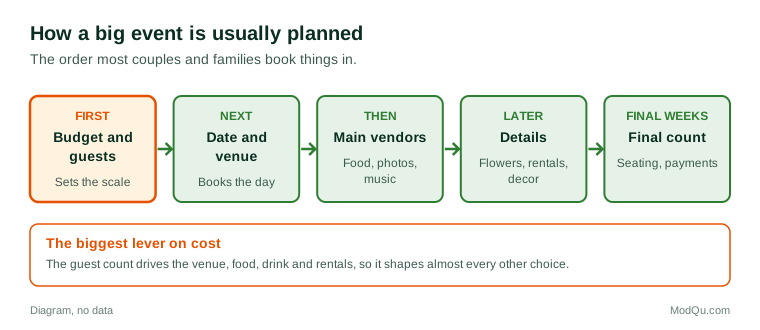
Most planners start with a budget, but budgets are often set before people know what things cost. The main factors that drive the total are:
- The number of guests, which affects the venue, food, drink, rentals and invitations.
- The date and season, with popular months and Saturdays costing more.
- The location, since prices vary between cities, towns and destinations.
- Who pays, whether the couple, parents, other relatives or a mix.
- Priorities, such as food, photography, music or the dress.
Many couples rank a few priorities and save on the rest. Some set money aside in a separate account; others use credit, which can leave debt after the event.
Example (hypothetical figures)
A couple sets a budget of $30,000 for 120 guests. The venue and catering quote is $145 per guest, or $17,400. Adding 20 guests to include co-workers raises that to $20,300, an increase of $2,900, before extra rentals and invitations. They decide to keep the list at 120.
Venues and the guest list
The venue is usually the first and largest booking, and it sets the date. Options include banquet halls, hotels, restaurants, golf clubs, wineries, farms and barns, community halls, places of worship, parks and family properties. Some venues include catering, tables and staff; others are "dry hire" spaces where the couple brings in every service.
The guest list is often the hardest part to agree on, because it involves both families. Decisions about children, plus-ones and co-workers can change the total by large amounts.
Vendors
Vendors are the businesses and individuals hired for the event. Common ones include:
- caterer and bar service;
- photographer and videographer;
- DJ, band or musicians;
- florist and decorator;
- officiant;
- hair and makeup artists;
- dress shop, tailor and formal wear rental;
- baker;
- rentals (tables, chairs, linens, tents, lighting);
- transportation;
- stationery and invitations;
- wedding planner or day-of coordinator.
Couples find vendors through recommendations from friends, the venue's preferred list, wedding shows, online directories and reviews, and social media. Many look at portfolios and meet several vendors before booking.
Example
A couple books their photographer 14 months ahead after seeing a friend's photos online. Their caterer comes from the venue's preferred list. They find their DJ through a wedding show, and the florist through a neighbour. Asked later, they say recommendations from people they knew mattered more than online reviews.
Contracts, deposits and planning tools
Most vendors ask for a signed contract and a deposit, often non-refundable, to hold a date. Contracts set out what is included, the payment schedule, overtime charges, cancellation and postponement terms, and what happens if the vendor cannot attend. Reading them carefully matters because terms differ between vendors.
Planning tools include checklists, budget spreadsheets, wedding websites for guests, online RSVP, seating chart apps and shared folders. Some couples hire a full-service planner; others hire a day-of coordinator who takes over in the final weeks; many do it themselves with help from family.
What goes over budget
Costs that couples often underestimate include:
- taxes, service charges and gratuities added to quotes;
- alterations to the dress or suit;
- rentals the venue does not include;
- extra hours from the photographer or band;
- travel and accommodation;
- vendor meals, which many contracts require;
- last-minute additions as the day gets closer.
Example
A couple's catering quote is for food only. Three months before the event they learn that the venue charges separately for cake cutting, a late-night snack is extra, and an 18% service charge and sales tax apply to the whole bill. They cut the late-night snack and move the dessert to cupcakes from a local bakery.
The cost of being a guest
Celebrations also cost money for guests, and this side is often left out. Guests may pay for travel and a hotel, a gift or cash contribution, new clothing, and events before the day such as a shower, a stag or stagette, or a bachelor or bachelorette trip. Members of the wedding party usually pay more, since they may buy matching outfits and help pay for pre-wedding events.
Destination weddings move much of the cost from the hosts to the guests. Some guests say no to invitations because of cost, and some couples choose a destination partly to keep the guest list small. How much is "normal" to give as a gift varies by culture, region and relationship, and people often feel unsure about it.
Example (hypothetical figures)
A guest invited to a destination wedding prices a five-night resort package at $1,850, a new outfit at $150, a gift of $100 and pet boarding at $250 while away. The total is $2,350. They attend the local party the couple holds when they return instead, and send the gift.
Planning across families and cultures
Many celebrations bring together two families with different customs, languages or religions. Couples may hold two ceremonies, combine traditions in one day, or adapt rituals so both families recognize them. Questions such as who is invited, what food is served, whether alcohol is offered and how long the celebration lasts can depend on these customs. Planners and vendors who know specific traditions, such as particular music, dress or ceremonies, are often found through community networks rather than general directories.
Changing traditions and other celebrations
Wedding traditions have changed. Smaller weddings, weekday and off-season dates, destination weddings, elopements followed by a party, and a mix of cultural traditions from two families are all common. Many couples live together before marrying and pay for the wedding themselves.
Other large celebrations follow similar steps. A milestone birthday or anniversary party may use the same venues, caterers and DJs. Religious and cultural celebrations, such as a bar or bat mitzvah, a quinceañera or a large family festival meal, often have their own customs and specialized vendors. Questions businesses want answered include what people spend, which vendors they hire, how they find them, and how far ahead they book.
Key terms
- DepositMoney paid to hold a date or service, often non-refundable.
- VendorA business or person hired to provide a service for an event.
- Day-of coordinatorA person who manages the event's schedule in the final weeks and on the day.
- OfficiantThe person who leads a ceremony and, for weddings, is authorized to perform it.
- RSVPA guest's reply saying whether they will attend.
- Dry hireRenting a venue space only, with all services brought in.
- Service chargeA percentage added to a bill by a venue or caterer.
- ElopementA very small or private wedding, often with few or no guests.
Full glossary: live events production terms on EditingTests.com.
Weddings and celebrations vocabulary test
How well do you know the language of this topic? Try 8 quick questions. Your score is shown straight away and is not saved.
What the weddings and celebrations survey asks
This survey is part of ModQu's Life Stages and Family survey. The weddings and celebrations part takes about five minutes and covers:
- What kind of event you held or planned, and when.
- Your total budget, and who paid for it.
- Which vendors you hired, and how you found each one.
- Which planning tools and services you used.
- What cost more than you expected.
- What you would do differently if you planned it again.
After that you can choose to continue with other short parts of the Life Stages and Family survey, such as ageing and senior living or end-of-life planning, or stop.
Ready to take part?
Your answers help show what people really think and do. Results are only ever reported as totals; no one can see your individual answers.
Start the surveyQuestions about this survey
Who can take part?
Adults who married or planned a major event in the last two years.
Do I have to give my name?
No. You may be asked for your age group, region and similar details so results can be broken down, but not your name. ModQu never asks for passwords, card numbers or account numbers.
How are the results used?
Answers are combined into totals and percentages and published in ModQu reports. Individual answers are never shown.
Is the vocabulary test part of the survey?
No. It is optional and separate, and your score is not stored.