
Share your views on war and peace
Tell us how worried you are about war, whether defence spending should change and how conflict has affected your life. Your answers are combined with other people's and reported only as totals.
Start the war and conflict surveyAbout 5 minutes. No account needed. You can stop at any time.
Kinds of conflict
Armed conflict takes several forms:
- Wars between states, fought by national armed forces.
- Civil wars between groups within one country.
- Insurgencies and armed uprisings against a government.
- Terrorism, violence against civilians to spread fear for political aims.
- Cyber attacks on infrastructure and information systems, sometimes linked to wider conflicts.
- Frozen conflicts, where fighting has stopped but no settlement has been reached.
Conflicts differ in scale, length and in how much they affect people outside the area of fighting.
How worried people are
Concern about war rises and falls with events. People may worry about a conflict involving their own country, a war in a neighbouring region, or the risk of a wider war. Concern can affect mood, plans and spending. People in countries that have recently experienced conflict, or that border an active war, often report higher concern.
Example
A student in a country far from any fighting says she thinks about war more than she did a few years ago. She follows a conflict on social media every day and has started to feel anxious. She decides to limit her news checking to once a day and to talk with a counsellor at her college.
How conflict abroad reaches daily life
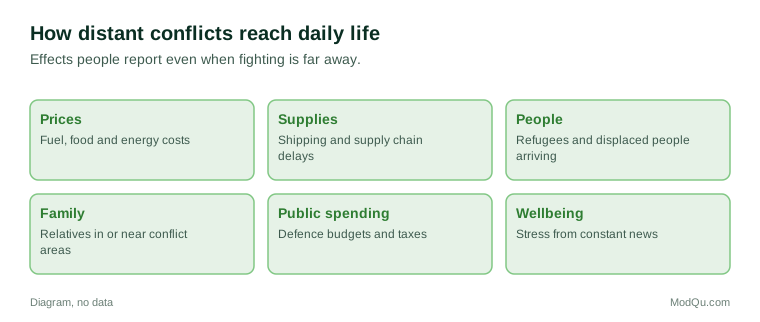
Even distant conflicts can affect people through:
- higher fuel, food and energy prices;
- disruption to supply chains and shipping;
- refugees and displaced people arriving in host countries;
- family members living in or near conflict areas;
- changes in defence spending and taxes;
- cyber attacks on services;
- fear and stress from constant news.
The figure below groups these effects.
Example (hypothetical figures)
A household's monthly energy bill rises from 140 to 196 after a conflict disrupts gas supplies. That is an increase of 56, or 40 percent. The household turns the heating down by two degrees and cuts the bill back to 175.
Defence spending
Governments decide how much to spend on armed forces, equipment and defence research. Views on defence spending often depend on:
- how threatened people feel;
- alliances and commitments to partners;
- other spending priorities such as health and education;
- views on the use of military force;
- jobs in defence industries in their area.
Surveys usually ask whether spending should go up, stay the same or go down, and sometimes what it should be spent on.
Peace efforts
Ways to prevent or end conflict include:
- diplomacy and negotiation between parties;
- mediation by neutral countries or organizations;
- ceasefires and peace agreements;
- peacekeeping missions, often under the United Nations;
- sanctions to pressure parties;
- support for reconciliation, justice and rebuilding after war.
People differ on which tools work best and when force is justified. International humanitarian law, including the Geneva Conventions, sets rules for the conduct of war, such as protecting civilians, the wounded and prisoners.
Refugees and displacement
Conflicts force people to flee their homes, either within their own country or across borders. Host countries and communities provide shelter, schooling and work, often with help from international agencies and charities. Public views on how many refugees to accept and how to support them vary widely and can change with events.
Example
A family in a town near a border hosts two people who fled fighting in a neighbouring country. A local charity helps with language classes and job searches. After a year, one of their guests is working at a local bakery, and the family says the experience changed how they see the conflict.
Conflict and the news
People see conflict through news coverage and social media, which may include graphic images and false or misleading claims. Each side in a conflict may spread propaganda. Many people say they find it hard to know what is true and choose to limit how much they watch.
Veterans and military families
Wars also affect the people who serve and their families: injuries, mental health effects, time away from home and the transition back to civilian life. Support services for veterans and military families vary between countries.
What people disagree about
- When, if ever, military action is justified.
- Whether defence spending should rise or fall.
- Whether to send weapons or aid to countries at war.
- How many refugees to accept.
- Whether sanctions work.
Why surveys ask about war and conflict
Questions that media organizations, policy groups, universities, governments and international bodies want answered include how worried people are about war, whether defence spending should change, which peace efforts they support and how conflict has affected their lives. Answers are grouped and every question can be skipped.
Talking with children about war
Parents and teachers often face questions from children who see images of war on television or online. Child welfare organizations commonly suggest finding out what children already know, answering questions honestly in language suited to their age, limiting exposure to graphic images, reassuring them about their own safety and focusing on people who are helping. Schools in some countries provide guidance and lessons on conflict and peace. Children from families affected by war may need extra support, and some schools work with refugee organizations to help pupils who have arrived from conflict areas.
Conflict and young people
Young people often see conflict mainly through social media, which can bring them close to events in a way earlier generations did not experience. Some respond by joining campaigns for peace or aid, raising money or volunteering with refugees. Others feel anxious or helpless. In some countries young adults may face conscription or be asked whether they would serve, and surveys sometimes ask how willing people would be to defend their country. Answers differ widely between countries and age groups.
Key terms
- Armed conflictFighting between organized armed groups, including states.
- Civil warA war between groups within the same country.
- CeasefireAn agreement to stop fighting, often temporarily.
- PeacekeepingDeployment of international forces to help keep peace after a ceasefire.
- Humanitarian lawInternational rules for the conduct of war, protecting civilians and others.
- RefugeeA person who has fled their country because of conflict or persecution.
- Internally displaced personA person forced from their home who remains in their own country.
- PropagandaInformation, often biased or false, used to promote a cause.
Full glossary: defense policy terms on EditingTests.com.
War and conflict vocabulary test
How well do you know the language of this topic? Try 8 quick questions. Your score is shown straight away and is not saved.
What the war and conflict survey asks
This survey is part of ModQu's Politics and Current Affairs survey. The war and conflict part takes about five minutes and covers:
- How worried you are about war and armed conflict.
- Whether you think defence spending should go up, stay the same or go down.
- Which peace efforts you support, such as diplomacy, aid or sanctions.
- How conflict abroad has affected your life, such as prices or family.
- Your views on supporting refugees and displaced people.
- Where you get news about conflicts and how much you trust it.
After that you can choose to continue with other short parts of the Politics and Current Affairs survey, such as political engagement or trust in political parties, or stop.
Ready to take part?
Your answers help show what people really think and do. Results are only ever reported as totals; no one can see your individual answers.
Start the surveyQuestions about this survey
Who can take part?
Adults.
Do I have to give my name?
No. You may be asked for your age group, region and similar details so results can be broken down, but not your name. ModQu never asks for passwords, card numbers or account numbers.
How are the results used?
Answers are combined into totals and percentages and published in ModQu reports. Individual answers are never shown.
Is the vocabulary test part of the survey?
No. It is optional and separate, and your score is not stored.
Will the survey ask which side I support in a conflict?
No. Questions are about general concern, defence and peace efforts, not about sides in specific conflicts.
Can I skip questions that are upsetting?
Yes. Every question can be skipped, and you can stop at any time.