
Share your experience of buying art
Tell us whether you have bought original art, where you bought it and how much you would spend on a piece. Your answers are combined with other people's and reported only as totals.
Start the visual arts and collecting surveyAbout 5 minutes. No account needed. You can stop at any time.
This page describes buying and collecting art as a consumer topic. It is not investment advice.
What visual arts and collecting cover
Visual arts include painting, drawing, printmaking, photography, sculpture, ceramics, textile art, glass, mixed media and digital art. Collecting means buying and keeping artworks over time, whether a few pieces for a home or a large collection.
People who buy art include:
- Occasional buyers who buy a piece for a home, a gift or a special occasion.
- Regular collectors who buy several works a year and follow particular artists.
- Corporate collectors, such as offices, hotels and hospitals.
- Public collectors, such as museums, galleries and governments. In Canada, the Canada Council for the Arts runs an Art Bank that rents contemporary Canadian art to public and private organizations.
Many people who buy original art do not think of themselves as collectors.
Where people buy art
People buy original art in many places:
- Directly from artists, at studios, open studio tours and artists' websites.
- Commercial galleries, which represent artists and sell their work.
- Artist-run centres and co-operatives.
- Art fairs, from local craft and art shows to large international fairs.
- Auction houses, for both new and older works.
- Online, through gallery websites, online marketplaces and social media.
- Fundraising auctions run by schools, charities and art organizations.
- Second-hand sources, such as estate sales, antique shops and thrift stores.
Example
A couple visits an open studio tour in their region, where local artists open their studios to the public for a weekend. They meet a painter whose landscapes they like and buy a small painting for their living room. They follow the artist on social media and buy a second, larger work two years later.
What affects the price of art
Art prices vary from a few dollars to millions. Factors that affect price include:
- The artist's reputation and career stage: emerging, mid-career or established.
- Size and medium: larger works and oil paintings often cost more than small works on paper.
- Original or edition: one-of-a-kind works generally cost more than prints made in editions.
- Exhibition and sales history: where the artist has shown and what their work has sold for.
- Condition and provenance, especially for older works.
- Where it is sold: gallery prices include the gallery's commission, while buying directly may cost less.
Galleries commonly take a commission on sales, often a large share of the price, which pays for the gallery's space, promotion and work representing the artist.
Example (hypothetical figures)
A painting is sold through a gallery for $2,400. The gallery's commission is 50%, so the gallery keeps $1,200 and the artist receives $1,200. The artist's materials and framing cost $280, leaving $920 before taxes for a painting that took about 40 hours, or $23 an hour.
Originals, prints and editions
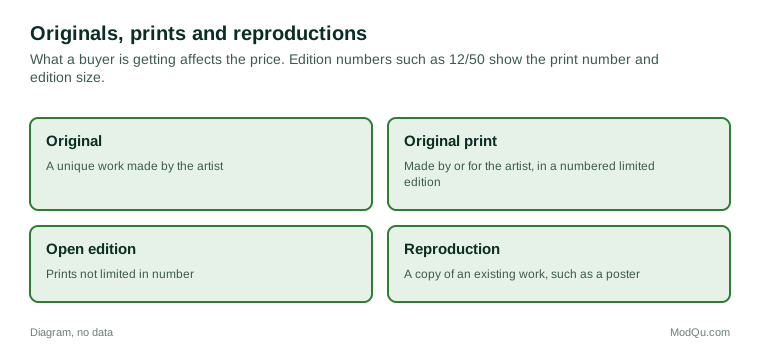
People who want art but cannot afford original paintings often buy prints. It helps to know the difference between:
- Original prints, such as etchings, linocuts, lithographs and screen prints, made by the artist or under their direction, usually in a limited edition, numbered and signed.
- Reproductions, such as posters and giclée prints of an existing painting, which may be signed but are copies.
- Open editions, which are not limited in number.
An edition number such as 12/50 means the print is number 12 of 50 made. An artist's proof (AP) is one of a small number of prints set aside outside the main edition.
Buying online
Online sales have made it easier to find and buy art from anywhere. Buyers often mention:
- seeing work by many more artists than they could visit in person;
- difficulty judging colour, size and texture from photographs;
- shipping costs and the risk of damage;
- return policies;
- scams, such as fake artists or copies sold as originals.
Common advice is to ask for the size and photographs in natural light, check the seller's reputation, ask about returns and shipping insurance and pay by a method that offers buyer protection.
Example
A buyer finds a ceramic artist online and likes a vase. Before buying, they ask the artist for a photo of the vase next to a ruler and a photo in daylight. The colour is slightly different from the website photo, but they still like it. The artist ships it double-boxed with insurance, and it arrives safely.
Caring for and living with art
Collectors often learn by experience how to care for art: keeping works out of direct sunlight, away from heat and damp, framing works on paper with acid-free materials, and handling them carefully. Many keep records of each work, including the artist, title, date, price, receipts and any certificate of authenticity, which helps with insurance and, later, with passing works on.
Some people insure valuable works under their home insurance or a separate policy, and some donate works to public galleries. In Canada, certain donations of art to designated institutions can receive tax benefits.
Artists' rights and resale
Artists keep copyright in their work even after selling it, unless they agree otherwise. This means a buyer owns the physical work but generally cannot make and sell copies of it. Canada also recognizes moral rights, which protect an artist's right to be named as the creator and to object to changes that harm their reputation.
An artist's resale right gives artists a share of the price when their work is resold through the art market. It exists in many countries, including the United Kingdom and members of the European Union. Canada has discussed adding one, and artists' organizations have called for it.
Example
A collector who bought a print years ago wants to use it on greeting cards to sell at a market. A friend points out that the artist still holds the copyright. The collector contacts the artist, who agrees to a licence in exchange for a fee and a credit on each card.
What people disagree about
People disagree about whether art should be bought as an investment, how much commission galleries should take, whether Canada should have an artist's resale right, and whether digital and AI-generated images count as art. Questions that galleries, artists and art organizations want answered include whether people have bought original art, where they bought it and how much they would spend on a piece.
Key terms
- OriginalA unique artwork made by the artist, not a copy.
- Limited editionA set number of prints made of an image, usually numbered and signed.
- ReproductionA copy of an existing artwork, such as a poster or digital print.
- CommissionThe share of a sale price kept by a gallery or agent.
- ProvenanceThe record of an artwork's ownership history.
- Artist's proofOne of a small number of prints set aside outside the main edition.
- CopyrightThe legal right to copy and reproduce a work, which usually stays with the artist.
- Moral rightsRights that protect an artist's name on a work and the work's integrity.
Full glossary: art market terms on EditingTests.com.
Visual arts and collecting vocabulary test
How well do you know the language of this topic? Try 8 quick questions. Your score is shown straight away and is not saved.
What the visual arts and collecting survey asks
This survey is part of ModQu's Arts, Culture and Sport survey. The visual arts and collecting part takes about five minutes and covers:
- Whether you have bought original art, prints or reproductions, and what kinds.
- Where you bought them: from artists, galleries, fairs, auctions or online.
- How much you have spent on a single piece, and how much you would spend.
- How you decide what to buy, and what puts you off.
- How often you visit galleries, studios and art fairs.
- Whether you think of yourself as a collector.
After that you can choose to continue with other short parts of the Arts, Culture and Sport survey, such as museums and galleries or live events and theatre, or stop.
Ready to take part?
Your answers help show what people really think and do. Results are only ever reported as totals; no one can see your individual answers.
Start the surveyQuestions about this survey
Who can take part?
Adults.
Do I have to give my name?
No. You may be asked for your age group, region and similar details so results can be broken down, but not your name. ModQu never asks for passwords, card numbers or account numbers.
How are the results used?
Answers are combined into totals and percentages and published in ModQu reports. Individual answers are never shown.
Is the vocabulary test part of the survey?
No. It is optional and separate, and your score is not stored.