
Share your views on political parties
Tell us how much you trust political parties, whether you support one and what would increase your trust. Your answers are combined with other people's and reported only as totals.
Start the trust in political parties surveyAbout 5 minutes. No account needed. You can stop at any time.
What political parties do
A political party is an organization of people who share broad political aims and seek to win elections and hold office. Parties:
- choose candidates for elections;
- develop policy programmes and manifestos;
- campaign and raise money;
- organize members and volunteers;
- form governments or act as the opposition;
- link citizens to decision-makers.
Party systems differ. Some countries have two main parties; many have several, and governments are formed by coalitions. In some countries, parties are weak and candidates run mainly on their own reputations. In a few, one party dominates or only one party is allowed.
What trust means here
Trust in parties can mean several things:
- belief that parties keep their promises;
- belief that they act in the public interest rather than for themselves or donors;
- confidence that they are honest and competent;
- feeling that they represent people like oneself.
People often trust their own preferred party more than parties in general, and they may trust a local representative more than the party they belong to.
What builds and weakens trust
Factors people link to lower trust include:
- broken promises after an election;
- scandals over money, expenses or misconduct;
- the influence of large donors and lobbyists;
- negative campaigning and personal attacks;
- a feeling that parties are all the same;
- leaders who seem distant from ordinary life.
Factors people link to higher trust include:
- keeping key promises, or explaining clearly why they cannot be kept;
- transparency about funding;
- visible local representatives who respond to problems;
- respectful debate and willingness to cooperate across parties;
- candidates who reflect the community.
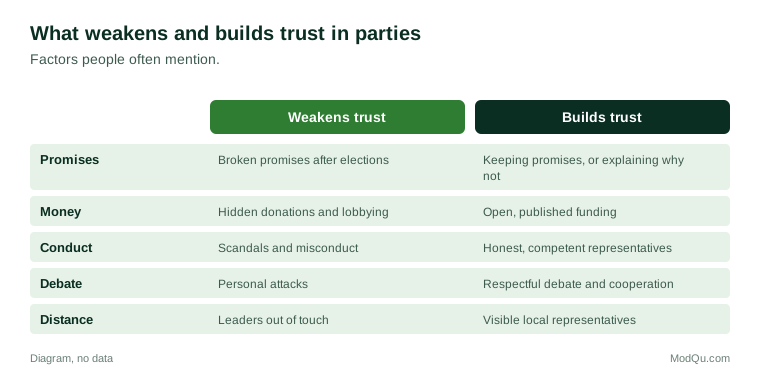
The figure below sets these side by side.
Example
A retired bus driver voted for the same party for forty years. When the party broke a promise on pensions, he voted for a different party for the first time. He says he does not trust either of them much now, but he trusts his local representative, who helped his neighbour with a housing problem.
Party loyalty and identity
Some people feel a lasting attachment to a party, often learned from parents or linked to their class, region, religion or community. This is known as party identification. People with strong attachment usually vote for the same party even when they disagree with some of its policies. In many countries, the share of voters with a strong attachment has fallen over recent decades, and more people switch between parties from one election to the next.
People who support no party
A growing group in many countries say they do not feel close to any party. They may:
- vote for different parties at different elections;
- vote based on leaders or local candidates rather than parties;
- support independent candidates;
- vote only on specific issues;
- not vote at all.
Example
A young software developer says she agrees with one party on the environment, another on housing and a third on taxes. At the last election she chose based on which local candidate answered her email about public transport. She says she is "loyal to issues, not parties".
Membership
Party membership has fallen in many established democracies, though some parties have seen sudden rises when new leaders or movements attract people. Members pay a fee, may choose candidates or leaders, and often do most of the volunteer work in campaigns. Some parties now offer cheaper or free "supporter" status with fewer rights.
Example (hypothetical figures)
A party had 120,000 members ten years ago and 78,000 today. That is a fall of 42,000, or 35 percent. During a leadership contest it signs up 15,000 registered supporters who can vote for the leader but not choose local candidates.
Funding and trust
How parties are funded is a major issue for trust. Some countries provide public funding to parties based on votes or seats, limit private donations or require donations above a set amount to be published. Others have few limits. Many people say they would trust parties more if they knew who funded them.
What people disagree about
- Whether parties are still needed, or whether independents and direct democracy are better.
- Whether parties should receive public funding.
- How to limit the influence of donors.
- Whether party members or all voters should choose leaders.
- How parties can win back trust.
Why surveys ask about trust in parties
Questions that media organizations, policy groups, universities and public bodies want answered include how much people trust parties, whether they support one, how loyal they are and what would increase their trust. The survey does not require you to say which party you support, and answers are reported only in groups.
Trust in politicians as individuals
Trust in parties is linked to, but different from, trust in individual politicians. Many people say they trust "politicians in general" very little but think well of their own representative, a pattern found in surveys in several countries. Personal contact, local visibility and help with problems often build trust in an individual, while national scandals and broken promises shape views of parties as a whole. Leaders can lift or lower trust in their party: a popular leader may attract voters who distrust the party, and an unpopular one may drive away loyal supporters. Some voters say they would trust parties more if candidates were chosen more openly by local members rather than by party leaders.
Key terms
- Political partyAn organization seeking to win elections and hold office to carry out shared aims.
- ManifestoA party's published programme of promises for an election.
- CoalitionAn agreement between parties to govern together.
- Party identificationA lasting sense of attachment to a party.
- Swing voterA voter who does not always vote for the same party.
- IndependentA candidate or representative who does not belong to a party.
- OppositionParties not in government that question and challenge it.
- Party fundingThe money parties raise from members, donors and, in some countries, public sources.
Full glossary: political science terms on EditingTests.com.
Trust in political parties vocabulary test
How well do you know the language of this topic? Try 8 quick questions. Your score is shown straight away and is not saved.
What the trust in political parties survey asks
This survey is part of ModQu's Politics and Current Affairs survey. The trust in political parties part takes about five minutes and covers:
- How much you trust political parties in general.
- Whether you feel close to or support one party.
- Whether you have changed which party you vote for.
- Whether you are or have been a party member.
- What would increase your trust in parties.
- How you would like parties to be funded.
After that you can choose to continue with other short parts of the Politics and Current Affairs survey, such as political engagement or international affairs, or stop.
Ready to take part?
Your answers help show what people really think and do. Results are only ever reported as totals; no one can see your individual answers.
Start the surveyQuestions about this survey
Who can take part?
Adults.
Do I have to give my name?
No. You may be asked for your age group, region and similar details so results can be broken down, but not your name. ModQu never asks for passwords, card numbers or account numbers.
How are the results used?
Answers are combined into totals and percentages and published in ModQu reports. Individual answers are never shown.
Is the vocabulary test part of the survey?
No. It is optional and separate, and your score is not stored.
Do I have to say which party I support?
No. That question can be skipped, and answers are reported only in groups.
Can I take part if I do not trust any party?
Yes. Low trust is a common answer and an important part of the results.