
Tell us how you file your taxes
Tell us how you filed your last return, how long it took and what you found hardest. Your answers are combined with other people's and reported only as totals.
Start the taxes and tax filing surveyAbout 5 minutes. No account needed. You can stop at any time.
What tax filing involves
An income tax return reports a person's income for the year, claims deductions and credits, and works out whether they owe more tax or are due a refund. In Canada, individuals file with the Canada Revenue Agency (CRA), and residents of Quebec also file a provincial return with Revenu Québec. In the United States, people file federal returns with the Internal Revenue Service (IRS) and, in most states, a state return too.
For most employees, tax is taken off each paycheque, so filing is a way to settle up: the return checks that the right amount was withheld. For self-employed people, landlords and investors, the return is where most of the calculation happens.
The return also matters beyond tax. In Canada, many benefits and credits, such as the Canada Child Benefit and the GST/HST credit, are based on the return, so people with little or no income often need to file to receive them.
The main ways people file
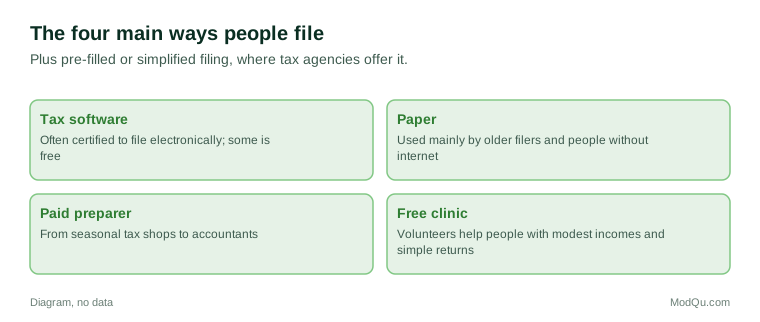
People file in four main ways:
- On their own with tax software, often certified to file electronically. Some software is free, especially for simple returns.
- On paper, still used by some people, mainly older filers and those without internet access.
- With a paid preparer, ranging from seasonal tax shops to accountants.
- Through free clinics, run by volunteers for people with modest incomes and simple returns. In Canada, the Community Volunteer Income Tax Program supports these clinics.
Some people also use automatic or simplified filing services where tax agencies offer them, which pre-fill information already held by the agency.
Example
A university student files their first return using free software. It takes about an hour, most of it spent finding their tuition slip. They receive a small refund and are surprised to learn they can carry forward unused tuition credits to future years.
What makes a return simple or complicated
A return is usually simple when someone has one employer, no investments outside registered accounts, and no major life changes. It becomes more complicated with:
- self-employment or side income from gig work;
- rental income;
- investment income and capital gains;
- moving for work, separation or divorce, or the death of a family member;
- medical expenses, child care costs and other deductions that need receipts;
- income from another country.
People with complicated returns are more likely to pay for help, even if they feel confident with numbers, because mistakes can be costly.
Example (hypothetical figures)
A graphic designer has a salary of $55,000 and earns $12,000 from freelance projects. They must report the freelance income, can deduct business expenses such as software and part of their home office, and may need to pay tax in instalments the next year. They decide that a $250 preparer fee is worth the time saved and the reduced risk of errors.
How long it takes and what people find hard
The time spent on taxes ranges from under an hour to several days. The most common difficulties people report are:
- finding and organizing slips and receipts;
- understanding which deductions and credits apply to them;
- tracking self-employment expenses during the year;
- worrying about making a mistake and being reassessed;
- dealing with a balance owing they did not expect.
Many people put off filing until close to the deadline. Late filing can mean penalties if tax is owing, and delays in benefit payments.
Refunds and balances owing
A refund means more tax was withheld than was owed. Many people look forward to their refund and plan to use it for debt repayment, savings or a purchase. Others prefer to have less tax withheld during the year and receive a smaller refund.
A balance owing can come as a shock, particularly for people with more than one job, pension income or self-employment income. Tax agencies usually offer payment arrangements for people who cannot pay in full by the due date.
Example
A retiree with two pensions finds they owe $1,800 at tax time because each pension withheld tax as if it were their only income. After talking to a volunteer clinic, they ask one pension provider to withhold more tax each month so they will not face a large bill next year.
Keeping records during the year
Much of the stress of tax time comes from searching for documents. People who find filing easy often have a simple system:
- a folder, box or email label where every tax slip and receipt goes as soon as it arrives;
- a separate bank account or card for self-employment or rental income and expenses;
- a running list of medical expenses, charitable donations and child care costs;
- digital copies of receipts, since tax agencies can ask for proof for several years after filing.
In Canada, taxpayers are generally expected to keep supporting records for six years. Online accounts with the tax agency also help, because many slips are uploaded there by employers, banks and pension plans, and some software can import them directly.
Example
A family that used to spend a full weekend on taxes starts photographing receipts with a phone app throughout the year and labelling them by category. The next spring, they finish both parents' returns in one evening and find two donation receipts they would previously have lost.
Paying for tax help
What people will pay for tax help depends on how complicated their return is and how much they value their time. Some see a preparer's fee as insurance against mistakes. Others prefer software because they want to understand their own taxes. Price sensitivity varies: some people switch preparers over a small difference in price, while others stay with the same accountant for decades.
Tax software firms, preparers and accountants want to know what drives these choices, how much people would pay, and what would make them switch from doing it themselves to using a professional, or the other way round.
Scams and safety at tax time
Tax season brings scams. Common ones include phone calls or texts claiming to be from the tax agency and demanding immediate payment in gift cards or cryptocurrency, and fake refund messages asking for banking details. Tax agencies do not demand payment in gift cards or threaten arrest by phone. People are encouraged to check any message through their official online account.
Key terms
- Tax returnThe annual form that reports income and works out tax owed or refunded.
- DeductionAn amount subtracted from income before tax is calculated.
- Tax creditAn amount that directly reduces the tax payable.
- RefundMoney returned when more tax was paid during the year than was owed.
- Balance owingTax still to be paid after the return is assessed.
- Notice of assessmentThe tax agency's statement confirming the result of your return.
- InstalmentsTax payments made during the year by people without enough tax withheld.
- Capital gainProfit from selling an investment or property for more than it cost.
Full glossary: tax preparation terms on EditingTests.com.
Taxes and tax filing vocabulary test
How well do you know the language of this topic? Try 8 quick questions. Your score is shown straight away and is not saved.
What the taxes and tax filing survey asks
This survey is part of ModQu's Money and Banking survey. The taxes and tax filing part takes about five minutes and covers:
- How you filed your last tax return: software, paper, a paid preparer, a free clinic or another way.
- How long it took you, including gathering documents.
- Which parts you found hardest.
- Whether you received a refund or owed money, and what you did with any refund.
- What you paid for help, and what you would be willing to pay.
- Whether you plan to change how you file next year, and why.
After that you can choose to continue with other short parts of the Money and Banking survey, such as everyday banking or digital payments and wallets, or stop.
Ready to take part?
Your answers help show what people really think and do. Results are only ever reported as totals; no one can see your individual answers.
Start the surveyQuestions about this survey
Who can take part?
Adults who file a tax return.
Do I have to give my name?
No. You may be asked for your age group, region and similar details so results can be broken down, but not your name. ModQu never asks for passwords, card numbers or account numbers.
How are the results used?
Answers are combined into totals and percentages and published in ModQu reports. Individual answers are never shown.
Is the vocabulary test part of the survey?
No. It is optional and separate, and your score is not stored.