
Share your view of school lunches
Tell us whether your child takes a packed lunch or eats school meals, what lunch costs and how healthy you think it is. Your answers are combined with other people's and reported only as totals.
Start the school lunches surveyAbout 5 minutes. No account needed. You can stop at any time.
How children eat at school
School lunch arrangements vary by country, region and school. The main options are:
- School meals: hot or cold meals prepared at school or delivered by a caterer, served in a canteen, cafeteria or classroom.
- Packed lunches: food brought from home in a lunch box, sometimes called a bag lunch or tiffin.
- Going home: in some places children go home for lunch, especially in rural areas or where the school day is short.
- Buying food nearby: older students may buy food from shops or vendors near the school.
- Snacks only: in schools with a short day, children may only eat a snack.
Many countries run national school meal programs. In some, meals are free for all pupils; in others they are free for families on low incomes and paid for by everyone else; in others there is no program at all. The World Food Programme supports school meal programs in many lower-income countries, where a school meal can be an important reason for children to attend.
Packed lunch or school meals?
Families weigh several factors:
- Cost: whether school meals are free, subsidised or full price compared with home-made lunches.
- Nutrition: whether they trust school meals to be healthy.
- Child's preferences: picky eaters may prefer familiar food from home.
- Dietary needs: allergies, religious diets and vegetarian or vegan food.
- Convenience: preparing packed lunches every morning takes time.
- Social reasons: children may want to eat what their friends eat.
Example
A parent switches their nine-year-old from packed lunches to school meals after the school introduces a vegetarian option every day. It saves them fifteen minutes each morning, and the child likes eating the same food as their friends.
Costs
Where families pay for school meals, the price per meal is often set by the school, local authority or caterer. Packed lunch costs depend on what is packed.
Example (hypothetical figures)
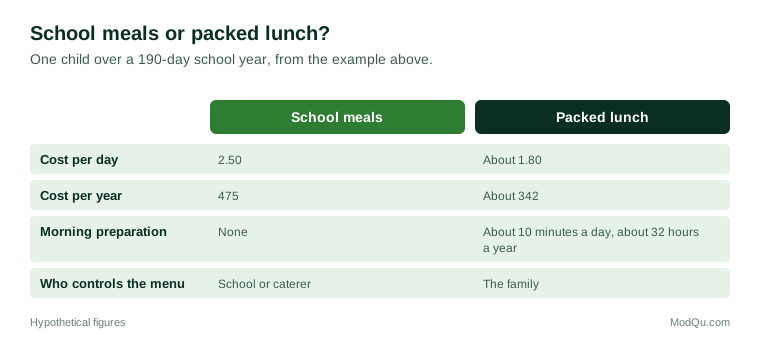
A family compares lunch costs for one child over a 38-week school year (190 school days). School meals cost 2.50 a day, or 475 a year (2.50 × 190). Their typical packed lunch of a sandwich, fruit, yoghurt and a drink costs about 1.80 a day, or 342 a year. The packed lunch saves 133 a year but takes about 10 minutes to prepare each morning, which adds up to about 32 hours a year (190 × 10 minutes = 1,900 minutes).
Families with several children see these costs multiplied. Free school meal programs, where they exist, can make a large difference to household budgets.
Nutrition standards
Many countries set rules for what school meals must contain, such as portions of fruit and vegetables, limits on fried food, sugar and salt, availability of drinking water and restrictions on sugary drinks. Some also set rules for food sold in school vending machines and tuck shops. Packed lunches are usually not regulated, though some schools publish guidance, for example asking families not to pack sweets or nut products.
Studies in several countries have compared school meals and packed lunches. Findings vary by place and over time, so it is hard to say in general which is healthier; much depends on what a particular school serves and what a particular family packs.
Picky eaters, allergies and special diets
School lunches must work for many different children:
- Picky eaters may eat little of a school meal, leading some parents to pack familiar food.
- Food allergies, such as to nuts, eggs or milk, require careful planning and sometimes nut-free school policies.
- Religious diets, such as halal, kosher or vegetarian food for Hindu, Jain or other families.
- Medical diets, such as for coeliac disease or diabetes.
- Ethical diets, such as vegetarian and vegan food.
Example
A school with many pupils from different faith communities offers a halal option and a vegetarian option each day and labels allergens on the menu board. Parents can view the weekly menu online and choose packed lunch on days their child dislikes the options.
Breakfast and after-school food
Lunch is not the only food schools provide. Breakfast clubs run in many schools, offering a morning meal before lessons, sometimes free and sometimes for a small charge. They help children who arrive hungry and give working parents an earlier drop-off time. Some schools also provide a snack mid-morning, such as fruit or milk, and after-school clubs may serve food. These extra meals add to what schools and families must plan for and pay for.
Food waste and the lunch break
School lunches can create a lot of food waste, from uneaten meals and packaging. Some schools use measures such as letting children choose portion sizes, giving more time to eat, and composting. The length of the lunch break also matters: short breaks can mean children rush or skip food to play. Questions that schools and caterers want answered include how much children actually eat, which dishes are popular and what families would change.
Debates
- Universal free meals. Some argue every child should get a free school meal to remove stigma and improve health and learning. Others argue limited budgets should target families in need.
- Quality versus cost. Caterers work with tight budgets per meal, and parents sometimes question quality.
- Packed lunch rules. Some families feel schools are too strict about what can be packed; others welcome guidance.
- Local and sustainable food. Some programs buy from local farmers to support communities and reduce transport.
- Stigma. Where free meals are means-tested, some children may feel singled out; systems that use cards or accounts for everyone aim to prevent that.
Key terms
- School meal programA scheme that provides meals to pupils at school, often funded by government.
- Packed lunchFood brought from home for a child to eat at school.
- Free school mealsMeals provided at no cost to some or all pupils.
- Means-testedAvailable only to those whose income or wealth is below a set level.
- Nutrition standardsRules about what food and drink can be served in schools.
- AllergenA food or substance that can cause an allergic reaction.
- Tuck shopA small school shop selling snacks and drinks.
- HalalFood prepared according to Islamic law.
Full glossary: nutrition science terms on EditingTests.com.
School lunches vocabulary test
How well do you know the language of this topic? Try 8 quick questions. Your score is shown straight away and is not saved.
What the school lunches survey asks
This survey is part of ModQu's Parenting and Children survey. The school lunches part takes about five minutes and covers:
- Whether your child takes a packed lunch, eats school meals or does something else.
- How much lunch costs your family a week.
- Whether your child receives free or subsidised school meals.
- How healthy you think school meals are, and what you would change.
- Whether school meals meet your child's dietary needs.
- How much of their lunch your child actually eats.
After that you can choose to continue with other short parts of the Parenting and Children survey, such as baby products and nappies or baby food and formula, or stop.
Ready to take part?
Your answers help show what people really think and do. Results are only ever reported as totals; no one can see your individual answers.
Start the surveyQuestions about this survey
Who can take part?
Parents of school-age children.
Do I have to give my name?
No. You may be asked for your age group, region and similar details so results can be broken down, but not your name. ModQu never asks for passwords, card numbers or account numbers.
How are the results used?
Answers are combined into totals and percentages and published in ModQu reports. Individual answers are never shown.
Is the vocabulary test part of the survey?
No. It is optional and separate, and your score is not stored.
Are school meals free everywhere?
No. Some countries provide free meals for all pupils, some only for families on low incomes, and some have no national program.
Can schools cater for allergies and religious diets?
Many do, by offering alternatives and labelling allergens, but arrangements vary between schools. Families usually discuss needs with the school directly.