
Share your plans for retirement
Tell us when you plan to retire, whether you would work part-time first and what worries you most. Your answers are combined with other people's and reported only as totals.
Start the retirement from work surveyAbout 5 minutes. No account needed. You can stop at any time.
What retirement from work means
Retirement is the point at which a person stops working for pay, or reduces paid work, usually later in life, and starts to rely mainly on pensions, savings and other income. It is both a financial event and a major life change.
In Canada there is no general mandatory retirement age; most provinces ended mandatory retirement in the 2000s, with some exceptions for jobs with specific requirements. People can generally choose when to retire, within the limits of their finances, health and work.
This page focuses on the decision to leave work and the transition. How people save and invest for retirement is a separate topic.
How people decide when to retire
The timing of retirement depends on several things at once:
- Money: whether pensions, savings and other income will be enough, and when pension benefits can start.
- Health: one's own health and the physical demands of the job. Poor health is a common reason for retiring earlier than planned.
- Work: how much a person enjoys their job, workplace changes, layoffs, and whether the employer offers part-time or flexible options.
- Family: a partner's retirement, caring for parents, grandchildren or a partner with health needs.
- Pension rules: some workplace pensions reward working to a certain age or years of service, and some reduce benefits for retiring early.
- Identity and purpose: for some, work is a big part of who they are, and stopping is hard to imagine.
Many people retire at a different age than they planned. Some retire earlier, often because of health, caregiving or job loss. Others work longer, because they enjoy it, need the income, or found retirement less fulfilling than expected.
Example
A sales manager planned to retire at 65. At 61 their company reorganized and offered them an early retirement package. After working out their income with a financial planner, they accepted, then took a part-time role at a garden centre a year later because they missed the routine and the people.
Routes into retirement
People take different paths out of full-time work:
- Full retirement: stopping work completely on one date.
- Phased retirement: reducing hours over months or years with the same employer, for example from five days to three, then to two.
- Bridge jobs: moving to a different, often less demanding or part-time job before fully retiring.
- Consulting or self-employment: continuing to use skills on one's own terms.
- Unretirement: returning to paid work after retiring.
- Volunteering, which many retirees take up in place of paid work.
Phased retirement can help both workers and employers. Workers keep some income and routine, and employers keep experienced staff longer and have time to pass on knowledge. Not every employer offers it, and pension rules can make it complicated.
How retirement income fits together in Canada
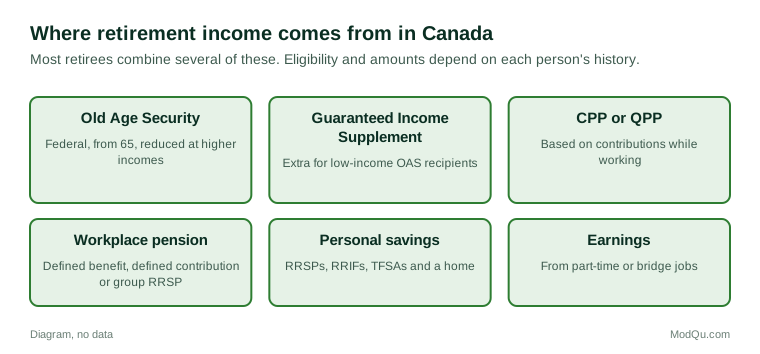
Retirement income in Canada is often described as coming from several sources, sometimes called pillars:
- Old Age Security (OAS): a monthly federal payment for most people aged 65 and over who meet residence requirements. It is reduced for people with higher incomes. People can delay starting it, which increases the monthly amount.
- Guaranteed Income Supplement (GIS): an extra monthly payment for low-income OAS recipients.
- Canada Pension Plan (CPP) or, in Québec, the Québec Pension Plan (QPP): earnings-related pensions based on contributions made while working. People can start CPP as early as 60 with a reduced amount, or delay it as late as 70 for a larger amount.
- Workplace pensions: defined benefit or defined contribution plans, and group RRSPs, through an employer.
- Personal savings: RRSPs, RRIFs, TFSAs, other investments and, for many, the value of a home.
- Earnings from part-time work.
The rules for each program change from time to time, and people's eligibility depends on their own history. Service Canada, the government department that administers OAS and CPP, publishes current information and estimates.
Example (hypothetical figures)
A worker is offered a choice of starting their CPP pension at 65 at $900 a month or at 70 at a higher amount. Under the rules used in this example, each year of delay after 65 increases the amount by 8.4%, so delaying five years increases it by 42%, to $1,278 a month. If they start at 65, they receive $10,800 a year for those five years, $54,000 in total. The break-even point, where the extra $378 a month makes up for the $54,000 not received, comes about 12 years after the pension starts at 70, ignoring inflation and tax.
Questions that businesses want answered here include at what age people plan to retire, whether they intend to keep working part-time, and how confident they are that their income will be enough.
Adjusting to life after work
Retirement changes daily life in many ways. People describe gains such as free time, less stress, travel, hobbies, time with family, and better sleep. They also describe losses: of routine, of social contact with colleagues, of purpose, and of the identity that came with a job title.
Researchers and retirement coaches often describe retirement as a process with stages: a period of planning, a "honeymoon" after leaving work, a period of adjustment or disappointment for some, and then a settled routine. Not everyone goes through every stage, and the length of each varies.
Things retirees often say helped them adjust include planning activities in advance, keeping some structure in the week, staying physically active, staying in touch with friends, volunteering or part-time work, and talking openly with a partner about expectations.
Example
A couple retires within a few months of each other. After the first holiday, they find they disagree about how to spend their days: one wants to travel, the other wants to garden and see grandchildren. They agree on two trips a year and set aside days for their own activities, and both say the first year was harder than they expected.
What people worry about
When people approaching retirement are asked what worries them most, common answers include:
- Running out of money, especially if they live a long time.
- Rising costs, including inflation, housing and care.
- Health and long-term care, and who would look after them.
- Losing purpose or social contact.
- Market changes affecting savings and pensions.
- Supporting family, such as adult children or ageing parents.
- Knowing when they can afford to retire, and whether they have saved enough.
Worries differ between groups. People with a defined benefit pension often feel more secure about income. Those relying on their own savings, those with little savings, and those whose jobs are physically demanding may face harder choices.
Trends and what people disagree about
People in Canada are living longer, which means retirements can last for decades. Many workers have defined contribution plans or no workplace pension, rather than the defined benefit pensions that were more common in the past, which shifts investment risk to individuals. The share of older adults still working has increased in recent decades.
There are debates about these trends. Should people be encouraged to work longer, or should retirement ages for public pensions stay as they are? Should employers be required to offer pensions? How should employers support older workers, including through flexible and phased options? And how should workers in physically demanding jobs, who may not be able to work longer, be treated?
Key terms
- Phased retirementGradually reducing working hours before retiring fully.
- Bridge jobA different, often part-time job between a career and full retirement.
- Old Age SecurityA monthly federal payment for most Canadians aged 65 and over.
- Canada Pension PlanAn earnings-related public pension based on contributions while working.
- Guaranteed Income SupplementAn extra monthly payment for low-income OAS recipients.
- UnretirementReturning to paid work after retiring.
- Early retirementRetiring before the usual or planned age, sometimes with a reduced pension.
- Defined benefit pensionA workplace pension that promises a set retirement income.
Full glossary: pension administration terms on EditingTests.com.
Retirement from work vocabulary test
How well do you know the language of this topic? Try 8 quick questions. Your score is shown straight away and is not saved.
What the retirement from work survey asks
This survey is part of ModQu's Work and Careers survey. The retirement from work part takes about five minutes and covers:
- At what age you plan to retire, or when you retired.
- Whether you would work part-time or in a different job first.
- What will most affect your decision about when to retire.
- Which sources of income you expect to rely on.
- What worries you most about retiring.
- For recent retirees, how the change has gone so far.
After that you can choose to continue with other short parts of the Work and Careers survey, such as job satisfaction or remote and hybrid work, or stop.
Ready to take part?
Your answers help show what people really think and do. Results are only ever reported as totals; no one can see your individual answers.
Start the surveyQuestions about this survey
Who can take part?
Workers aged 50 and over and recent retirees.
Do I have to give my name?
No. You may be asked for your age group, region and similar details so results can be broken down, but not your name. ModQu never asks for passwords, card numbers or account numbers.
How are the results used?
Answers are combined into totals and percentages and published in ModQu reports. Individual answers are never shown.
Is the vocabulary test part of the survey?
No. It is optional and separate, and your score is not stored.
Is this survey about investments?
No. It asks about the decision to stop working and how people plan and adjust, not about specific savings or investments.