
Share how you take part in politics
Tell us how interested you are in politics, how often you discuss it and whether you have contacted a politician. Your answers are combined with other people's and reported only as totals.
Start the political engagement surveyAbout 5 minutes. No account needed. You can stop at any time.
What political engagement means
Political engagement is how people pay attention to, and take part in, decisions about how their community, region or country is run. It can be active or passive, occasional or constant, local or national. Researchers usually group it into:
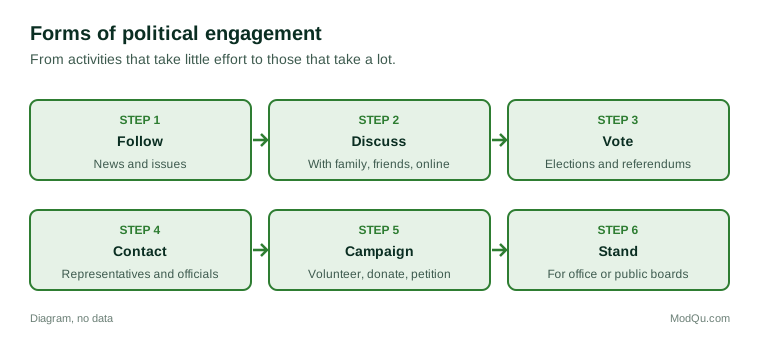
- Interest and attention: following political news, knowing about issues and leaders.
- Discussion: talking about politics with family, friends, colleagues or online.
- Voting in national, regional and local elections and referendums.
- Contacting: writing to, calling or meeting elected representatives or officials.
- Campaigning: volunteering for a candidate or cause, donating, putting up signs.
- Joining: membership of political parties, unions, associations or advocacy groups.
- Collective action: petitions, boycotts, protests and demonstrations.
- Standing for office or serving on public boards and committees.
The figure below arranges these from lower to higher effort.
Interest in politics
Interest varies widely. Some people follow politics daily and enjoy debating it; others say it is boring, confusing or upsetting. Interest often rises around elections, crises and issues that affect people directly, such as local school closures or price rises. Surveys often ask a simple question about how interested people are, then ask about specific activities, because general interest and actual activity do not always match.
Example
A nurse says she is "not interested in politics" but has signed three petitions about hospital staffing, written to her local representative about parking at the hospital, and voted in every election since she turned 18. She sees these as practical steps rather than politics.
Talking about politics
Discussion is one of the most common forms of engagement. People talk about politics at home, at work, with friends and online. Some avoid it to keep the peace in families or workplaces. Many people say online discussions have become more hostile, which leads some to stop posting while still reading.
Contacting representatives
People contact elected representatives and officials to raise personal problems, such as a delayed benefit or immigration case, or to express views on a policy. Methods include email, letters, phone calls, online forms, public meetings and in-person surgeries or office hours. Many representatives have staff who handle casework. People who contact representatives often say they did so after a personal problem rather than out of general interest.
Example
A small business owner emails her regional representative after a road closure cuts her trade for months. A staff member replies within a week and arranges a meeting with the transport department. She says she had never contacted a politician before and was surprised that it helped.
Why some people stay away
Reasons people give for low engagement include:
- feeling that their voice makes no difference;
- distrust of politicians and parties;
- lack of time because of work and family;
- not knowing enough or finding politics confusing;
- dislike of conflict and hostility;
- feeling that politics is for other kinds of people;
- barriers such as language, disability or not having the right to vote.
Who engages more
Research in many countries has found that engagement is often higher among older people, people with more education, higher incomes and homeowners, and people with strong ties to community groups. Younger people may vote less in some places but take part more in petitions, online campaigns and protests. Patterns differ by country and change over time.
Example (hypothetical figures)
A town survey of 800 adults finds that 72 percent voted in the last national election, 41 percent discussed politics at least weekly, 18 percent signed a petition in the past year and 6 percent contacted a representative. Among people under 30, petition-signing was 27 percent but voting was 55 percent.
Engagement in different political systems
How people can take part depends on the system they live in. In some countries voting is compulsory; in most it is voluntary. Some have frequent referendums or citizens' assemblies, where randomly chosen residents discuss an issue and make recommendations. In others, freedom to organize, speak or protest is restricted, and political engagement can carry personal risk. Surveys that cover many countries take these differences into account.
Digital engagement
The internet has created new forms of engagement: online petitions, social media campaigns, crowdfunding for causes, livestreamed council meetings and online consultations by governments. Some see these as lowering barriers; others worry about "clicktivism", where easy online actions replace deeper involvement, and about misinformation and harassment.
What people disagree about
- Whether voting should be compulsory.
- Whether online engagement is real participation.
- How to encourage young people to take part.
- Whether citizens' assemblies should have real power.
- How politicians should respond to petitions and campaigns.
Why surveys ask about political engagement
Questions that media organizations, policy groups, universities and public bodies want answered include how interested people are, how often they discuss politics, which activities they take part in and what would make them more likely to engage. Answers are grouped, and the survey does not ask which party you support unless you choose to say.
Engagement between elections
Much political activity happens between elections. Residents attend public meetings about local plans, respond to government consultations, join school boards or tenants' associations, and support campaigns on single issues. Workers take part through unions and professional bodies. Some people stay engaged through volunteering for charities that also lobby governments. These forms of engagement often have a more direct effect on daily life than a single vote, and many people who say they are not interested in politics take part in them without calling it politics.
Key terms
- Political engagementPaying attention to and taking part in decisions about how a community or country is run.
- TurnoutThe share of eligible voters who vote in an election.
- ReferendumA public vote on a single question.
- PetitionA formal request to an authority, signed by many people.
- CaseworkHelp a representative's office gives to individuals with problems involving government.
- Citizens' assemblyA group of randomly selected residents who study an issue and make recommendations.
- Compulsory votingA system where eligible citizens are required by law to vote.
- Advocacy groupAn organization that campaigns to influence policy on an issue.
Full glossary: political science terms on EditingTests.com.
Political engagement vocabulary test
How well do you know the language of this topic? Try 8 quick questions. Your score is shown straight away and is not saved.
What the political engagement survey asks
This survey is part of ModQu's Politics and Current Affairs survey. The political engagement part takes about five minutes and covers:
- How interested you are in politics.
- How often you discuss politics, and with whom.
- Which activities you have taken part in, such as voting, petitions or volunteering.
- Whether you have contacted a politician or official, and what happened.
- What stops you taking part more.
- What would make you more likely to get involved.
After that you can choose to continue with other short parts of the Politics and Current Affairs survey, such as trust in political parties or international affairs, or stop.
Ready to take part?
Your answers help show what people really think and do. Results are only ever reported as totals; no one can see your individual answers.
Start the surveyQuestions about this survey
Who can take part?
Adults.
Do I have to give my name?
No. You may be asked for your age group, region and similar details so results can be broken down, but not your name. ModQu never asks for passwords, card numbers or account numbers.
How are the results used?
Answers are combined into totals and percentages and published in ModQu reports. Individual answers are never shown.
Is the vocabulary test part of the survey?
No. It is optional and separate, and your score is not stored.
Will I be asked which party I support?
Only if you choose to say. Questions about party support can be skipped, and answers are reported only in groups.
Can I take part if I cannot vote in my country?
Yes. Political engagement includes many activities open to people who cannot vote.