
Share where you get parenting advice
Tell us where you get parenting advice, whether you use a parenting app and which source you trust most. Your answers are combined with other people's and reported only as totals.
Start the parenting advice and apps surveyAbout 5 minutes. No account needed. You can stop at any time.
Why parents look for advice
Parenting raises questions at every stage. Common topics include:
- Babies: feeding, sleep, crying, development and health.
- Toddlers: tantrums, toilet training, speech and eating.
- School-age children: behaviour, homework, friendships and activities.
- Teenagers: independence, mental health, screen time, relationships and risky behaviour.
- Throughout: discipline, family routines, childcare, money and parents' own wellbeing.
First-time parents tend to seek the most advice, but many experienced parents also look for help when a new issue arises or a second child is very different from the first.
Main sources of advice
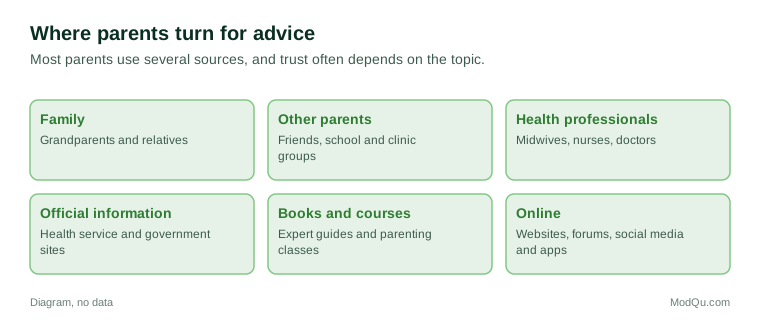
Parents use many sources, often several at once:
- Family, especially grandparents, who offer experience and practical help.
- Friends and other parents, including parent groups at schools, clinics and places of worship.
- Health professionals: midwives, nurses, health visitors, community health workers, doctors and paediatricians.
- Teachers and childcare workers.
- Official information from health services and government websites.
- Books and magazines written by experts or other parents.
- Websites and forums, where parents ask and answer each other's questions.
- Social media: parenting accounts, influencers, groups and short videos.
- Parenting apps.
- Parenting courses and classes, offered by health services, charities and community groups.
Example
A first-time parent with a baby who wakes often at night reads an article from their national health service, asks the health visitor at a clinic appointment, joins an online group for parents of babies born the same month, and calls their own parent for reassurance. They try one suggestion from each and keep a sleep diary to see what helps.
Parenting apps
Parenting apps cover many needs:
- Pregnancy and baby trackers showing development week by week.
- Feeding, sleep and nappy logs, often shared between parents and carers.
- Development milestone checklists.
- Health records such as vaccinations and growth.
- Community features for chatting with other parents.
- Behaviour and routine tools, such as reward charts and visual timetables.
- Family organisation: shared calendars, lists and chore tracking.
- School communication apps run by schools.
Parents value apps for convenience, reminders and being able to look things up at any hour. Concerns include data privacy, since apps may collect sensitive information about children and pregnancy; the quality and source of advice; adverts and paid upgrades; and the risk of feeling anxious from too much tracking.
Example (hypothetical figures)
A couple log their newborn's feeds in a shared app for four weeks. In week 1 they record 70 entries; by week 4 they record 50, because feeds have become fewer and more regular. The total over four weeks is 240 entries, an average of 60 a week. After a month they stop logging because they no longer need it.
Whom parents trust
When asked which source they trust most, parents often name health professionals and family, though trust varies by topic. Parents may trust a doctor on health, a grandparent on everyday care and other parents on practical tips. Signs that parents use to judge online advice include:
- whether it comes from a recognised health body or qualified professional;
- whether it cites evidence or is based on one person's experience;
- whether the author is selling something;
- whether it agrees with other trusted sources;
- how recent it is.
Researchers who study online health information note that popular advice is not always accurate, and that confident, personal stories can be more persuasive than official guidance even when they are less reliable.
Why advice conflicts
Parents often find that advice disagrees. Reasons include:
- Changing guidance, as research leads health bodies to update advice, for example on safe sleep or introducing allergenic foods.
- Differences between countries in official recommendations.
- Cultural traditions that differ from current official advice.
- Different parenting philosophies, such as stricter or gentler approaches to discipline.
- Commercial interests, when advice is linked to products.
- Individual differences between children.
Example
A grandparent suggests putting the baby to sleep on their front, as was common advice when they raised their own children. The parent explains that national safe-sleep guidance now recommends back sleeping, and shows them the leaflet from the hospital. The grandparent follows the current advice when babysitting.
Parenting styles and philosophies
Advice is often linked to a parenting style or philosophy. Researchers have long described broad styles, such as authoritative (warm with clear rules), authoritarian (strict with less warmth), permissive (warm with few rules) and uninvolved. Popular approaches discussed today include gentle parenting, attachment parenting and positive discipline. Parents often mix ideas, and approaches differ across cultures.
Parenting courses and support services
Some parents take a more structured approach by joining a course. Antenatal classes prepare people for birth and the first weeks with a baby. Health services, charities and community groups offer courses on babies' sleep and feeding, managing behaviour, communicating with teenagers and parenting after separation. Some courses are free and open to all; others are offered to families who need extra help, or are paid. Parents who attend often value meeting other parents in the same situation as much as the content of the course itself.
Debates
- Information overload. Many parents feel overwhelmed by the volume of advice.
- Social media influence. Parenting content on social media can be helpful and supportive, but some parents report feeling judged or pressured by idealised images.
- Expert versus lived experience. Parents differ on how much weight to give professionals compared with other parents.
- Privacy. Concerns remain about apps collecting children's data and about parents sharing children's photos and stories online.
Key terms
- Health visitorA nurse or health worker who supports families with young children in some countries.
- Parenting appA mobile app that offers advice, tracking or tools for parents.
- MilestoneA skill most children reach by a certain age.
- Parenting styleA broad pattern of how parents combine warmth and rules.
- Authoritative parentingA style combining warmth with clear rules and expectations.
- Safe sleep guidanceOfficial advice on how babies should sleep to reduce risks.
- SharentingParents sharing information, photos or stories about their children online.
- Evidence-basedBased on research findings rather than opinion or single stories.
Full glossary: childcare services terms on EditingTests.com.
Parenting advice and apps vocabulary test
How well do you know the language of this topic? Try 8 quick questions. Your score is shown straight away and is not saved.
What the parenting advice and apps survey asks
This survey is part of ModQu's Parenting and Children survey. The parenting advice and apps part takes about five minutes and covers:
- Where you get parenting advice, and which sources you use most.
- Whether you use a parenting app, and what you use it for.
- Which source of advice you trust most, and on which topics.
- How often you find advice conflicting, and how you decide what to follow.
- Whether you have attended a parenting course or class.
- What advice or support you wish you had more of.
After that you can choose to continue with other short parts of the Parenting and Children survey, such as baby products and nappies or baby food and formula, or stop.
Ready to take part?
Your answers help show what people really think and do. Results are only ever reported as totals; no one can see your individual answers.
Start the surveyQuestions about this survey
Who can take part?
Parents.
Do I have to give my name?
No. You may be asked for your age group, region and similar details so results can be broken down, but not your name. ModQu never asks for passwords, card numbers or account numbers.
How are the results used?
Answers are combined into totals and percentages and published in ModQu reports. Individual answers are never shown.
Is the vocabulary test part of the survey?
No. It is optional and separate, and your score is not stored.
Do I have to follow a particular parenting style?
No. Most parents mix ideas from different approaches, and what works can differ between children in the same family.
Are parenting apps reliable?
Quality varies. Some are produced with health professionals and cite official guidance; others are not. Checking who made the app and where its advice comes from helps.
What should I do if advice conflicts?
Many parents check current guidance from their national health service and ask a health professional who knows their child.