
Share your museum and gallery visits
Tell us when you last visited a museum or gallery, what made you go and whether you would buy a membership. Your answers are combined with other people's and reported only as totals.
Start the museums and galleries surveyAbout 5 minutes. No account needed. You can stop at any time.
What museums and galleries cover
A museum is an institution that collects, cares for, studies and shows objects of artistic, cultural, historical or scientific interest to the public. A gallery usually focuses on art. Kinds of museums include:
- Art galleries, from large public galleries to small artist-run centres.
- History museums, including national, provincial and local history museums, and historic sites.
- Science centres and natural history museums, often hands-on and popular with families.
- Children's museums, designed for play and learning.
- Specialized museums, such as those about transport, sport, music, war, medicine or a single industry.
- Indigenous cultural centres and museums, often run by Indigenous communities.
- Living history sites, zoos, aquariums, botanical gardens and planetariums, which are sometimes counted as museums.
Some museums are run by governments, such as Canada's national museums, which are federal Crown corporations. Others are non-profit organizations, university museums or community-run sites. Commercial galleries also sell art; this page is mainly about museums and public galleries.
Why people visit
People visit museums and galleries for a range of reasons:
- Learning about a subject, a period of history or a culture.
- Seeing something special, such as a famous work or a touring exhibition.
- Family outings, especially with young children on weekends and holidays.
- Social time with friends or a partner.
- Tourism, when visiting a new city.
- Personal interest or identity, such as a connection to the history shown.
- A quiet, reflective space, or a place to be inspired.
- School trips and programs, which are often a child's first museum visit.
Many visits are prompted by a specific event: a new exhibition, a free day, a holiday program or a visitor from out of town.
Example
A couple who had not visited their city's art gallery in years go to a touring exhibition after seeing posters on the bus. They enjoy it and stay for the permanent collection afterwards. Over the next year they return twice more, both times for special exhibitions, and say they had forgotten how much the gallery offered.
What keeps people away
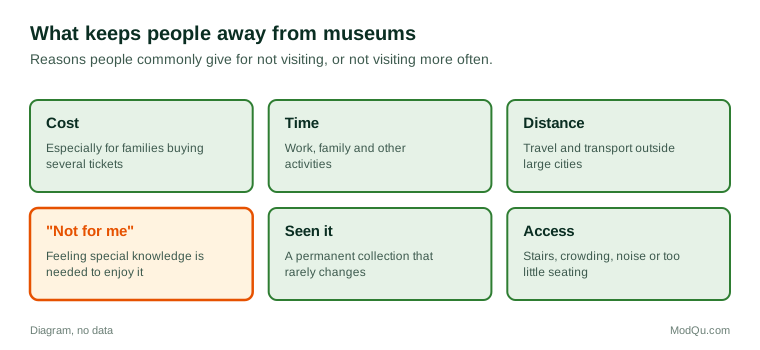
Reasons people give for not visiting, or not visiting more, include:
- Cost, especially for families paying for several tickets.
- Lack of time and competing activities.
- Distance and transport, especially for people outside large cities.
- Feeling that museums are "not for people like me", or that they need special knowledge to enjoy them.
- Having already seen it, if the permanent collection rarely changes.
- Accessibility barriers, such as stairs, lack of seating, crowding or noise.
- Not knowing what is on.
Example (hypothetical figures)
A family of two adults and two children wants to visit a science centre. Single tickets cost $25 per adult and $18 per child, so one visit costs $86. A family membership costs $190 a year. If they visit three times, single tickets would cost $258, so the membership saves $68. If they visit only twice, tickets cost $172, which is $18 less than the membership.
Admission, free days and memberships
Museums use several pricing approaches:
- Paid general admission, sometimes with lower prices for children, students and seniors.
- Free admission, either always or on certain days or evenings.
- Pay what you can times.
- Separate tickets for special exhibitions.
- Memberships, which give a year of entry, often with discounts, member events and guest passes.
- Library pass programs, where library card holders can borrow free museum passes.
- Programs for newcomers, such as free entry for new citizens through some cultural access programs.
People often weigh a membership by counting how many visits they expect to make. Members tend to visit more often, partly because the cost of each extra visit feels like zero.
Family visits and children
Families with young children are among the most frequent museum visitors. What families tend to look for includes hands-on exhibits, space to move and make noise, washrooms with change tables, places to eat, stroller access and programs for children's ages. Many museums run camps, workshops and story times. For children, a good early visit can shape whether they visit museums as adults.
Example
A parent takes a toddler to a children's museum on a rainy Tuesday morning. The museum runs a sensory play hour for children under four with fewer visitors and quieter lighting. The parent buys a membership that day, because the program suits their child and is only twenty minutes from home.
Accessibility and inclusion
Museums have been working to welcome a wider range of visitors. Approaches include:
- step-free access, seating, accessible washrooms and lifts;
- large-print labels, audio descriptions and touch tours for people who are blind or partially sighted;
- sign language tours and captioned videos;
- relaxed or sensory-friendly hours with lower light and sound for autistic visitors and others;
- labels in several languages;
- exhibitions created with communities whose histories are shown.
Museums in Canada have also been reconsidering how they hold and display Indigenous objects and ancestral remains, including repatriation, the return of objects and remains to the communities they came from.
Digital collections and online visits
Many museums now put their collections online, with photographs and descriptions of objects, virtual tours, videos and online talks. Some people use them to plan a visit; others visit only online, especially if they live far away. Museums debate how far online access replaces or encourages in-person visits.
Example
A retired teacher in a small northern town uses a national museum's online collection to research objects linked to their grandparents' community. They later travel to see the objects in person and join an online talk with the curator. They say the online collection was what made the trip worthwhile.
What people disagree about
People disagree about whether museums should be free to enter, how much public money they should receive, how museums should handle objects acquired in the past from other countries and communities, and how much museums should comment on current social and political issues. Questions that museums and galleries want answered include when people last visited a museum or gallery, what made them go and whether they would buy a membership.
Key terms
- MuseumAn institution that collects, cares for and shows objects of artistic, cultural, historical or scientific interest.
- CuratorA specialist who looks after a collection and plans exhibitions.
- Permanent collectionThe objects a museum owns and shows over the long term.
- Touring exhibitionAn exhibition that travels between museums for a limited time.
- MembershipA paid yearly pass that gives entry and other benefits.
- RepatriationThe return of objects or remains to the community or country they came from.
- Relaxed hoursTimes set aside with lower light, sound and crowds for visitors who need a calmer setting.
- DocentA trained guide, often a volunteer, who leads tours in a museum.
Full glossary: museum education terms on EditingTests.com.
Museums and galleries vocabulary test
How well do you know the language of this topic? Try 8 quick questions. Your score is shown straight away and is not saved.
What the museums and galleries survey asks
This survey is part of ModQu's Arts, Culture and Sport survey. The museums and galleries part takes about five minutes and covers:
- When you last visited a museum or gallery, and which kind.
- What made you go, such as an exhibition, family outing or visitors.
- What stops you from visiting more often.
- What you pay, and whether you would buy a membership.
- Whether you use online collections, virtual tours or talks.
- What would make museums more welcoming for you and your household.
After that you can choose to continue with other short parts of the Arts, Culture and Sport survey, such as live events and theatre or sports fans, or stop.
Ready to take part?
Your answers help show what people really think and do. Results are only ever reported as totals; no one can see your individual answers.
Start the surveyQuestions about this survey
Who can take part?
Adults.
Do I have to give my name?
No. You may be asked for your age group, region and similar details so results can be broken down, but not your name. ModQu never asks for passwords, card numbers or account numbers.
How are the results used?
Answers are combined into totals and percentages and published in ModQu reports. Individual answers are never shown.
Is the vocabulary test part of the survey?
No. It is optional and separate, and your score is not stored.