
Share your views on local services
Tell us how satisfied you are with roads, parks, libraries and other services where you live. Your answers are combined with other people's and reported only as totals.
Start the local services surveyAbout 5 minutes. No account needed. You can stop at any time.
What local services cover
Local services are the public services provided by a municipality: a city, town, township, village, rural municipality or regional government. In Canada, municipalities are created by the provinces, and provincial laws set out what they can and must do. The exact list varies, but common local services include:
- Roads and sidewalks: building, repairing, snow clearing and street lighting.
- Water and sewer: drinking water, wastewater treatment and stormwater drains.
- Waste: garbage, recycling and organics collection, and landfill or transfer sites.
- Parks and recreation: parks, sports fields, arenas, pools, community centres and programs.
- Public libraries, often run by a library board funded mainly by the municipality.
- Public transit in larger cities and some regions.
- Fire and emergency services, and in many places local or contracted police.
- Planning and building: zoning, building permits and inspections.
- Bylaw enforcement, such as noise, parking, property standards and animal control.
- Social and community services, which in some provinces include social housing, child care and public health.
Some services, such as hospitals, schools and most social programs, are mainly provincial, which can make it hard for residents to know which level of government is responsible.
How local services are paid for
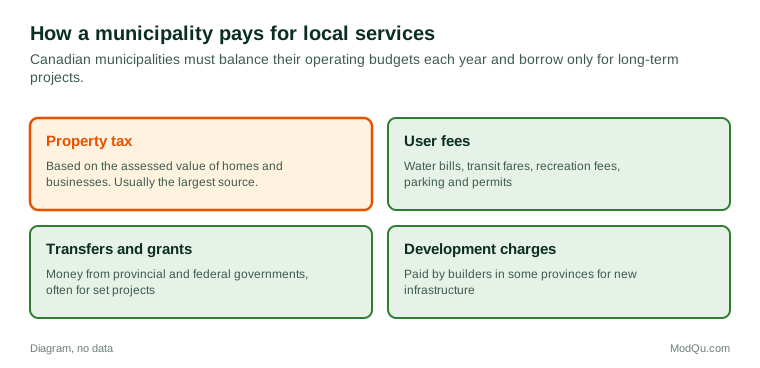
Canadian municipalities rely heavily on a few sources of money:
- Property tax, based on the assessed value of homes and businesses.
- User fees, such as water bills, transit fares, recreation program fees, parking and permits.
- Transfers and grants from provincial and federal governments, often for specific projects.
- Development charges paid by builders in some provinces to help cover new infrastructure.
Municipalities in Canada are generally not allowed to run deficits on their operating budgets, so they must balance spending and revenue each year. They can borrow for long-term capital projects such as bridges and water plants.
Example (hypothetical figures)
A homeowner's property is assessed at $500,000. The municipal tax rate is 0.8% of assessed value, so the municipal portion of the tax bill is $4,000 a year. If the budget for the next year rises by 4% and assessments do not change, the bill would rise by about $160, to $4,160, before any education or regional portion is added.
How residents use local services
People use local services in very different ways. A family with young children may use parks, pools and library story times every week. A commuter may care most about roads and transit. An older resident may rely on snow clearing, accessible sidewalks and community centre programs. A renter may never see a property tax bill, though it is part of their rent.
This means residents often judge "the city" by the one or two services that touch their own lives most.
Example
A resident who uses a wheelchair finds that the bus stops on their street are cleared of snow after every storm, but the sidewalks leading to them are not. They contact their councillor, who explains that bus stops and sidewalks are cleared by different crews on different schedules. The city later changes the routes so both are cleared together on main transit streets.
What residents tend to complain about
Common concerns about local services include:
- Potholes and road repair, especially after winter.
- Snow clearing: how quickly and in what order streets and sidewalks are cleared.
- Garbage and recycling: missed pickups, bin limits and changing rules.
- Traffic and parking, including speeding on residential streets.
- Recreation programs that fill up quickly, and wait lists for swimming lessons and camps.
- Permit delays for renovations and new buildings.
- Property tax increases and how the money is spent.
- Ageing infrastructure, such as old water mains, bridges and community centres.
Many municipalities run a 311 line, website or app where residents can report a problem, such as a pothole or a broken street light, and track whether it has been fixed.
Example
A resident reports a large pothole through the city's 311 app, attaching a photo and the location. Two days later the app shows the request as "completed". The pothole has been filled with cold patch, a temporary fix. A permanent repair is scheduled for the summer paving program.
Libraries, parks and community spaces
Libraries and parks are among the services residents tend to rate most highly. Public libraries have changed a great deal: alongside books, many lend e-books, audiobooks, tools, musical instruments and museum passes, offer internet access and printing, host programs for children, newcomers and seniors, and provide a warm or cool place to go in extreme weather.
Parks and green spaces are used for exercise, play, sport, dog walking and community events. Demand often grows faster than the land available, especially in growing suburbs and dense city neighbourhoods.
How residents have a say
Residents influence local services through:
- Municipal elections, held every few years, with lower turnout than provincial or federal elections in many places.
- Contacting councillors about local problems.
- Public meetings and consultations on budgets, plans and new developments.
- Resident surveys, which many municipalities run to track satisfaction and set priorities.
- Community associations and neighbourhood groups.
Example
A town asks residents to rank five possible budget priorities: roads, a new arena, more library hours, more frequent bus service and keeping taxes down. The online consultation attracts mostly older homeowners. The town adds paper copies at the library and pop-up booths at a farmers' market to reach younger residents and renters before making its decision.
What people disagree about
People disagree about how much property taxes should rise, whether to spend on new facilities or repair old ones, how to share road space between cars, transit, cyclists and pedestrians, how much growth and density a community should accept, and which services should be paid for by user fees rather than taxes. Questions that municipalities and public agencies want answered include how satisfied residents are with local roads, how often they use a public library and which local service most needs improvement.
Key terms
- MunicipalityA local government such as a city, town or township.
- Property taxA tax based on the assessed value of land and buildings.
- AssessmentThe value a public agency sets on a property for tax purposes.
- User feeA charge paid by the people who use a particular service.
- BylawA local law passed by a municipal council.
- ZoningRules that set what kinds of buildings and uses are allowed in each area.
- 311A phone number, website or app for reporting local problems and asking about city services.
- InfrastructurePhysical systems such as roads, bridges, water mains and sewers.
Full glossary: public works administration terms on EditingTests.com.
Local services vocabulary test
How well do you know the language of this topic? Try 8 quick questions. Your score is shown straight away and is not saved.
What the local services survey asks
This survey is part of ModQu's Government and Public Services survey. The local services part takes about five minutes and covers:
- Which local services you use, and how often.
- How satisfied you are with roads, snow clearing, garbage collection, parks and libraries.
- Which local service most needs improvement where you live.
- Whether you think you get good value for your property taxes or rent.
- Whether you have reported a problem to your municipality, and what happened.
- How you take part in local decisions, such as voting, consultations or contacting a councillor.
After that you can choose to continue with other short parts of the Government and Public Services survey, such as trust in government or online government services, or stop.
Ready to take part?
Your answers help show what people really think and do. Results are only ever reported as totals; no one can see your individual answers.
Start the surveyQuestions about this survey
Who can take part?
Residents.
Do I have to give my name?
No. You may be asked for your age group, region and similar details so results can be broken down, but not your name. ModQu never asks for passwords, card numbers or account numbers.
How are the results used?
Answers are combined into totals and percentages and published in ModQu reports. Individual answers are never shown.
Is the vocabulary test part of the survey?
No. It is optional and separate, and your score is not stored.
Why does my property tax bill have more than one part?
In many provinces the bill includes a municipal portion, an education portion set by the province and, in some places, a regional portion. Each is calculated separately.
Who do I contact about a problem with a local service?
Most municipalities have a 311 line, a website form or an app for reporting problems. For urgent safety issues such as a water main break, call the emergency number your municipality lists.