
Share your experience of live shows
Tell us how many live shows you attended this year, what you usually pay per ticket and where you buy tickets. Your answers are combined with other people's and reported only as totals.
Start the live events and theatre surveyAbout 5 minutes. No account needed. You can stop at any time.
What live events and theatre cover
Live events are performances watched in person. This page focuses on the performing arts and similar shows:
- Theatre: plays, musicals, touring Broadway-style productions, fringe festivals and community theatre.
- Dance: ballet, contemporary dance and cultural dance companies.
- Opera and classical music: orchestras, chamber music and choirs.
- Comedy: stand-up, improvisation and sketch shows.
- Family shows: children's theatre, puppetry, magic and circus.
- Spoken word and talks: readings, lectures and live podcast recordings.
Music festivals and large concerts are covered on a separate page. Venues range from large theatres and concert halls to community halls, school auditoriums, bars and outdoor stages. Producers include non-profit theatre and dance companies, commercial producers and amateur groups.
How people decide what to see
People tend to decide what to see based on a mix of:
- The show itself: a favourite musical, a well-known actor or comedian, or a story they want to see.
- Reviews and word of mouth from friends and family.
- Price and seat location.
- The occasion: birthdays, anniversaries, holidays and visitors in town.
- Timing and convenience: day of the week, start time, travel and parking.
- Who they are going with, and whether the show suits children or older relatives.
Many people attend only one or two shows a year, often for a special occasion, while a smaller group attends regularly and buys subscriptions.
Example
A grandparent wants to take two grandchildren to a holiday show. They compare a large touring musical downtown and a family production at a local theatre company. The touring show has better-known songs but costs far more and ends late. They choose the local production, which has a matinee and free parking, and the children talk about it for weeks.
Ticket prices and fees
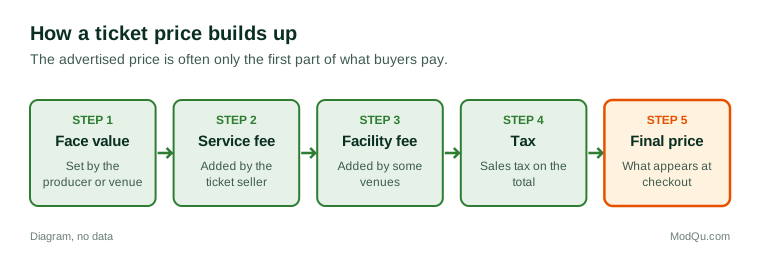
The price people pay for a ticket is often more than the advertised price. Common parts include:
- The face value set by the producer or venue.
- Service or convenience fees charged by the ticket seller.
- Facility fees added by some venues.
- Delivery or processing fees, even for e-tickets.
- Taxes.
Some provinces and countries have introduced rules on showing the full price, including mandatory fees, up front. Many buyers say surprise fees at checkout are one of their main frustrations.
Example (hypothetical figures)
A buyer sees a theatre ticket advertised at $75. At checkout, a $9.50 service fee and a $4.00 facility fee are added, then 13% tax on the total. The subtotal is $88.50, and with $11.51 tax the final price is $100.01 per ticket. For two tickets, the total is $200.02, about a third more than the $150 they had planned on.
Dynamic pricing, resale and scams
Ticket prices for popular shows can change in several ways:
- Dynamic pricing, where the seller raises or lowers prices based on demand, similar to airline seats.
- Resale, where people who bought tickets sell them on to others, sometimes for much more than face value.
- Bots used by some resellers to buy large numbers of tickets as soon as they go on sale.
- Fake or duplicate tickets, sold through social media or classified ads.
Some Canadian provinces, including Ontario, and some US states have laws on ticket resale, bots and price disclosure. Buyers are often advised to buy from the venue or an authorized seller, check the venue's resale policy and avoid paying by methods that cannot be reversed.
Example
A fan tries to buy tickets to a comedian's tour as soon as they go on sale, but the show sells out in minutes. Within an hour, resale listings appear at three times the original price. They decide to wait. A week before the show, the venue releases a small number of extra seats at face value, and they buy two.
Subscriptions and loyal audiences
Many non-profit theatre, dance and orchestra companies sell subscriptions or season packages: tickets to several shows in a season, often with a discount, the same seats and easy exchanges. Subscribers give companies money in advance and a loyal audience.
Many companies report that fewer people now commit to a full season, preferring to buy single tickets closer to the date. Some offer flexible packages, memberships or "choose your own" bundles instead.
The night out
For many people, a show is part of a larger evening: dinner before, drinks after, parking or transit, and sometimes a babysitter. This adds to the cost and planning. Venues and restaurants nearby often benefit from each other. Matinees are popular with older audiences and families, while some younger audiences prefer late shows, short programs and casual venues.
Example
A couple with young children plan a rare night out. They add up a babysitter for five hours, dinner, parking and two tickets, and realize the evening will cost much more than the tickets alone. They choose a smaller show at a neighbourhood theatre they can walk to and have dinner at a café next door, which halves the total cost.
Why people stay home, and how audiences are changing
Reasons people give for attending fewer live shows include cost, streaming and other entertainment at home, late finishing times, travel and parking, concerns about crowds and the feeling that shows are not for them. Some audiences that stopped attending during the COVID-19 pandemic have not fully returned, and many companies are working to attract new and younger audiences with lower-priced tickets, pay-what-you-can performances, relaxed performances and new kinds of shows.
Accessibility also matters: wheelchair seating, assisted listening devices, captioned and audio-described performances, and relaxed performances for people who benefit from a less formal setting.
What people disagree about
People disagree about whether dynamic pricing and high resale prices are fair, whether ticket fees should be capped, how much public arts funding should support theatre and dance, and whether companies should focus on popular shows or new work. Questions that venues and producers want answered include how many live shows people attended this year, what they usually pay per ticket and where they buy tickets.
Key terms
- Face valueThe original price printed on or set for a ticket.
- Service feeA charge added by a ticket seller on top of the face value.
- Dynamic pricingChanging ticket prices up or down based on demand.
- ResaleSelling a ticket on to another buyer after it was first bought.
- SubscriptionA package of tickets to several shows in a season.
- MatineeA daytime performance, usually in the afternoon.
- Relaxed performanceA show with a more relaxed setting, such as softer lighting and freedom to move or make noise.
- Box officeThe venue's own ticket sales office or service.
Full glossary: theater management terms on EditingTests.com.
Live events and theatre vocabulary test
How well do you know the language of this topic? Try 8 quick questions. Your score is shown straight away and is not saved.
What the live events and theatre survey asks
This survey is part of ModQu's Arts, Culture and Sport survey. The live events and theatre part takes about five minutes and covers:
- How many live shows you attended this year, and which kinds.
- How you decide what to see and who you go with.
- What you usually pay per ticket, and how fees affect your decision.
- Where you buy tickets, and whether you have used resale sites.
- Whether you buy subscriptions or single tickets.
- What would make you go to more live shows.
After that you can choose to continue with other short parts of the Arts, Culture and Sport survey, such as museums and galleries or sports fans, or stop.
Ready to take part?
Your answers help show what people really think and do. Results are only ever reported as totals; no one can see your individual answers.
Start the surveyQuestions about this survey
Who can take part?
Adults.
Do I have to give my name?
No. You may be asked for your age group, region and similar details so results can be broken down, but not your name. ModQu never asks for passwords, card numbers or account numbers.
How are the results used?
Answers are combined into totals and percentages and published in ModQu reports. Individual answers are never shown.
Is the vocabulary test part of the survey?
No. It is optional and separate, and your score is not stored.
What is a pay-what-you-can performance?
It is a performance where audience members choose how much to pay for a ticket, sometimes with a suggested amount. Many companies offer them to make shows more affordable.