
Tell us about life insurance
Tell us whether you have life insurance, how you bought it and what has stopped you buying more. Your answers are combined with other people's and reported only as totals.
Start the life insurance surveyAbout 5 minutes. No account needed. You can stop at any time.
What life insurance does
A life insurance policy pays a sum of money, called the death benefit, to the people or organizations named as beneficiaries when the insured person dies. The money is usually paid tax-free in Canada. It can be used for anything, but common uses include:
- replacing lost income for a spouse and children;
- paying off a mortgage or other debts;
- covering funeral costs;
- paying for children's education;
- paying taxes on an estate;
- leaving a gift to family or a charity.
People without dependants or debts may need little life insurance. People with young children and a mortgage may need a large amount.
Term life insurance
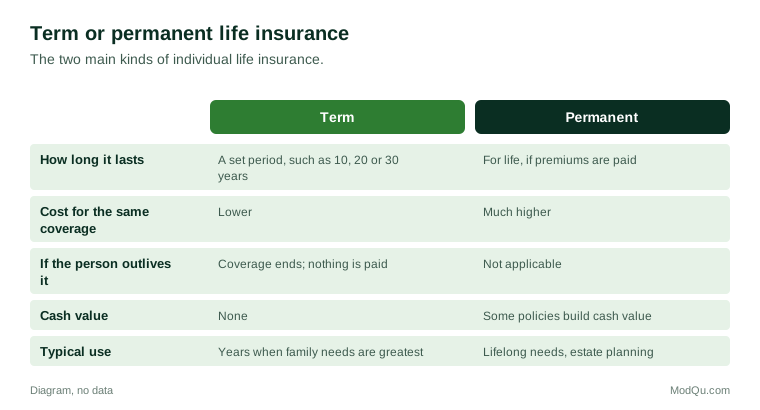
Term insurance covers a set period, such as 10, 20 or 30 years, or until a certain age. If the insured person dies during the term, the benefit is paid. If they outlive the term, the coverage ends and nothing is paid.
Term insurance is usually the least expensive way to buy a large amount of coverage for the years when family needs are greatest. Premiums are fixed for the term but rise sharply if the policy is renewed at an older age.
Example (hypothetical figures)
A healthy 35-year-old non-smoker buys a 20-year term policy for $500,000 for about $30 a month. The coverage lasts until their youngest child is in their twenties and the mortgage is nearly paid. At 55, renewing the same coverage would cost several times as much, but by then they expect to need much less.
Permanent life insurance
Permanent insurance covers the whole of life as long as premiums are paid. The main types are:
- Whole life, with guaranteed premiums and a cash value that grows over time.
- Universal life, which combines insurance with an investment account and allows some flexibility in payments.
- Term to 100, which provides lifelong coverage without cash value.
Permanent policies cost much more than term insurance for the same benefit. They are used for needs that last a lifetime, such as estate taxes, leaving an inheritance, or supporting a dependant with a disability. Some people buy them as a forced savings plan, though this is debated.
Insurance through work and the bank
Many people's only life insurance comes through their employer, often one or two times their salary. Group coverage is convenient and often requires no medical questions, but it usually ends when the person leaves the job and may not be enough for a family.
Banks and lenders also offer mortgage life insurance, which pays off the mortgage if the borrower dies. The benefit usually decreases as the mortgage is paid down while premiums stay the same, and it pays the lender rather than the family. Many borrowers buy it at signing without comparing it with an individual term policy.
Example
A parent assumes their workplace coverage of two years' salary is enough. When they change jobs, the new employer's plan has a waiting period. A financial planner points out that their family would have had no coverage at all during those three months.
How much coverage people buy
Common ways to estimate how much life insurance is needed include:
- income replacement: a multiple of yearly income, such as 7 to 10 times;
- needs analysis: adding up debts, future living costs, education costs and final expenses, then subtracting savings and other coverage.
In practice, many people buy a round number that feels affordable. Research on insurance often finds that households underestimate how much they would need.
How people buy life insurance
People buy coverage in several ways:
- through an insurance adviser or broker, who can compare products and insurers;
- directly from an insurer, by phone or online;
- through banks, often at the same time as a mortgage;
- through associations and group plans.
Buying online has grown, especially for term policies. Some insurers now offer coverage with fewer medical tests or none at all for smaller amounts, using health questions and data checks instead.
Underwriting and medical questions
Before issuing a policy, insurers assess risk through underwriting. Depending on the amount and the person's age, this can involve health questions, a paramedical exam, blood and urine tests and medical records. Smoking, health conditions, family history and dangerous hobbies can raise premiums or lead to exclusions. Some people avoid applying because they dislike medical exams or fear being refused.
Stay-at-home parents and non-earners
Life insurance is often linked to income, so families sometimes insure only the main earner. But a parent who stays home provides child care, cooking, transport and household management that would cost a great deal to replace. Advisers often suggest coverage for both partners, sized to what it would cost the surviving parent to manage without that work.
Example
A family insures the working parent for $750,000 and the stay-at-home parent for nothing. When they price out full-time child care, after-school care and help at home for ten years, they decide to add a $300,000 term policy for the second parent.
Why people do not buy enough
Common reasons people give include:
- cost, or the belief that it costs more than it does;
- not wanting to think about death;
- assuming workplace coverage is enough;
- not knowing how much they need;
- distrust of insurance salespeople;
- never getting round to it.
What happens at claim time
When the insured person dies, beneficiaries contact the insurer with the policy number, a death certificate and claim forms. Most claims are paid within weeks. Delays can happen if the death occurs within the first two years of the policy, the contestability period, when the insurer can review the application for misstatements. Beneficiaries sometimes do not know a policy exists, which is one reason advisers recommend telling family where policies are kept.
What insurers want to know
Insurers and advisers want to understand who has coverage, who does not and why, how people prefer to buy, what they think coverage costs, and what would make them buy more. Life events such as marriage, a new baby and buying a home are the moments when many people first consider it.
Key terms
- Death benefitThe amount paid to beneficiaries when the insured person dies.
- BeneficiaryThe person or organization named to receive the death benefit.
- Term insuranceCoverage for a set period that pays only if death occurs during it.
- Whole life insuranceLifelong coverage with guaranteed premiums and a cash value.
- Cash valueThe savings part of some permanent policies.
- UnderwritingThe insurer's assessment of the risk before issuing a policy.
- PremiumThe regular payment for an insurance policy.
- Contestability periodThe early years of a policy during which the insurer can review the application.
Full glossary: life insurance terms on EditingTests.com.
Life insurance vocabulary test
How well do you know the language of this topic? Try 8 quick questions. Your score is shown straight away and is not saved.
What the life insurance survey asks
This survey is part of ModQu's Insurance survey. The life insurance part takes about five minutes and covers:
- Whether you have life insurance, and whether it is through work, a bank or your own policy.
- What type of policy you have and roughly how much coverage.
- How you bought it, and how you compared options.
- What made you buy it, or what has stopped you from buying more.
- Whether you would buy a policy entirely online.
- Whether your family knows where your policies are kept.
After that you can choose to continue with other short parts of the Insurance survey, such as car insurance or home and tenant insurance, or stop.
Ready to take part?
Your answers help show what people really think and do. Results are only ever reported as totals; no one can see your individual answers.
Start the surveyQuestions about this survey
Who can take part?
Adults aged 25 to 70.
Do I have to give my name?
No. You may be asked for your age group, region and similar details so results can be broken down, but not your name. ModQu never asks for passwords, card numbers or account numbers.
How are the results used?
Answers are combined into totals and percentages and published in ModQu reports. Individual answers are never shown.
Is the vocabulary test part of the survey?
No. It is optional and separate, and your score is not stored.