
Tell us about your claim
Tell us what kind of claim you made, how long it took and whether you stayed with your insurer. Your answers are combined with other people's and reported only as totals.
Start the insurance claims surveyAbout 5 minutes. No account needed. You can stop at any time.
What a claim is
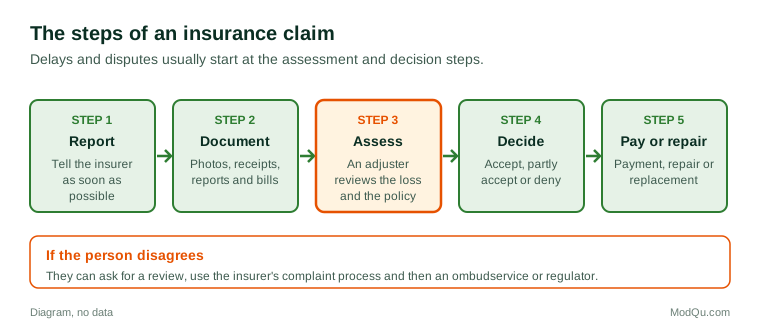
An insurance claim is a request to an insurer to pay for a loss covered by a policy. Claims range from a cracked windshield or a lost suitcase to a house fire or a serious injury. The process follows similar steps across most types of insurance:
- Report the loss to the insurer or broker, as soon as practical.
- Provide information: what happened, when and where, and supporting documents such as photos, receipts, police reports or medical records.
- Assessment by an adjuster or claims specialist, who checks whether the loss is covered and how much it will cost.
- Decision and settlement: the insurer pays for repairs, replaces items, reimburses costs or explains why it will not pay.
- Follow-up: repairs, payments and any review or appeal.
For small claims this can take days. For large or complex claims, such as major water damage or injury, it can take months or years.
Common types of claim
People claim most often for:
- car damage from collisions, theft, vandalism and hail;
- home damage from water, fire, wind and break-ins;
- health and dental expenses through benefits plans;
- travel problems such as medical emergencies, cancelled trips and lost baggage;
- life and disability benefits after a death or illness;
- pet treatment under pet insurance.
Health and dental claims are usually routine and often submitted electronically by the provider. Property and travel claims tend to involve more documentation and judgment.
Example
A family's basement floods after a heavy storm. They call their broker the same evening, take photos of the water and damaged items, and move what they can upstairs. An adjuster visits two days later, and a restoration company begins drying the basement the next day. The claim takes four months to settle as contents are listed and repairs are quoted.
What makes a claim go well
Policyholders who describe good experiences often mention:
- a quick first response and a named contact person;
- clear explanations of what is covered and what happens next;
- regular updates without having to chase;
- fair valuations and prompt payment;
- help with practical needs, such as a rental car or temporary housing;
- respect and empathy, especially after a death, injury or traumatic loss.
What makes a claim go badly
Common complaints include:
- long delays and unanswered calls or emails;
- repeated requests for the same documents;
- adjusters changing several times;
- low offers for written-off cars or damaged belongings;
- disputes about whether the loss is covered;
- denial based on exclusions or pre-existing conditions the policyholder did not understand;
- premium increases or non-renewal after a claim.
Example (hypothetical figures)
A driver's car is written off after a collision. They paid $28,000 for it three years earlier and expected about $20,000. The insurer offers $16,500 based on the market value of similar cars. The driver finds three listings for similar cars at around $19,000 and sends them to the adjuster, who raises the offer to $18,400.
Deciding whether to claim
Not every loss leads to a claim. People weigh:
- the size of the loss against the deductible;
- whether a claim will raise their premium or affect future insurability;
- the time and effort involved;
- whether another party's insurer should pay instead.
Some people avoid claiming for small losses to keep a claims-free record, while others feel that if they pay premiums they should use their coverage.
Documentation
The quality of documentation often determines how smoothly a claim proceeds. Useful records include:
- photos or video of belongings and the condition of the home or vehicle, taken before any loss;
- receipts for valuable items;
- photos of damage taken as soon as it is safe;
- names and details of other people involved and any witnesses;
- police report numbers for thefts and some collisions;
- medical records and itemized bills for health and travel claims.
When people disagree with a decision
If a claim is denied or the offer seems too low, policyholders can:
- ask for a written explanation that cites the policy wording;
- provide more evidence, such as quotes, listings or medical letters;
- ask for the decision to be reviewed by a supervisor;
- use the insurer's formal complaints process;
- in Canada, take unresolved complaints to an independent ombudservice, such as the General Insurance OmbudService for property and car insurance or the OmbudService for Life and Health Insurance;
- seek legal advice for large or complex disputes.
Many people do not know these options exist and accept the first decision.
Example
A traveller's medical claim is refused because the insurer believes a condition was not stable before departure. The traveller asks their doctor for a letter explaining that the medication change was a routine dosage adjustment. With the letter, the insurer reviews the claim and pays it.
How claims affect loyalty
Insurers know that the claim experience drives customer loyalty. A well-handled claim can make someone stay with an insurer for years, even at a higher price. A poorly handled claim often leads to switching and negative reviews. Questions that insurers want answered include how long claims take, how satisfied people are at each stage, what made the difference, and whether the policyholder renewed.
Technology and claims
Many insurers now offer claims through apps, with photo uploads, video assessments and online tracking. Some simple claims are settled very quickly using automated checks. Policyholders often like the speed but want to be able to reach a person when something is complicated or upsetting.
Key terms
- ClaimA request to an insurer to pay for a covered loss.
- AdjusterThe person who assesses a claim and its cost.
- SettlementThe payment or repair arranged to resolve a claim.
- ExclusionSomething the policy does not cover.
- DeductibleThe amount the policyholder pays before the insurer pays.
- Total lossWhen repairing an item or vehicle would cost more than it is worth.
- SubrogationThe insurer recovering its costs from the party responsible for the loss.
- OmbudserviceAn independent service that reviews unresolved insurance complaints.
Full glossary: insurance claims terms on EditingTests.com.
Insurance claims vocabulary test
How well do you know the language of this topic? Try 8 quick questions. Your score is shown straight away and is not saved.
What the insurance claims survey asks
This survey is part of ModQu's Insurance survey. The insurance claims part takes about five minutes and covers:
- What kind of claim you made in the last three years, and with which type of insurance.
- How long the claim took from first report to settlement.
- How you rate communication, fairness and speed.
- Whether the outcome matched what you expected from your policy.
- Whether you disputed the decision, and what happened.
- Whether you renewed with the same insurer afterwards.
After that you can choose to continue with other short parts of the Insurance survey, such as car insurance or home and tenant insurance, or stop.
Ready to take part?
Your answers help show what people really think and do. Results are only ever reported as totals; no one can see your individual answers.
Start the surveyQuestions about this survey
Who can take part?
Adults who made any insurance claim in the last three years.
Do I have to give my name?
No. You may be asked for your age group, region and similar details so results can be broken down, but not your name. ModQu never asks for passwords, card numbers or account numbers.
How are the results used?
Answers are combined into totals and percentages and published in ModQu reports. Individual answers are never shown.
Is the vocabulary test part of the survey?
No. It is optional and separate, and your score is not stored.
Do I need to name my insurer?
You may be asked which insurer you used so results can be compared, but you can choose not to answer. Results are never reported for named individuals.
Can ModQu help me with my claim?
No. ModQu runs surveys and does not act for policyholders. Your insurer's complaints process and the ombudservices listed above can help with disputes.