
Tell us about your home insurance
Tell us whether you have home or tenant insurance, how you bought it and what you think it covers. Your answers are combined with other people's and reported only as totals.
Start the home and tenant insurance surveyAbout 5 minutes. No account needed. You can stop at any time.
Who needs home or tenant insurance
Home insurance is not required by law, but lenders require it for anyone with a mortgage. Condominium corporations insure the building, and owners usually need their own condo policy for their unit and belongings. Landlords insure the buildings they own, but their policy does not cover tenants' belongings or tenants' liability.
That means three main groups buy coverage:
- homeowners, who insure the building, belongings and liability;
- condo owners, who insure improvements to their unit, belongings, liability and some shared costs;
- tenants, who insure belongings, liability and extra living expenses.
Tenant insurance is often inexpensive compared with the cost of replacing belongings, yet many renters do not have it. Some landlords now require tenants to carry it.
What a typical policy covers
Most policies combine several parts:
- Dwelling: the structure of the home.
- Contents: furniture, clothing, electronics and other belongings, sometimes with limits on items such as jewellery, bicycles or collections.
- Liability: if someone is injured on your property or you accidentally damage someone else's property.
- Additional living expenses: hotel and meal costs if you cannot live at home after an insured loss.
Policies are often described as "comprehensive" (covering all risks except those excluded) or "named perils" (covering only listed risks such as fire and theft).
Example
A tenant's apartment is damaged by smoke from a fire two floors below. Their tenant policy pays to clean and replace clothing and furniture, and covers three weeks in a hotel while the building is repaired. Their neighbour, without insurance, has to pay for everything themselves.
Common exclusions and gaps
Many people are surprised by what their policy does not cover. Common exclusions or limits include:
- overland flooding from rivers, lakes or heavy rain, which often needs an add-on;
- sewer backup, also usually an add-on;
- earthquakes, often requiring separate coverage;
- gradual damage, such as slow leaks, rot and mould;
- wear and tear and lack of maintenance;
- home businesses, whose equipment and liability may need extra coverage;
- short-term rentals, if the home is rented to guests without telling the insurer.
Flooding and climate risk
Water damage has become one of the largest sources of home insurance claims. In Canada, overland flood insurance has been available from many private insurers for about a decade, but some homes in high-risk areas find it unavailable or very expensive. Governments have been studying ways to make flood insurance available to high-risk households.
Wildfires, hail, windstorms and extreme rainfall have also increased claims costs. These changes affect premiums, deductibles and in some areas whether insurers will offer coverage at all.
Example
A family in a river valley buys a home without asking about flood coverage. Two years later, after a spring flood fills their basement, they learn their policy covers sewer backup but not overland water from the river. The repair costs fall mostly on them.
How premiums are set
Insurers look at many factors:
- the home's location and its exposure to fire, flood, theft and storms;
- age, size, construction type and the condition of the roof, wiring, plumbing and heating;
- distance to a fire hydrant and fire station;
- the value of belongings;
- claims history;
- security systems, water leak detectors and sump pumps;
- the deductible chosen.
Bundling home and car insurance with one insurer often brings a discount.
Example (hypothetical figures)
A homeowner's premium is $1,800 a year with a $1,000 deductible. Raising the deductible to $2,500 lowers the premium to $1,550, saving $250 a year. They calculate that the saving would cover the extra deductible only if they went six years without a claim, and decide the risk is acceptable for them.
Replacement cost and actual cash value
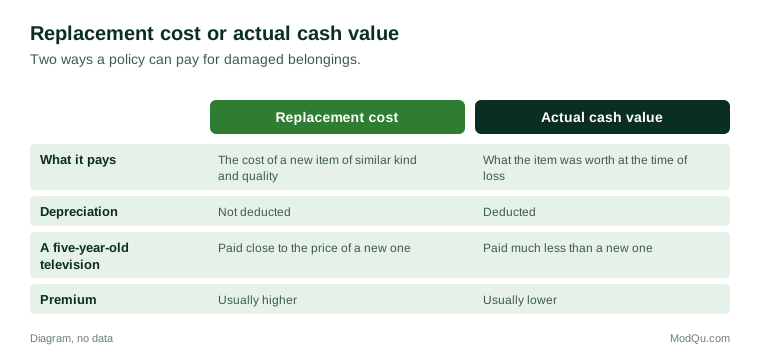
Policies pay claims in different ways. Replacement cost pays to replace damaged items with new ones of similar kind and quality. Actual cash value pays what the items were worth at the time of loss, after depreciation. A five-year-old television insured at actual cash value may be worth much less than the cost of a new one. Many people do not know which type their policy uses.
Reducing risk at home
Insurers and fire services encourage simple steps that make losses less likely or smaller, and some insurers offer discounts for them:
- installing and testing smoke and carbon monoxide alarms;
- fitting water leak sensors near water heaters, washing machines and under sinks;
- installing a sump pump and a backwater valve to reduce basement flooding;
- keeping gutters and downspouts clear and directing water away from the foundation;
- shutting off the main water valve when away for long periods;
- monitored alarm systems and good locks;
- clearing brush and flammable material around homes in wildfire areas.
Some municipalities offer subsidies for backwater valves and other flood protection. Many homeowners are not aware of these programs.
Making a claim
After a loss, policyholders contact their insurer or broker, document the damage and list what was lost. An adjuster assesses the claim. Common frustrations include proving what was owned, delays in repairs, disagreements over value and premium increases after a claim. Keeping photos or a video of belongings makes claims easier.
How people buy and renew
People buy home insurance from brokers, directly from insurers, through their bank or through group plans. Many choose an insurer when they buy a home and rarely compare again. Rising premiums and new exclusions have prompted more people to review their policies.
Tenants and insurance
Renters often underestimate how much their belongings are worth. When they add up furniture, clothing, electronics and kitchen items, the total is often several times what they expected. Renters may also not know that tenant insurance includes liability coverage, which can protect them if, for example, a bathtub overflow damages the unit below.
Key terms
- Dwelling coverageInsurance for the structure of a home.
- Contents coverageInsurance for belongings inside the home.
- Liability coverageProtection if you are responsible for injury or damage to others.
- Additional living expensesCosts of living elsewhere while your home is repaired after an insured loss.
- Overland floodingWater entering a home from rivers, lakes or heavy rain on the ground surface.
- Sewer backupWater or sewage flowing back into a home through drains.
- Replacement costPayment to replace items with new ones of similar kind and quality.
- Actual cash valuePayment for what items were worth at the time of loss, after depreciation.
Full glossary: property casualty insurance terms on EditingTests.com.
Home and tenant insurance vocabulary test
How well do you know the language of this topic? Try 8 quick questions. Your score is shown straight away and is not saved.
What the home and tenant insurance survey asks
This survey is part of ModQu's Insurance survey. The home and tenant insurance part takes about five minutes and covers:
- Whether you have home, condo or tenant insurance, and how you bought it.
- What you believe your policy covers, including flooding and sewer backup.
- How your premium has changed recently.
- Whether you have made a claim, and how it was handled.
- How worried you are about floods, fires or storms where you live.
- What would make you change your coverage or insurer.
After that you can choose to continue with other short parts of the Insurance survey, such as car insurance or life insurance, or stop.
Ready to take part?
Your answers help show what people really think and do. Results are only ever reported as totals; no one can see your individual answers.
Start the surveyQuestions about this survey
Who can take part?
Homeowners and renters.
Do I have to give my name?
No. You may be asked for your age group, region and similar details so results can be broken down, but not your name. ModQu never asks for passwords, card numbers or account numbers.
How are the results used?
Answers are combined into totals and percentages and published in ModQu reports. Individual answers are never shown.
Is the vocabulary test part of the survey?
No. It is optional and separate, and your score is not stored.