
Share your experience of holidays and travel
Tell us where you went on your last trip, how you booked it and what you plan for next year. Your answers are combined with other people's and reported only as totals.
Start the holiday and leisure travel surveyAbout 5 minutes. No account needed. You can stop at any time.
What this topic covers
Leisure travel means trips taken for pleasure, rest or personal reasons rather than for work. This topic covers:
- Domestic trips within Canada, from weekend getaways to cross-country journeys.
- Trips to the United States, which are common for Canadians because of distance and familiarity.
- International holidays, including beach resorts, city breaks, tours and adventure trips.
- Visiting friends and relatives, one of the most common reasons for travel.
- Road trips, camping and cottage stays.
- Package holidays and all-inclusive resorts.
Air travel, hotels and rentals, cruises, booking sites and car rental each have their own pages. This page looks at the trip as a whole.
Why people travel
People travel for leisure for many reasons, and often more than one at once:
- rest and relaxation, especially a break from work and routine;
- seeing family and friends who live far away;
- escaping winter, a strong reason for Canadian trips south in January to March;
- culture and history: museums, food, festivals and historic sites;
- nature and outdoor activity: parks, hiking, skiing, fishing and beaches;
- special occasions: honeymoons, anniversaries, milestone birthdays and family reunions;
- events: concerts, sports games and weddings;
- roots travel to places linked to family history.
How people choose where to go
Common factors in choosing a destination include:
- cost, including flights, accommodation and daily spending;
- time available and distance;
- weather at the time of year;
- safety, including travel advisories;
- exchange rates, which affect how far Canadian dollars go;
- recommendations from friends, family, social media and travel writers;
- past experience, since many people return to places they enjoyed;
- who is travelling: couples, families with young children, groups of friends, solo travellers and older travellers have different needs.
The Government of Canada publishes travel advice and advisories for every country, which many travellers check before booking.
Example
A couple in their sixties plan a three-week trip to celebrate their retirement. They narrow the list to three countries, check the government travel advisories, compare the exchange rate for each, and choose the one where a friend has offered to show them around for the first few days.
Planning and booking
People plan trips in different ways. Some book months ahead to secure prices and choices; others wait for last-minute deals. Common ways of booking include:
- directly with airlines, hotels and tour companies;
- through online travel agencies and booking apps;
- through travel agents, who are often used for complex trips, cruises, group travel and package holidays;
- through package deals that combine flights and accommodation;
- with points and rewards from credit cards or loyalty programs.
Planning often involves several sources: reviews, maps, social media, travel guides and advice from people who have been there.
Example
A family of five books a summer trip to the east coast eight months ahead to get a rental cottage big enough for everyone. They book flights to the nearest airport with points, rent a minivan, and leave the rest of the itinerary open so they can decide day by day.
What people spend
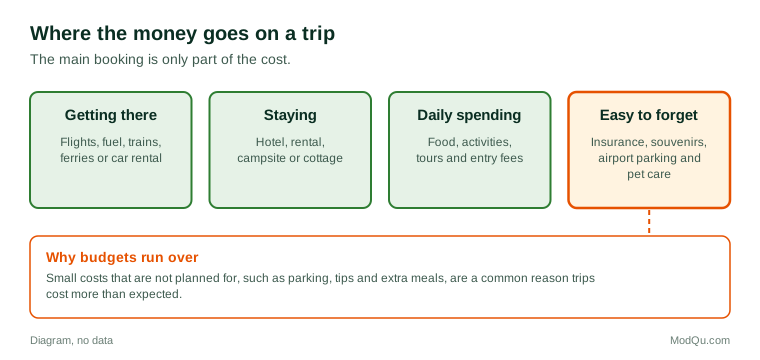
The cost of a trip includes much more than the main booking. Common costs are:
- transportation: flights, fuel, trains, buses, ferries and car rental;
- accommodation;
- food and drink;
- activities, tours and entry fees;
- travel insurance;
- shopping and souvenirs;
- costs at home, such as pet care or parking at the airport.
Many travellers set a budget, but it is common to spend more than planned. Rising prices for flights and accommodation have led some households to travel less often, travel closer to home or take shorter trips. Others keep travelling but cut back elsewhere, treating a yearly holiday as a priority in the household budget.
Example (hypothetical figures)
Two friends plan a one-week trip with a budget of $2,500 each. Flights cost $750 each, their shared rental costs $1,400 ($700 each), and they set aside $100 a day each for food and activities, $700 each for the week. That totals $2,150 each before insurance and souvenirs, leaving $350 each for extras.
Travelling with others
Travelling with children brings its own questions: school holidays, flight times, child-friendly accommodation and activities, and cost per person. Multigenerational trips, where grandparents travel with children and grandchildren, have become common, especially for reunions and milestone birthdays. Solo travel is popular among people of all ages, with safety and single supplements, the extra charge for one person in a room priced for two, as common concerns.
Accessibility also shapes travel. People with disabilities and older travellers consider whether airports, transportation, accommodation and attractions are accessible, and many say this limits where they can go.
Example
A traveller who uses a wheelchair plans a city break. Before booking, they email three hotels to ask for photos of the accessible bathroom, check which subway stations have elevators, and choose a hotel within rolling distance of the main sights, even though it costs more than others.
What affects travel plans
Travel plans are sensitive to events and changes, including:
- prices and the value of the Canadian dollar;
- personal finances and job security;
- health, both personal and public health situations;
- weather and natural disasters, such as hurricanes and wildfires;
- political events and changes to border rules;
- flight disruptions and strikes.
People's plans for the next year are often a useful early sign of change in the travel industry, which is why questions about intended travel are common in travel surveys.
Responsible travel and what people disagree about
Some travellers want to reduce the environmental effect of their trips by flying less, travelling by train, staying longer in one place or choosing local businesses. Others feel that individual choices make little difference. Popular destinations around the world have introduced visitor limits and tourist taxes to manage crowds, and opinion is divided on whether these are fair.
People also disagree about whether all-inclusive resorts or independent travel give better value, whether travel is a necessity or a luxury, how much to rely on online reviews, and whether to travel during busy seasons.
Key terms
- Domestic travelTravel within your own country.
- Package holidayA trip that combines flights, accommodation and sometimes meals.
- All-inclusiveA resort price that covers rooms, meals, drinks and many activities.
- Travel advisoryGovernment advice about safety in another country.
- ItineraryA plan of a trip's places, dates and activities.
- Exchange rateThe value of one currency in another.
- Single supplementAn extra charge for one person in a room priced for two.
- Shoulder seasonThe period between the busy and quiet travel seasons.
Full glossary: travel tourism terms on EditingTests.com.
Holiday and leisure travel vocabulary test
How well do you know the language of this topic? Try 8 quick questions. Your score is shown straight away and is not saved.
What the holiday and leisure travel survey asks
This survey is part of ModQu's Travel and Hospitality survey. The holiday and leisure travel part takes about five minutes and covers:
- Where you went on your last holiday or leisure trip, and with whom.
- How you planned and booked it.
- What the trip cost, and whether you stayed within your budget.
- What mattered most in choosing the destination.
- Whether you plan to travel more or less next year, and why.
- What would stop you from travelling.
After that you can choose to continue with other short parts of the Travel and Hospitality survey, such as air travel or hotels and short-term rentals, or stop.
Ready to take part?
Your answers help show what people really think and do. Results are only ever reported as totals; no one can see your individual answers.
Start the surveyQuestions about this survey
Who can take part?
Adults who travelled for leisure in the last two years.
Do I have to give my name?
No. You may be asked for your age group, region and similar details so results can be broken down, but not your name. ModQu never asks for passwords, card numbers or account numbers.
How are the results used?
Answers are combined into totals and percentages and published in ModQu reports. Individual answers are never shown.
Is the vocabulary test part of the survey?
No. It is optional and separate, and your score is not stored.
Do trips to see family count?
Yes. Visiting friends and relatives is one of the kinds of leisure travel the survey asks about.