
Share your experience across generations
Tell us whether you help with grandchildren, whether generations share your home and what support you give or receive. Your answers are combined with other people's and reported only as totals.
Start the grandparents and multigenerational families surveyAbout 5 minutes. No account needed. You can stop at any time.
What this topic covers
This topic is about relationships and support between generations of a family: grandparents, their adult children and their grandchildren. It covers grandparents who provide childcare, households where three or more generations live together, help with money and housing, and care that flows both ways as grandparents age.
Families differ widely. Some grandparents live in the same house as their grandchildren; some live nearby and help every week; others live in another province or country and keep in touch by video. Some grandparents are raising grandchildren themselves, often called skip-generation families.
Grandparents and childcare
Grandparents are a major source of childcare. They may look after babies when parental leave ends, pick children up from school, care for them during school holidays or when they are sick, and fill gaps when licensed care is not available or affordable.
The arrangement brings benefits and strains:
- For parents: lower costs, flexible hours and care from someone they trust.
- For grandparents: time with grandchildren and a sense of purpose, but also physical demands and less free time.
- For children: a close bond with grandparents and contact with family history and language.
Questions about rules (food, screens, discipline), payment, and how many days are reasonable can cause tension if not discussed openly. Some families pay grandparents for regular care or cover their costs for food and travel; others see payment as out of place in a family. Where grandparents are still working themselves, childcare may be limited to evenings, weekends and emergencies.
Example
A retired grandmother looks after her two grandchildren three days a week while their parents work. After a year she tells her daughter that three days is tiring and she wants to travel in the spring. They agree on two days a week, and the family finds a licensed home child care provider for the third.
Three generations under one roof
A multigenerational household is one where three or more generations live together, such as grandparents, parents and children. Statistics Canada has reported that multigenerational households are one of the fastest-growing types of household in Canada, and they are more common in some immigrant and Indigenous communities.
Families give many reasons for living together:
- Housing costs, which make it hard for young families to buy or rent alone.
- Childcare from grandparents living in the home.
- Care for ageing parents, who may not want to live alone or in a care home.
- Culture and tradition, where living together is expected and valued.
- Immigration, when parents or grandparents join family already in Canada.
- Life events, such as a separation, a job loss or the death of a spouse.
Making a shared home work
Living together requires practical and personal arrangements. Families often talk about:
- Space: separate bedrooms, a second kitchen, a basement suite, or a separate entrance.
- Money: who owns the home, who pays the mortgage, utilities and food, and what happens if someone moves out.
- Privacy and routines: quiet hours, guests, use of shared rooms.
- Roles: who cooks, cleans, drives and looks after children.
- Future plans: what happens if a grandparent needs more care.
Home designs have adapted, with builders offering homes that include an in-law suite, and some municipalities allowing secondary suites or laneway and garden homes on residential lots.
Example (hypothetical figures)
Two grandparents sell their home and put $200,000 toward a larger house with their daughter's family, who take a $500,000 mortgage. The house costs $700,000. The grandparents' share is 200 ÷ 700, or about 29%. They record the arrangement in writing with a lawyer, including what happens to their share if the house is sold.
Support that flows both ways
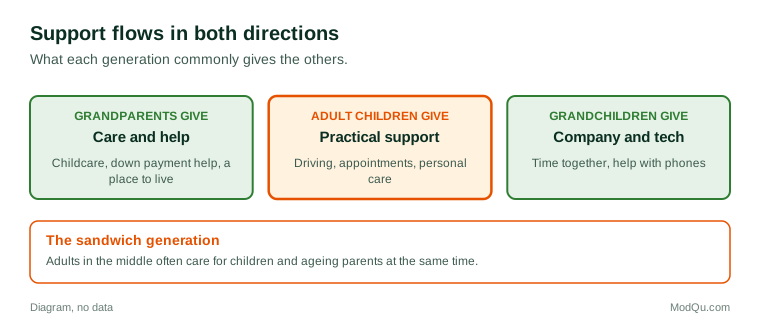
Support between generations runs in both directions and changes over time:
- Grandparents to the younger generations: childcare, help with a down payment, paying for activities or education savings, advice, and a place to live during hard times.
- Adult children to grandparents: driving, shopping, managing appointments and medication, help with technology, and personal care as health declines.
- Grandchildren to grandparents: company, help with phones and computers, and in some families care work as teenagers or young adults.
Many middle-aged adults are part of the "sandwich generation", caring for children and ageing parents at the same time, which can strain time, money and health.
Example
A man in his late forties lives with his wife, their two teenagers and his mother, who has early memory loss. His mother still cooks for the family most days, and the teenagers help her with her tablet. When her memory worsens, the family arranges adult day programs twice a week so that she has company and they can keep working.
Grandparents raising grandchildren
Some grandparents become the main carers for their grandchildren when parents cannot care for them because of illness, addiction, incarceration, death or child protection concerns. These kinship arrangements may be informal, arranged through a child welfare agency, or made legal through custody or guardianship orders. Grandparents in this role often face sudden costs, legal steps, and the work of parenting again later in life, and support programs and financial help vary by province.
Long-distance grandparenting
Many grandparents live far from their grandchildren, sometimes in another country. They keep in touch through video calls, messaging, shared photo albums, mailed letters and gifts, and long visits. Immigration rules affect some families: in Canada, the Parent and Grandparent Super Visa allows eligible parents and grandparents of citizens and permanent residents to visit for extended periods, subject to conditions such as health insurance and income requirements.
Changing patterns and debates
People are living longer, so more children grow up knowing their grandparents and even great-grandparents. At the same time, families are often more spread out. Debates in this area include how much childcare grandparents should be expected to provide, whether they should be paid, how to share costs fairly in a shared home, and what governments should do to support family caregivers. Questions businesses want answered include how many families live across generations, what childcare grandparents provide, and what housing and services such families need.
Key terms
- Multigenerational householdA home where three or more generations live together.
- Skip-generation familyA household where grandparents raise grandchildren without the parents.
- Sandwich generationAdults caring for both their children and their ageing parents.
- In-law suiteA self-contained living space within or attached to a family home.
- Secondary suiteA separate unit within a house, permitted under municipal rules.
- Super VisaA Canadian visa letting eligible parents and grandparents visit for long periods.
- Kinship careCare of a child by relatives or close family friends.
- Adult day programA daytime program offering activities and care for older adults.
Full glossary: senior living services terms on EditingTests.com.
Grandparents and multigenerational families vocabulary test
How well do you know the language of this topic? Try 8 quick questions. Your score is shown straight away and is not saved.
What the grandparents and multigenerational families survey asks
This survey is part of ModQu's Life Stages and Family survey. The grandparents and multigenerational families part takes about five minutes and covers:
- Whether you help care for grandchildren, and how often.
- Whether three or more generations live in your home, and why.
- What support you give to, or receive from, other generations of your family.
- How your household shares costs, space and tasks.
- How you keep in touch with family who live far away.
- What would make life across generations easier for your family.
After that you can choose to continue with other short parts of the Life Stages and Family survey, such as ageing and senior living or weddings and celebrations, or stop.
Ready to take part?
Your answers help show what people really think and do. Results are only ever reported as totals; no one can see your individual answers.
Start the surveyQuestions about this survey
Who can take part?
Grandparents and multigenerational households.
Do I have to give my name?
No. You may be asked for your age group, region and similar details so results can be broken down, but not your name. ModQu never asks for passwords, card numbers or account numbers.
How are the results used?
Answers are combined into totals and percentages and published in ModQu reports. Individual answers are never shown.
Is the vocabulary test part of the survey?
No. It is optional and separate, and your score is not stored.