
Share your fast-food habits
Tell us how often you eat fast food, whether you order through an app and whether prices have changed how often you go. Your answers are combined with other people's and reported only as totals.
Start the fast food and quick service surveyAbout 5 minutes. No account needed. You can stop at any time.
What quick service means
The restaurant industry divides restaurants into types by how they serve customers. The main ones are:
- Quick-service restaurants (QSRs), commonly called fast food: customers order at a counter, kiosk, drive-through or app, pay before eating, and get food quickly. Menus focus on burgers, chicken, pizza, sandwiches, tacos, coffee and breakfast items.
- Fast-casual restaurants: counter service like fast food, but with a menu and setting closer to a sit-down restaurant, often with made-to-order bowls, salads, burritos or higher-priced burgers, and usually higher prices.
- Full-service restaurants, where staff take orders and serve at the table.
- Coffee and doughnut shops, a large part of quick service in Canada, often with drive-throughs.
- Food courts, food trucks and convenience stores, which also sell quick meals.
Most quick-service restaurants in Canada belong to large chains, many run as franchises, where a local owner operates a restaurant under a company's brand and system. There are also many independent fast-food restaurants, such as local pizza, shawarma, burger and fish-and-chip shops.
How often people go and why
How often people eat fast food varies widely, from several times a week to almost never. The reasons people give tend to be:
- Speed when short of time, such as between work and children's activities;
- Convenience, with many locations and drive-throughs;
- Price, compared with full-service restaurants;
- Taste and cravings for familiar foods;
- Consistency: knowing what to expect;
- Travel: road trips and highway stops;
- Social reasons: teenagers meeting friends, families treating children;
- Late hours, when little else is open.
People who eat fast food less often mention cost, health, taste, and wanting to cook more at home.
Example
A parent with two children in evening sports picks up fast food once or twice a week on practice nights, between work and the rink. They would rather cook, but with 45 minutes between the end of work and the start of practice, the drive-through is the only option that fits.
How people order
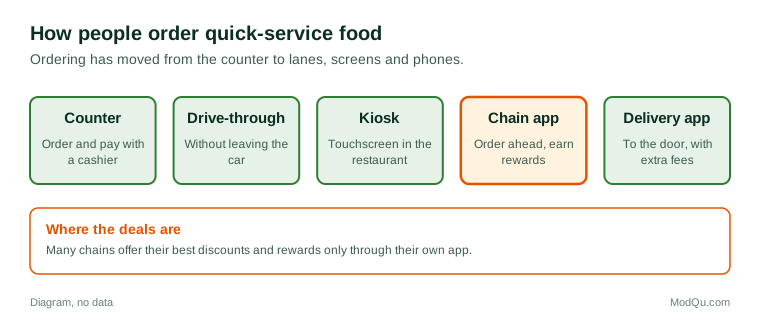
The way people order fast food has changed a great deal:
- Drive-throughs handle a large share of orders at many chains in Canada, and some new restaurants are built with two drive-through lanes or none for dining in.
- Self-order kiosks in restaurants let customers order and pay on a screen.
- Mobile apps let customers order ahead and pick up, often with a separate pickup shelf or parking spot.
- Third-party delivery apps bring fast food to the door, usually with higher prices and extra fees.
- The counter, still common and preferred by some customers.
Questions that businesses want answered here include how many people order through apps, how they choose between the drive-through, the counter and delivery, and what they value most in each.
Apps, loyalty programs and deals
Most large chains have their own app, often linked to a loyalty program. Customers earn points or rewards for purchases and get personalized offers. Apps let restaurants send deals, track orders and learn about customers' habits.
Customers like the discounts and the convenience. Some say they use apps mainly for deals and would not otherwise. Others dislike sharing data, keeping many different apps, or feeling that the best prices are only available to app users.
Example (hypothetical figures)
A customer buys a breakfast combo for $8.49 three times a week. Through the chain's app, they get a $2 discount once a week and earn points that give a free combo every 10 purchases. Over 10 weeks they buy 30 combos: the full price would be $254.70. They pay $8.49 × 27 = $229.23 after three free combos, then save $20 more from 10 weekly discounts, for a total of $209.23, about 18% less.
Prices and value
Fast-food prices rose quickly in Canada and many other countries in the early 2020s, along with food prices generally, because of higher costs for ingredients, wages, energy and rent. Many customers noticed that meals that once seemed cheap now cost about as much as some sit-down meals.
People respond in different ways:
- going less often;
- choosing value menus, combos and app deals;
- ordering smaller meals or skipping drinks and sides;
- switching to cheaper chains or grocery store options;
- cooking at home more.
Some customers also notice shrinkflation, where portion or package sizes get smaller while prices stay the same or rise.
Health and nutrition
Many fast-food items are high in calories, sodium, saturated fat or sugar, and eating fast food often has been linked in research to less healthy diets. At the same time, many chains now offer salads, grilled items, smaller portions, fruit and lower-sugar drinks, and some publish nutrition information online and in apps.
In Ontario, chains with 20 or more locations must post calories on menus and menu boards. Other provinces have discussed similar rules. People's use of calorie information varies: some check it and change their order, while many say they rarely look.
This page describes these issues in general terms and does not give dietary advice.
Example
A commuter who buys lunch at a sandwich chain most workdays starts looking at the calories shown on the menu board. They switch from a footlong to a six-inch sandwich with a side salad. The price is a little lower, and they say they no longer feel tired in the afternoon, though they still order the larger sandwich on Fridays.
Work, packaging and what people disagree about
Fast food is also a large employer, especially of young people in their first jobs. Debates about minimum wages, scheduling and staffing often focus on quick-service restaurants. Packaging is another issue: single-use cups, bags and containers create waste, and Canada and several provinces and cities have introduced rules on some single-use plastics.
People disagree about whether governments should limit fast-food advertising to children, require more nutrition labelling, or tax sugary drinks; whether self-order kiosks and automation improve service or reduce jobs; and whether fast food is still good value at today's prices.
Key terms
- Quick-service restaurantA restaurant where customers order at a counter, kiosk, drive-through or app and pay first.
- Fast casualCounter-service restaurants with a menu and setting closer to sit-down dining.
- FranchiseA business run by a local owner under a company's brand and system.
- Drive-throughA lane where customers order and collect food without leaving their car.
- Loyalty programA scheme that rewards repeat customers with points, offers or free items.
- Combo mealA main item sold with a side and a drink at a set price.
- Self-order kioskA touchscreen where customers order and pay without a cashier.
- ShrinkflationSmaller portions or packages sold for the same or a higher price.
Full glossary: restaurant chains terms on EditingTests.com.
Fast food and quick service vocabulary test
How well do you know the language of this topic? Try 8 quick questions. Your score is shown straight away and is not saved.
What the fast food and quick service survey asks
This survey is part of ModQu's Food and Drink survey. The fast food and quick service part takes about five minutes and covers:
- How often you eat fast food, and at what times of day.
- Which kinds of quick-service restaurants you visit most.
- How you usually order: counter, drive-through, kiosk, app or delivery.
- Whether you use apps and loyalty programs, and why.
- Whether rising prices have changed how often you go or what you order.
- What matters most to you when choosing where to go.
After that you can choose to continue with other short parts of the Food and Drink survey, such as eating habits or coffee, tea and beverages, or stop.
Ready to take part?
Your answers help show what people really think and do. Results are only ever reported as totals; no one can see your individual answers.
Start the surveyQuestions about this survey
Who can take part?
Adults.
Do I have to give my name?
No. You may be asked for your age group, region and similar details so results can be broken down, but not your name. ModQu never asks for passwords, card numbers or account numbers.
How are the results used?
Answers are combined into totals and percentages and published in ModQu reports. Individual answers are never shown.
Is the vocabulary test part of the survey?
No. It is optional and separate, and your score is not stored.
I rarely eat fast food. Can I take part?
Yes. Your reasons for going rarely are just as useful as answers from regular customers.