
Tell us how you pay
Tell us which payment methods you use, which you trust and which you avoid. Your answers are combined with other people's and reported only as totals.
Start the digital payments and wallets surveyAbout 5 minutes. No account needed. You can stop at any time.
What digital payments cover
A digital payment is any payment where money moves electronically rather than as notes and coins. That covers a wide range of everyday actions:
- Card payments: debit and credit cards, inserted with a PIN, tapped at a terminal or typed in online.
- Mobile and wearable wallets: a card stored on a phone or watch and used by holding it near a terminal.
- Person-to-person transfers: sending money to a friend, a landlord or a babysitter by e-transfer or a payment app.
- Online checkouts: card details saved with a store, digital wallet buttons, and account-based services that pay on your behalf.
- Instalment plans: "buy now, pay later" offers that split a purchase into several payments.
- Automatic payments: subscriptions and bills charged to a card or bank account on a schedule.
Behind each of these sits a network that moves the money between banks, card companies and merchants. Most people never see that layer. What they notice is speed, convenience, fees and whether the payment works the first time.
How people choose a way to pay
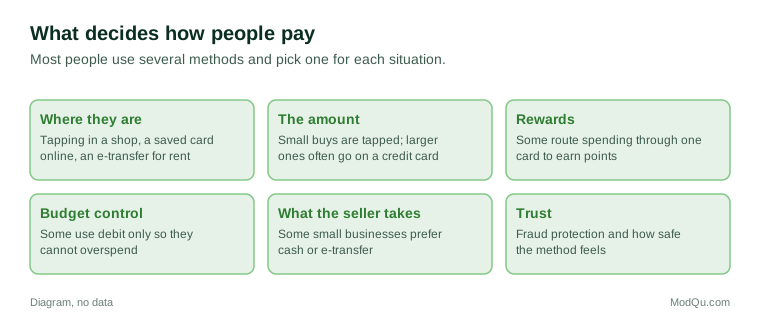
Most people use several methods and pick one for each situation without thinking much about it. The choice usually depends on a few things:
- Where they are: tapping at a coffee shop, a saved card at an online store, an e-transfer for rent.
- The amount: small purchases are often tapped; larger ones may go on a credit card for protection or rewards.
- Rewards and cash back: some people route as much spending as possible through one card to earn points.
- Budget control: others use debit only, so they cannot spend money they do not have.
- What the seller accepts: some small businesses still prefer cash or e-transfer to avoid card fees.
Example
A nurse pays for groceries with a rewards credit card, taps a phone for coffee, sends an e-transfer to split a dinner bill with friends and keeps $40 in cash for a farmers market that only takes cash. Asked which payment method they use most, they are not sure: each one has its place.
These habits matter to banks, card networks, payment apps and stores. Questions they want answered include which method people reach for first, what would make them switch, and how much a reward or discount would have to be worth to change behaviour.
Tap, phone and wearable payments
Contactless payment has become the normal way to pay in person in many countries. A card or device is held near the terminal and the payment goes through in seconds. For larger amounts, the terminal may ask for a PIN or the phone may ask for a fingerprint or face check.
Phone and watch wallets work in a similar way, but they add a layer of security: the card number is usually replaced by a token, so the store never receives the real number. Many people still prefer the physical card. Reasons they give include habit, worry about a phone's battery dying at the till, and not knowing how to set the wallet up.
Example
A retired teacher has a phone wallet set up by a grandchild but has never used it. At the till, they always reach for their card. When the card is lost on holiday, they discover the phone wallet still works and start using it at home too.
Sending money to other people
Person-to-person payments have replaced cheques and cash for many small debts between people. In Canada, Interac e-Transfer is widely used for this. Other countries have their own systems, and there are also app-based services that work across banks.
People use these transfers to pay rent, reimburse friends, pay tradespeople, sell items second-hand and send gifts. The main concerns are sending money to the wrong person, scams in online marketplaces, and transfer limits that are too low for rent or deposits.
Example
A student buys a used bike from an online listing. The seller asks for an e-transfer deposit before the meeting. The student refuses after a friend warns that deposits are a common scam. They pay in person instead, after checking the bike.
Buy now, pay later
"Buy now, pay later" (BNPL) plans let a shopper split a purchase into a small number of payments, often four payments over six weeks, sometimes without interest if every payment is on time. They are offered at many online checkouts and some stores.
Supporters say these plans help people spread costs without a credit card. Critics point to late fees, the ease of taking on several plans at once, and the risk that people lose track of what they owe. Some regulators have started to look at how these plans are disclosed and reported to credit bureaus.
Example (hypothetical figures)
A shopper buys a $240 jacket using a plan of four payments of $60, two weeks apart. They also buy $160 of shoes on another plan of four $40 payments. Two months later, payments of $60 and $40 fall in the same week as rent, and one payment is missed. The plan charges a late fee, and the shopper decides to stop using instalments.
Fees, and who pays them
Most digital payments look free to the person paying. The costs are usually paid by the seller:
- Card acceptance fees are charged to merchants for each card payment, often a percentage of the sale.
- Surcharges are passed on by some merchants to customers who pay by credit card, where the rules allow it.
- Foreign transaction fees can apply when paying in another currency.
- Transfer fees may apply to some person-to-person transfers, depending on the bank account.
This is why some small shops prefer cash or debit, or set a minimum amount for card payments. Shoppers are often unaware of these costs until a surcharge appears on a receipt.
Safety, fraud and trust
Trust is the main barrier to new payment methods. People worry about:
- card numbers being stolen online;
- phone theft and someone using the wallet;
- phishing texts and emails that look like they come from a bank or delivery company;
- scams where they are persuaded to send a transfer themselves, which may be harder to recover than a fraudulent card charge.
Many people feel safer with credit cards than with debit cards online because disputed charges do not take money from their own account while a claim is investigated. Others avoid saving card details with any store.
Is cash disappearing?
Cash use has fallen sharply in many countries, but it has not disappeared. Some people rely on it for budgeting, privacy or because they do not have a bank account. Small businesses may prefer it to avoid card fees. Cash is also important as a backup when networks fail or during power cuts.
Central banks, including the Bank of Canada, study how people pay and whether cash should remain widely available. Public attitudes are mixed: many people rarely use cash but still want it to be accepted.
Key terms
- Contactless paymentPaying by holding a card, phone or watch near a terminal.
- Digital walletAn app that stores payment cards on a phone or watch.
- TokenizationReplacing a card number with a substitute code so the real number is not shared.
- E-transferA bank-to-bank transfer sent using an email address or phone number.
- Buy now, pay laterA plan that splits a purchase into several smaller payments.
- ChargebackReversal of a card payment after the cardholder disputes it.
- SurchargeAn extra fee a merchant adds when a customer pays by credit card.
- PhishingA fake message that tries to trick someone into sharing details or sending money.
Full glossary: digital payments terms on EditingTests.com.
Digital payments and wallets vocabulary test
How well do you know the language of this topic? Try 8 quick questions. Your score is shown straight away and is not saved.
What the digital payments and wallets survey asks
This survey is part of ModQu's Money and Banking survey. The digital payments and wallets part takes about five minutes and covers:
- Which payment methods you used in the last month, in stores and online.
- Which method you use most, and why.
- Whether you use a phone or watch wallet, and what stops you if not.
- Your experience of buy now, pay later plans.
- How safe you feel with each payment method, and any fraud or scams you have faced.
- What would make you stop using cash completely, or what would make you keep it.
After that you can choose to continue with other short parts of the Money and Banking survey, such as everyday banking or credit cards and borrowing, or stop.
Ready to take part?
Your answers help show what people really think and do. Results are only ever reported as totals; no one can see your individual answers.
Start the surveyQuestions about this survey
Who can take part?
Adults who pay for things.
Do I have to give my name?
No. You may be asked for your age group, region and similar details so results can be broken down, but not your name. ModQu never asks for passwords, card numbers or account numbers.
How are the results used?
Answers are combined into totals and percentages and published in ModQu reports. Individual answers are never shown.
Is the vocabulary test part of the survey?
No. It is optional and separate, and your score is not stored.
Will you ask for my card details?
No. ModQu never asks for card numbers, account numbers, PINs or passwords.