
Share how you keep your child safe
Tell us which safety products you use, what worries you most and where you get safety advice. Your answers are combined with other people's and reported only as totals.
Start the child safety surveyAbout 5 minutes. No account needed. You can stop at any time.
What child safety covers
Child safety covers the steps parents, carers, schools and communities take to protect children from injury and harm. Injuries such as road crashes, drowning, falls, burns and poisoning are among the leading causes of death and disability for children worldwide, according to the World Health Organization, and many of them can be prevented.
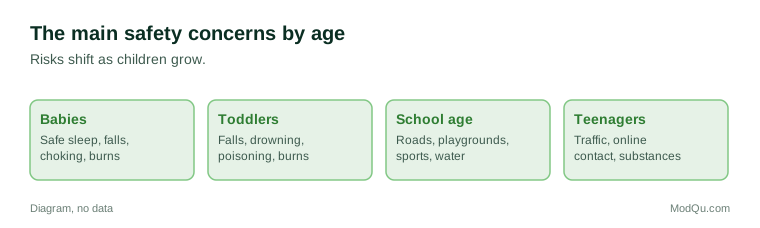
The risks a child faces depend on age:
- Babies are at risk from unsafe sleep, falls from changing tables and beds, choking and burns.
- Toddlers climb, explore and put things in their mouths, so falls, drowning, poisoning and burns are major concerns.
- School-age children spend more time outside, so roads, playgrounds, sports and water matter more.
- Teenagers face risks from traffic, sports, online contact, alcohol and other substances, and peer pressure.
The figure below shows the main areas of child safety by age group.
Safety in the car
Child car seats and booster seats are designed to protect children in a crash, and many countries require them by law until a child reaches a set age, height or weight. The rules differ between countries, as do the standards seats must meet. The main types are:
- Rear-facing seats for babies and young children, which support the head, neck and back.
- Forward-facing seats with a built-in harness for older toddlers and young children.
- Booster seats that raise a child so the adult seat belt fits properly across the chest and hips.
- Adult seat belts once the child is tall enough for the belt to fit safely.
Common problems include seats fitted too loosely, harness straps left too slack, children moved to the next stage too early and second-hand seats that have been in a crash or are past their expiry date. Some fire stations, health services and community groups offer free car seat checks.
Example
A parent buys a used car seat online to save money. At a free check run by a local road safety group, a technician finds the seat is past the expiry date printed on its label and was missing a part of the harness buckle. The parent buys a new seat, and the technician shows them how to install it so it moves less than a small amount at the base.
Safety at home
Many child injuries happen at home. Common steps families take include:
- Safety gates at the top and bottom of stairs.
- Window guards or locks to prevent falls from upper floors.
- Securing furniture and televisions to walls so they cannot tip over.
- Storing medicines, cleaning products and button batteries out of reach, ideally locked away.
- Socket covers and keeping cords out of reach.
- Safe sleep for babies, following the guidance of national health services.
- Stove guards and keeping hot drinks out of reach to prevent burns.
- Smoke and carbon monoxide alarms.
Button batteries and small magnets have become a particular concern because they can cause serious internal injuries if swallowed.
Water safety
Drowning can happen quickly and silently, and young children can drown in very shallow water, including in baths, buckets and garden ponds. Common safety measures include:
- constant, close supervision near any water;
- fencing around home pools, required in some places;
- swimming lessons, which many families start in early childhood;
- life jackets on boats and near open water;
- emptying paddling pools and buckets after use.
Risks differ by place: in some countries the main danger is home pools; in others it is rivers, lakes, the sea, wells or flood water.
Safety outside the home
As children grow, more of their risk comes from outside:
- Roads: learning to cross safely, cycling with helmets, visibility at night and safe routes to school.
- Playgrounds: falls from equipment and the surfaces underneath.
- Sports: protective equipment and the handling of head injuries.
- Strangers and getting lost: teaching children their address or a parent's phone number and what to do if they are lost.
- Sun and heat: shade, hats, sunscreen and water.
Parents balance safety with independence. Many want their children to walk to school, play outside and take reasonable risks, while also worrying about traffic and other dangers.
Example (hypothetical figures)
A parent walks their nine-year-old to school each day, a route of 1.2 kilometres with three road crossings. They decide to let the child walk alone in stages: first the last 400 metres, with no crossings, for a month; then the last 800 metres, including one crossing with a crossing guard; and finally the full 1.2 kilometres. The full walk takes the child about 15 minutes.
Safety online
Children use phones, tablets and computers from an early age. Online safety concerns include contact with strangers, bullying, harmful content, sharing personal information and images, scams and screen time. Parents use a mix of approaches:
- parental controls and filters on devices and home internet;
- rules on where and when devices are used;
- age limits on social media accounts;
- talking with children about what they see and who they talk to;
- checking privacy settings together.
Many parents say they feel less confident about online safety than about physical safety, because technology changes quickly and children often know more about it than adults.
Example
A parent notices their eleven-year-old has started using a chat feature in an online game with players they do not know. Rather than banning the game, they sit with the child to set the account to private, turn off chat with strangers and agree that the child will tell them if anyone asks for photos or personal details. A month later the child reports a player who asked for their address.
Where parents get safety advice
Parents get safety information from many sources: health visitors and nurses, doctors, hospitals, schools and childcare centres, government health and road safety agencies, product labels and manuals, other parents, family members, books, websites and social media. Advice sometimes conflicts, and some is out of date. Many parents say they rely most on people they trust personally, such as their own parents or friends, even when official advice has changed since those people raised children.
What people disagree about
- How much freedom? Some parents favour letting children roam, take risks and learn from small injuries; others prefer close supervision.
- Products or supervision? Some see safety products as essential; others feel there is too much pressure to buy them.
- Screens: views differ on what age children should have phones and social media.
Questions that public bodies and businesses want answered here include which safety products families use, what worries parents most and where they turn for advice.
Key terms
- Rear-facing car seatA child seat that faces the back of the vehicle, protecting the head and neck.
- Booster seatA seat that raises a child so an adult seat belt fits correctly.
- Safety gateA barrier at stairs or doorways to keep young children away from hazards.
- Anti-tip strapA strap that fixes furniture or a television to a wall so it cannot fall.
- Button batteryA small, coin-shaped battery that can cause serious injury if swallowed.
- Safe sleepGuidance on how babies should sleep to reduce risk.
- Parental controlsSettings that limit what children can see or do on devices.
- SupervisionWatching and being close enough to help a child.
Full glossary: child protection services terms on EditingTests.com.
Child safety vocabulary test
How well do you know the language of this topic? Try 8 quick questions. Your score is shown straight away and is not saved.
What the child safety survey asks
This survey is part of ModQu's Safety and Emergencies survey. The child safety part takes about five minutes and covers:
- Which safety products you use for your child at home, in the car and outside.
- What safety worry is biggest for you, and how it has changed as your child grew.
- How you handle your child's safety online.
- Whether your child has had an injury that needed medical care, and how it happened.
- Where you get safety advice, and which sources you trust.
- How you balance safety with letting your child be independent.
After that you can choose to continue with other short parts of the Safety and Emergencies survey, such as emergency preparedness or fire safety at home, or stop.
Ready to take part?
Your answers help show what people really think and do. Results are only ever reported as totals; no one can see your individual answers.
Start the surveyQuestions about this survey
Who can take part?
Parents of children under 16.
Do I have to give my name?
No. You may be asked for your age group, region and similar details so results can be broken down, but not your name. ModQu never asks for passwords, card numbers or account numbers.
How are the results used?
Answers are combined into totals and percentages and published in ModQu reports. Individual answers are never shown.
Is the vocabulary test part of the survey?
No. It is optional and separate, and your score is not stored.