
Share how ready you are for natural disasters
Tell us which hazards affect your area, how you get warnings and whether you know your evacuation route. Your answers are combined with other people's and reported only as totals.
Start the natural disaster preparedness surveyAbout 5 minutes. No account needed. You can stop at any time.
What natural disaster preparedness means
A natural hazard is a natural event that can cause harm, such as a flood, storm, earthquake, wildfire, landslide, drought, heat wave, volcanic eruption or tsunami. It becomes a disaster when it seriously disrupts a community and causes losses that people cannot cope with using their own resources.
Preparedness for natural disasters builds on general emergency preparedness, such as keeping supplies and a household plan, but adds steps specific to the hazards of a place:
- knowing which hazards affect the area and how serious they can be;
- knowing how warnings are given and what they mean;
- knowing evacuation routes and where to go;
- preparing the home to reduce damage;
- having insurance and documents in place for recovery.
The United Nations promotes international work on disaster risk reduction, and most countries have national and local agencies responsible for warnings, emergency response and recovery.
Knowing the hazards where you live
The hazards people face depend on geography and climate. Examples include:
- Floods from rivers, heavy rain, coastal storm surges or melting snow.
- Tropical storms, known as hurricanes, typhoons or cyclones depending on the region.
- Earthquakes along fault lines, and tsunamis that can follow them on coasts.
- Wildfires in dry forests, grasslands and areas where homes meet wild land.
- Heat waves, which affect health, especially in cities and for older people.
- Severe winter storms and extreme cold.
- Landslides on steep slopes after heavy rain or earthquakes.
- Drought, which develops slowly and affects water, food and farming.
- Volcanic eruptions near active volcanoes.
Many people are unsure which hazards affect their own address. Public hazard maps, such as flood maps and earthquake zone maps, are available in many countries, but surveys often find that few people have looked at them. People who have recently moved, renters and newcomers to a country are less likely to know their local risks.
Example
A family moves to a house near a small river that looks peaceful in summer. A neighbour mentions that the street flooded ten years earlier. The family checks the public flood map, which shows the house is in a flood zone. They move important papers upstairs, find out the local warning system and buy flood insurance, which they had not known was separate from their main policy.
Warnings and alerts
Warning systems give people time to act. They include:
- Weather and hazard forecasts from national meteorological services.
- Official warnings, often in stages such as watch, warning and emergency, with colour codes in some countries.
- Emergency alerts sent to mobile phones in the affected area.
- Sirens, radio and television announcements, loudspeakers and door-to-door messages.
- Early warning systems for specific hazards, such as tsunami and earthquake alerts that give seconds to minutes of notice.
A warning is only useful if people receive it, understand it and act on it. Common problems include warnings in only one language, alerts that do not reach people without mobile phones, confusion over what different warning levels mean, and "warning fatigue" when previous warnings did not lead to serious events.
Evacuation
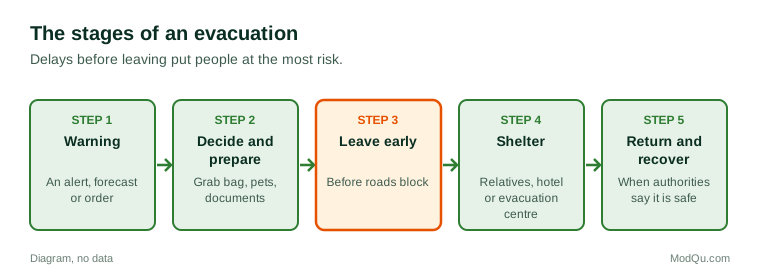
Evacuation means leaving an area because of danger. It may be advised or ordered by authorities. The figure below shows the main stages. Being ready to evacuate usually means:
- knowing more than one route out of the area;
- knowing where to go: relatives, friends, a hotel or an official evacuation centre;
- having a grab bag ready with essentials and documents;
- planning for pets and livestock, which many shelters do not accept;
- planning for people without cars, with disabilities or who need medical equipment;
- leaving early, because roads can become blocked and conditions can change fast.
Some people choose not to leave even when told to. Reasons include wanting to protect property, worry about looting, nowhere to go, cost, caring for animals, health problems, past experience of evacuations that turned out to be unnecessary and not believing the risk is serious.
Example (hypothetical figures)
A wildfire warning is issued for a rural area at 2 p.m. One household leaves at 2:30 p.m. and reaches a relative's home 40 kilometres away in 45 minutes. A neighbour waits until 5 p.m., when smoke has reached the road. Their trip on the same route takes 2 hours 15 minutes because of slow traffic and a closed road, three times as long as the first household's.
Preparing the home
Steps people take to reduce damage depend on the hazard:
- Floods: raising electrical sockets and appliances, flood barriers, moving valuables upstairs, non-return valves on drains.
- Storms: securing roofs, shutters, trimming trees, tying down outdoor objects.
- Earthquakes: fixing heavy furniture and water heaters to walls, storing heavy items low, building to seismic codes.
- Wildfires: clearing dry vegetation around the home, cleaning gutters, using fire-resistant materials.
- Heat waves: shading windows, fans or air conditioning, knowing cooler public places.
Some of these are cheap and quick; others, such as retrofitting a home for earthquakes, are expensive. Owners usually have more control over changes than renters.
Insurance and recovery
Insurance can help people rebuild after a disaster, but cover varies widely:
- in some countries flood or earthquake cover is part of standard home insurance; in others it must be bought separately or comes from a public scheme;
- premiums can be high in high-risk areas, and in some places cover becomes hard to get;
- many households are underinsured, meaning their cover would not pay the full cost of rebuilding;
- many people in lower-income countries have no insurance at all, and rely on family, community and government support.
Recovery can take months or years. It involves repairs, temporary housing, insurance claims, government aid, and coping with stress and loss.
Example
After a storm damages their roof, a homeowner makes an insurance claim. They had photos of each room taken a year earlier and a copy of the policy saved online, which speeds up the claim. A neighbour without photos or receipts takes much longer to prove what was lost.
Who is most at risk
Disasters do not affect everyone equally. People at greater risk include those living in poor-quality or informal housing, in flood plains or on unstable slopes, older people, people with disabilities, people with low incomes, outdoor workers, and people who are isolated or do not speak the local language. Community groups, local leaders and neighbours often play a large role in warning and helping these groups.
What people disagree about
- Building in risky areas: some argue for stricter limits on new homes in flood plains or wildfire zones; others defend the right to build.
- Who pays? Views differ on how much governments should cover losses, and whether that discourages private insurance.
- Climate change: many people link more frequent or severe events to climate change; views differ on how communities should adapt.
Questions that public bodies, insurers and businesses want answered here include how aware people are of local hazards, how they receive warnings and whether they would evacuate.
Key terms
- Natural hazardA natural event, such as a flood or earthquake, that can cause harm.
- DisasterA serious disruption of a community causing losses it cannot cope with alone.
- Hazard mapA map showing areas at risk from a particular hazard.
- Early warning systemA system that detects a hazard and warns people in time to act.
- Evacuation orderAn official instruction to leave an area.
- Evacuation centreA public place where evacuated people can shelter.
- UnderinsuranceHaving insurance that would not cover the full cost of a loss.
- Disaster risk reductionEfforts to reduce the damage caused by natural hazards.
Full glossary: disaster management terms on EditingTests.com.
Natural disaster preparedness vocabulary test
How well do you know the language of this topic? Try 8 quick questions. Your score is shown straight away and is not saved.
What the natural disaster preparedness survey asks
This survey is part of ModQu's Safety and Emergencies survey. The natural disaster preparedness part takes about five minutes and covers:
- Which natural hazards affect the area where you live.
- Whether you have checked a hazard map for your home.
- How you receive warnings, and which sources you trust.
- Whether you know your evacuation route and where you would go.
- What insurance you have for natural disasters, and whether you think it is enough.
- Whether you have been affected by a natural disaster, and what you would do differently.
After that you can choose to continue with other short parts of the Safety and Emergencies survey, such as emergency preparedness or fire safety at home, or stop.
Ready to take part?
Your answers help show what people really think and do. Results are only ever reported as totals; no one can see your individual answers.
Start the surveyQuestions about this survey
Who can take part?
Adults.
Do I have to give my name?
No. You may be asked for your age group, region and similar details so results can be broken down, but not your name. ModQu never asks for passwords, card numbers or account numbers.
How are the results used?
Answers are combined into totals and percentages and published in ModQu reports. Individual answers are never shown.
Is the vocabulary test part of the survey?
No. It is optional and separate, and your score is not stored.