
Share your first aid experience
Tell us whether you have had first aid training, whether you could do CPR and whether you keep a first aid kit. Your answers are combined with other people's and reported only as totals.
Start the first aid skills surveyAbout 5 minutes. No account needed. You can stop at any time.
What first aid is
First aid is the immediate care given to a person who is injured or suddenly unwell, until professional help takes over or the person recovers. Its aims are usually described as preserving life, preventing the condition from getting worse and helping recovery.
First aid ranges from simple care, such as cleaning a small cut or cooling a minor burn, to life-saving actions in serious emergencies, such as helping a person who is not breathing or stopping heavy bleeding. Anyone can learn first aid. In many countries, workplaces above a certain size must have trained first aiders, and some schools now teach basic life support to pupils.
This page describes first aid and training. It is not a substitute for a course or for professional medical help. In an emergency, people are advised to call their local emergency number.
What first aid courses teach
Courses range from short sessions of a few hours to multi-day workplace and outdoor courses. They are run by public bodies, the national Red Cross and Red Crescent societies, other charities, employers and private trainers. Common topics include:
- Checking for danger and assessing the scene before helping.
- Calling for help and what to tell the emergency operator.
- Checking whether a person is responsive and breathing.
- Cardiopulmonary resuscitation (CPR): chest compressions, and in some courses rescue breaths, for a person whose heart has stopped.
- Using an automated external defibrillator (AED).
- The recovery position for an unresponsive person who is breathing.
- Choking in adults, children and babies.
- Bleeding, including pressure on wounds.
- Burns, fractures, sprains and head injuries.
- Sudden illness: heart attack, stroke, seizures, severe allergic reactions, asthma attacks, diabetic emergencies.
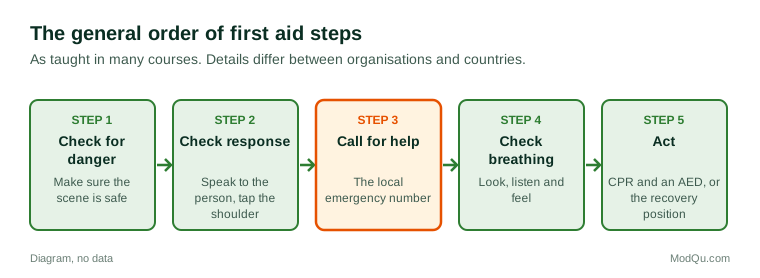
Courses usually include hands-on practice with training mannequins, which many people say is the part that builds the most confidence. The figure below shows the general order of steps taught in many courses for an emergency.
CPR and defibrillators
When a person's heart stops suddenly, known as cardiac arrest, they collapse, become unresponsive and stop breathing normally. Without help, they die within minutes. CPR keeps some blood flowing to the brain and heart until a defibrillator can be used or emergency services arrive.
An automated external defibrillator (AED) is a portable device that checks the heart's rhythm and, if needed, gives an electric shock to try to restore a normal rhythm. AEDs give spoken instructions and are designed to be used by untrained members of the public. Many countries are placing more AEDs in public places, such as stations, shopping centres, sports grounds and community buildings, and some keep registers or maps of where they are.
Emergency call operators in many places can guide callers through CPR over the phone.
Example
A spectator at a children's football match collapses. A parent who did a workplace first aid course a year earlier calls the emergency number, puts the phone on speaker and starts chest compressions while another parent runs to the clubhouse for the AED. The operator counts along with the compressions until paramedics arrive. The parent says they had forgotten some details from the course, but remembered enough to start.
How confident people feel
Many people who have had first aid training say they would not feel confident using it. Skills fade over time without practice, and the stress of a real emergency is very different from a training room. Common worries include:
- doing something wrong and making the injury worse;
- being blamed or sued;
- not remembering the steps;
- catching an infection;
- the emotional shock of the situation.
Many countries have laws, often called Good Samaritan laws, that protect people who help in an emergency in good faith from being held liable. The details vary from country to country.
Refresher courses are commonly recommended every few years. Some people use short online videos or apps to refresh their memory in between.
Example (hypothetical figures)
An office runs a survey of its 60 staff. Of the 60, 24 have done a first aid course at some time, 9 of them in the last three years. Asked whether they would feel confident doing CPR, 6 of the 24 say yes, including 5 of the 9 with recent training. The office decides to offer a short refresher course every two years.
The first aid kit
Many households, workplaces and vehicles keep a first aid kit. Contents vary, but common items include:
- adhesive plasters in different sizes;
- sterile gauze pads and dressings;
- bandages, including a triangular bandage;
- adhesive tape;
- disposable gloves;
- scissors and tweezers;
- antiseptic wipes;
- a thermometer;
- instant cold packs;
- a CPR face shield;
- a first aid guide or leaflet.
People with specific medical needs may also keep prescribed items such as an adrenaline auto-injector for severe allergies or an asthma inhaler. Workplace kits in many countries must meet set requirements depending on the size and type of workplace.
Common problems are kits that are missing items, contain out-of-date supplies, or cannot be found quickly when needed.
Why bystanders hesitate
In public emergencies, people often wait for someone else to act. Researchers call this the bystander effect: the more people present, the less likely any one person is to help, because each assumes someone else will. Other reasons include not being sure it is an emergency, fear of doing harm and not knowing what to do.
Training aims to reduce hesitation by giving people a clear first step: check for danger, call for help and start helping. Even simple actions, such as calling the emergency number, staying with the person and pointing someone towards an AED, can make a difference.
Example
An older woman falls on a busy pavement and cuts her head. Several people slow down but keep walking. A teenager who learned basic first aid at school stops, asks if she is all right, calls for an ambulance and presses a clean cloth on the wound. Once one person stops, two others stay to help.
Who gets trained
Access to first aid training is uneven. People are more likely to be trained if their job requires it, if they work in health care, education, sports or outdoor activities, or if they are parents who have taken a baby first aid course. Cost, time and not knowing where to find a course are common barriers. Some countries and communities offer free short courses in CPR to the public, and some require CPR training to pass a driving test or finish school.
What people disagree about
- Should training be compulsory? Some want first aid taught in all schools or required for drivers; others see it as a personal choice.
- Compressions only or with breaths? Guidance for untrained bystanders in some places focuses on chest compressions alone, while courses may also teach rescue breaths. Advice differs by organisation and situation.
- Who pays for public AEDs? Views differ on whether governments, businesses or communities should fund them.
Questions that public bodies and businesses want answered here include how many people have had training, how confident they feel and whether they keep a first aid kit.
Key terms
- First aidImmediate care for an injured or suddenly ill person until professional help takes over.
- CPRCardiopulmonary resuscitation: chest compressions, sometimes with rescue breaths, for a person whose heart has stopped.
- Cardiac arrestWhen the heart suddenly stops pumping blood effectively.
- AEDAutomated external defibrillator, a device that can shock the heart back into a normal rhythm.
- Recovery positionA way of placing an unresponsive, breathing person on their side to keep the airway clear.
- Bystander effectThe tendency for people to be less likely to help when others are present.
- Good Samaritan lawA law protecting people who help in an emergency in good faith.
- Refresher courseA short course to update and practise skills learned earlier.
Full glossary: emergency medicine terms on EditingTests.com.
First aid skills vocabulary test
How well do you know the language of this topic? Try 8 quick questions. Your score is shown straight away and is not saved.
What the first aid skills survey asks
This survey is part of ModQu's Safety and Emergencies survey. The first aid skills part takes about five minutes and covers:
- Whether you have had first aid training, what kind and how long ago.
- Whether you could do CPR, and how confident you would feel.
- Whether you know where the nearest AED is at home, work or in your area.
- Whether you keep a first aid kit at home, at work or in the car, and what is in it.
- Whether you have given first aid in a real situation, and what happened.
- What would make you more likely to take a course.
After that you can choose to continue with other short parts of the Safety and Emergencies survey, such as emergency preparedness or fire safety at home, or stop.
Ready to take part?
Your answers help show what people really think and do. Results are only ever reported as totals; no one can see your individual answers.
Start the surveyQuestions about this survey
Who can take part?
Adults.
Do I have to give my name?
No. You may be asked for your age group, region and similar details so results can be broken down, but not your name. ModQu never asks for passwords, card numbers or account numbers.
How are the results used?
Answers are combined into totals and percentages and published in ModQu reports. Individual answers are never shown.
Is the vocabulary test part of the survey?
No. It is optional and separate, and your score is not stored.