
Share your experience of product recalls
Tell us whether you have been affected by a recall, how you heard about it and what you did. Your answers are combined with other people's and reported only as totals.
Start the product safety and recalls surveyAbout 5 minutes. No account needed. You can stop at any time.
What a product recall is
A product recall is a request to return, repair, replace or stop using a product because it has been found to be unsafe or faulty. Recalls are usually issued by the company that made or sold the product, often in agreement with, or on the order of, a government safety regulator.
A recall is different from a simple product withdrawal, in which a product is taken off shop shelves before most people have bought it, and from a safety warning, which tells people how to use a product safely without asking for it back.
Most countries have public bodies responsible for product safety, though their powers differ. Separate regulators often cover food, medicines and medical devices, vehicles and general consumer goods. Some regions share recall information across borders, and international organisations encourage cooperation because many products are sold in many countries.
Why products are recalled
Products are recalled for many reasons. Common ones include:
- Fire and burn risks: electrical goods that overheat, faulty batteries, chargers and heaters.
- Choking and swallowing risks: small parts on toys and baby products, loose magnets and button batteries.
- Injury from failure: parts that break, collapse or detach, such as on furniture, prams or tools.
- Vehicle faults: problems with brakes, airbags, steering, seat belts or software.
- Food contamination: bacteria, foreign objects, or allergens that are not declared on the label.
- Medicine and medical device problems: contamination, wrong strength, labelling errors or device faults.
- Chemical hazards: banned or excess levels of substances such as lead in paint or toys.
- Strangulation and entrapment risks: cords on blinds and gaps in cots or bed rails.
Some problems are found by the maker's own testing or complaints; others come to light through regulators, hospital injury data or reports from the public.
How recalls are announced
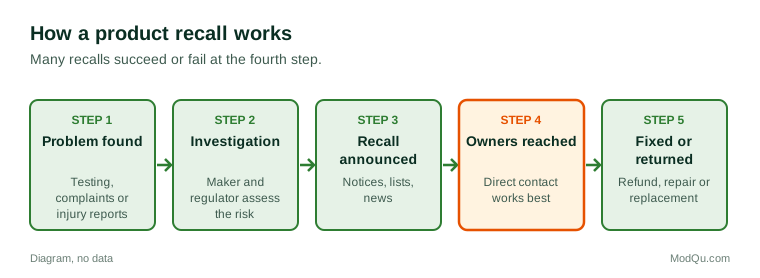
The figure below shows the main stages from a problem being found to the product being fixed or returned. Recalls are announced in several ways:
- Direct contact with buyers who registered a product, bought online, used a loyalty card or own a registered vehicle.
- Notices in shops where the product was sold.
- Public recall lists and websites run by government safety regulators.
- News reports and social media, especially for large or serious recalls.
- Email alerts from regulators that people can sign up for.
Direct contact works best. When a seller has no record of who bought a product, many owners never hear about the recall.
Example
A parent receives an email from the online shop where they bought a baby bouncer, saying the seat can tip over and the product is being recalled. They had not seen any news about it. They stop using the bouncer, fill in a form on the maker's website and receive a full refund within two weeks.
What consumers are asked to do
A recall notice usually tells people:
- how to identify the affected product, such as model numbers, batch codes, dates or serial numbers;
- what the risk is;
- whether to stop using it straight away;
- what remedy is offered: a refund, repair, replacement part or replacement product;
- how to claim the remedy, often without needing a receipt.
For vehicles, owners are usually asked to book a free repair at a dealer. For food, people are usually asked not to eat the product and to return it or throw it away. For medicines, people are often advised to keep taking them until they speak to a pharmacist or doctor, because stopping suddenly can be risky; the advice in each recall notice should be followed.
Why recalled products stay in use
A large share of recalled products are never returned or repaired. Reasons include:
- People never hear about the recall, especially for products bought in shops without registration.
- People do not think it applies to them or that the risk is real.
- The product seems to work fine.
- The remedy is inconvenient, such as having to post a heavy item or wait for a repair.
- Products have been passed on, sold second-hand or given away.
- Notices are hard to understand, with unclear model numbers or technical language.
Second-hand markets and online marketplaces can spread recalled products further, because buyers have no link to the original seller.
Example (hypothetical figures)
A maker recalls 50,000 space heaters after reports of overheating. Six months later, 9,000 have been returned or repaired, which is 18 percent. Most of the returns came from 12,000 buyers who registered their heaters or bought online, and whom the maker could contact directly. The maker begins a second round of notices in shops and newspapers to reach the rest.
Food and allergy recalls
Food recalls are among the most frequent. Many involve undeclared allergens, such as nuts, milk, eggs, wheat or sesame, that are in a product but not listed on the label. For people with severe allergies, this can be dangerous. Other food recalls involve harmful bacteria, mould, glass, metal or plastic pieces.
Food recalls often happen quickly and involve products eaten within days, so many people never learn that something they ate was recalled. People with allergies are more likely to sign up for alerts from food safety agencies.
Example
A person with a sesame allergy receives a food safety agency alert by text that a brand of crackers has been recalled because sesame was not on the label. They check their cupboard, find a box with the batch code listed and return it to the shop for a refund. They say they now always check batch codes on alerts, because many recalls cover only some batches.
Online shopping and product safety
Online shopping has made product safety more complex. Products sold through online marketplaces may be shipped directly from makers in other countries, may not meet local safety standards and may have no local company responsible for recalls. Regulators in several regions have introduced or proposed rules making online marketplaces take more responsibility for unsafe products sold through them.
What people disagree about
- Who should be responsible? Views differ on how much responsibility should fall on makers, sellers, online marketplaces, regulators and consumers.
- How fast should recalls be? Some say regulators act too slowly; companies say they need time to investigate.
- Registration and data: product registration helps recalls, but some people do not want to give personal details.
Questions that public bodies and businesses want answered here include how many people have been affected by a recall, how they heard about it and what they did.
Key terms
- Product recallA request to return, repair, replace or stop using an unsafe or faulty product.
- Product withdrawalRemoving a product from sale, usually before most people have bought it.
- Safety regulatorA public body responsible for making sure products are safe.
- Batch codeA code that identifies a group of products made at the same time.
- RemedyWhat a recall offers, such as a refund, repair or replacement.
- Undeclared allergenAn allergen in a food that is not listed on the label.
- Product registrationGiving the maker your details so they can contact you about the product.
- Recall effectivenessThe share of recalled products that are returned, repaired or destroyed.
Full glossary: safety case management terms on EditingTests.com.
Product safety and recalls vocabulary test
How well do you know the language of this topic? Try 8 quick questions. Your score is shown straight away and is not saved.
What the product safety and recalls survey asks
This survey is part of ModQu's Safety and Emergencies survey. The product safety and recalls part takes about five minutes and covers:
- Whether you have been affected by a product recall, and what kind of product.
- How you heard about it: direct contact, a shop, news, social media or an alert.
- What you did: returned, repaired, replaced, stopped using or kept using it.
- Whether you register products or sign up for recall alerts.
- Whether you check second-hand items for recalls.
- How much you trust recall information, and how it could be clearer.
After that you can choose to continue with other short parts of the Safety and Emergencies survey, such as emergency preparedness or fire safety at home, or stop.
Ready to take part?
Your answers help show what people really think and do. Results are only ever reported as totals; no one can see your individual answers.
Start the surveyQuestions about this survey
Who can take part?
Adults.
Do I have to give my name?
No. You may be asked for your age group, region and similar details so results can be broken down, but not your name. ModQu never asks for passwords, card numbers or account numbers.
How are the results used?
Answers are combined into totals and percentages and published in ModQu reports. Individual answers are never shown.
Is the vocabulary test part of the survey?
No. It is optional and separate, and your score is not stored.